
Window Leads: A Buying Guide for Replacement Installers

A cheap lead is often the most expensive job you will ever chase. Window lead ROI depends entirely on your cost per closed contract, not the initial sticker price on an invoice. When you buy window leads distributed to four other replacement contractors simultaneously, your reps spend their days fighting fatigued homeowners instead of running profitable in-home demonstrations.
You already know the frustration of single-digit contact rates, cratering sit rates, and aggressive aggregator queues that exhaust prospects before your team even dials. Chasing shared lists drains sales morale, burns out closers, and turns marketing spend into unrecoverable overhead.
This guide gives you the unit economics, delivery models, and vetting frameworks required to buy high-converting replacement window inquiries profitably. We break down realistic customer acquisition costs, contrast shared aggregator forms with exclusive routing, and show you how to scale installation crews predictably without locking your business into rigid long-term retainers.
Key Takeaways
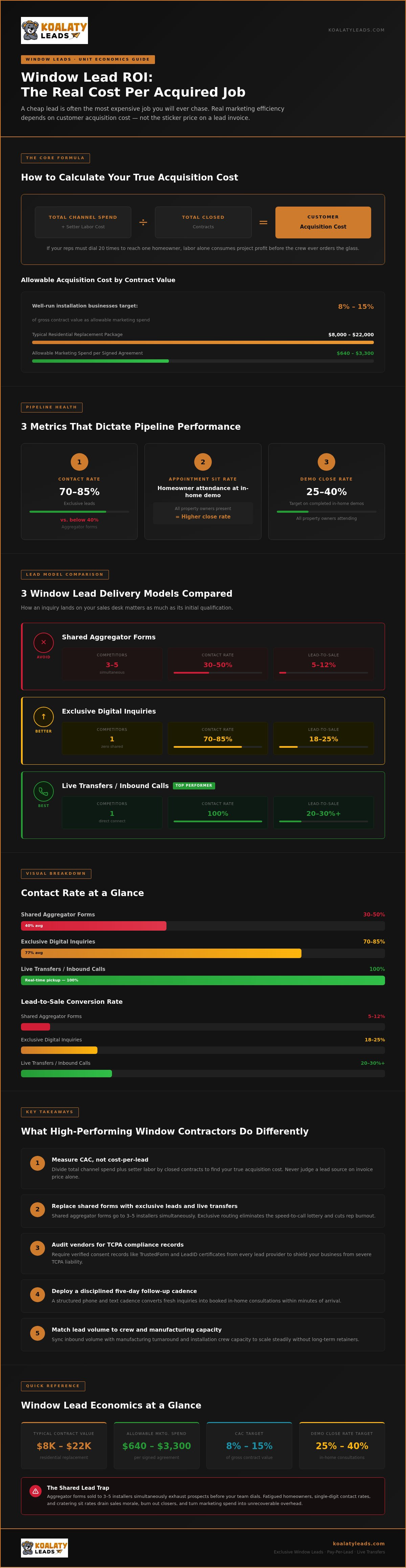
- Measure customer acquisition cost per installed project rather than front-end lead pricing to protect your demo sit rates and sales margins.
- Discover why replacing shared aggregator forms with exclusive window leads and direct calls cuts down rep burnout and boosts contact rates.
- Audit third-party vendors for verified consent records like TrustedForm and LeadID certificates to shield your company from severe TCPA liabilities.
- Deploy a disciplined five-day phone and text cadence engineered to convert fresh inquiries into booked in-home consultations within minutes.
- Sync your inbound lead volume with manufacturing turnaround and installation crew capacity to scale steadily without long-term retainers.
The Economics of Window Leads: Measuring Real Cost per Acquired Job
Evaluating your marketing performance purely on front-end cost per inquiry destroys gross margins. An inexpensive contact name looks efficient on a balance sheet, but rock-bottom upfront pricing usually masks dismal downstream conversion. When assessing standard lead generation models, the true expense of buying window leads is revealed only after calculating the sales payroll wasted chasing unresponsive submissions.
To see how high-performing remodeling sales teams qualify prospects and avoid tire-kickers, watch this practical guide:
Real marketing efficiency comes down to customer acquisition cost (CAC). Calculate your baseline with a simple formula: divide your total channel spend plus setter labor by your total closed contracts. If an entry point looks cheap but forces your reps to dial twenty times just to get one homeowner on the phone, the labor alone eats your project profit before the crew ever orders the glass.
Key Performance Metrics for Window Replacement Pipelines
Three milestones dictate pipeline health: contact rate, appointment sit rate, and contract close rate. Exclusive inquiries and direct calls routinely generate a 70% to 85% contact rate, while multi-sold aggregator forms often plummet below 40%. Top-performing installation companies target a 25% to 40% demo close rate on completed in-home consultations where all property owners attend.
Calculating Allowable Acquisition Cost by Average Ticket Size
Well-run installation businesses keep customer acquisition costs within 8% to 15% of gross contract value. For a typical residential replacement package running between $8,000 and $22,000, your allowable marketing spend sits between $640 and $3,300 per signed agreement. Small retrofit projects don't leave room for bloated acquisition costs, which is why scaling contractors invest in high-intent window leads that convert into whole-home installations.
Evaluating Window Leads: Exclusive Inbound Calls vs. Shared Web Forms
How an inquiry lands on your sales desk matters just as much as its initial qualification. If your setters spend forty hours a week competing in a frantic speed-to-call sprint against four other local companies, you are running an expensive telemarketing lottery. The FTC staff perspective on lead generation highlights the mechanics of consumer brokering systems, revealing why multi-sold distribution networks consistently create massive buyer friction.
| Delivery Model | Competitor Distribution | Typical Contact Rate | Lead-to-Sale Conversion |
|---|---|---|---|
| Shared Aggregator Forms | 3 to 5 installers simultaneously | 30% to 50% | 5% to 12% |
| Exclusive Digital Inquiries | 1 installer (Zero shared) | 70% to 85% | 18% to 25% |
| Live Transfers / Inbound Calls | 1 installer (Direct connection) | 100% (Real-time pick up) | 20% to 30%+ |
The Mechanics of Shared Aggregator Marketplaces
Aggregator platforms operate by maximizing inventory monetization. When an interested property owner fills out a web inquiry, that contact data instantly pings into the CRM systems of multiple competing contractors. Within seconds, the consumer's phone rings continuously from distinct sales desks, triggering instant annoyance, ignored unknown numbers, and aggressive price shopping.
The Operational Value of Exclusive Lead Routing
Exclusive routing protects your brand equity and in-home profit margins. Because no other sales outfits are dialing the homeowner, your reps conduct consultative qualification conversations without defending their prices against bottom-tier bids. Homeowners appreciate speaking with a single, dedicated contractor who focuses on their project scope rather than rushing through an estimate.
To eliminate bidding wars and secure higher appointment rates, consider buying dedicated window leads or warm live transfers that connect straight to your office phone.
Eliminating multi-sold records also insulates your sales staff from burnout. Instead of grinding through cold-calling queues and logging voicemail after voicemail, your inside reps focus their energy on setting solid calendar appointments. Live transfers take this operational efficiency one step further by dropping a pre-screened homeowner directly onto your line with zero delay.
Vetting Lead Generation Providers: Contract Terms and Quality Safeguards
Signing a vendor agreement without examining delivery mechanics puts your sales budget at severe risk. Before paying for window leads, you must audit how the provider captures consent, defines invalid contacts, and handles disputed charges. High-volume marketing agencies often bury restrictive credit terms behind long-term commitments, leaving your installation business holding the bag for unreachable prospects.
Protecting your company starts with demanding clear operational standards up front. The classic Harvard Business Review analysis on rapid lead response times showed that contacting inbound opportunities within minutes yields exponentially higher conversions. If your vendor relies on slow batching, co-registration forms, or hidden subcontractor networks, your sales reps never get that critical timing advantage.
Auditing Lead Source Integrity and Compliance
Confirm the exact digital pathways a vendor uses before buying their inquiries. Inquire whether prospects submit details on dedicated replacement landing pages or through sweepstakes incentives that produce unmotivated prospects. Federal telemarketing rules require proof of verifiable consent, making third-party certificates like Jornaya LeadID or TrustedForm non-negotiable safeguards to defend against TCPA claims on automated calls or texts.
Scrutinizing Billing Terms, Minimums, and Dispute Windows
Review the provider's dispute process with a fine-tooth comb. Legitimate vendors maintain transparent return parameters for disconnected lines, confirmed renters, and out-of-territory zip codes:
- Demand clear dispute windows, ideally giving your sales desk at least three to five business days to flag bad numbers.
- Avoid multi-month retainers that force you to fund ad spend regardless of project flow or seasonal manufacturing slowdowns.
- Favor flexible pay-per-lead models that let you scale spend volume up or down based on your pipeline requirements.
Contractors expanding their exterior remodeling services into complementary trades like siding leads must apply these identical vetting principles. Establishing clear credit policies and verifying origin data across every category keeps your acquisition costs predictable and protects your bottom line.
Converting Window Inquiries: In-Home Sales and Appointment Setting Cadence
Generating high-quality inquiries means nothing if your internal intake process drops the ball. Converting fresh web opportunities into signed replacement agreements requires disciplined sales mechanics, rapid response protocols, and strict qualification standards. When your sales desk masters speed-to-lead and treats every submission with urgency, your overall cost per completed installation drops sharply.
A multi-day follow-up cadence keeps prospects from falling through the cracks. In the replacement window vertical, homeowners routinely request information while at work or managing family routines, making a structured sequence mandatory:
- Day 1: Call within two minutes, dispatch a personalized confirmation SMS, and follow up with a secondary call four hours later.
- Day 2: Deliver a mid-morning phone call paired with an email highlighting regional project examples and warranty protection.
- Day 3: Place an early evening call to reach homeowners after standard business hours, supported by a brief conversational text message.
- Days 4 and 5: Transition to daily check-ins using alternating morning and afternoon outreach before moving unreached records to automated nurture queues.
The First Five Minutes: Establishing Rapid Contact Protocols
Speed to the initial dial dictates your ultimate appointment rate. Homeowners contacted within five minutes convert to booked consultations at substantially higher rates than inquiries left sitting for thirty minutes or more. Your CRM must fire automated notifications instantly, prompting reps to dial immediately while the project scope is top of mind.
Qualifying the Consultation: Decision-Makers and Scope Confirmation
Never dispatch an outside estimator to a home without confirming two critical variables: project scope and homeowner attendance. Running a true one-call close demonstration requires both decision-makers present at the kitchen table. Pre-qualify the opening counts, confirm that the homeowner wants full replacement rather than basic hardware repairs, and ensure they have allocated time for a comprehensive consultation.
If your business handles additional remodeling lines beyond replacement openings, tap into contractor lead services built to fill your specialists' calendars with qualified appointments across every specialty.
Investing in exclusive window leads gives your team the breathing room to execute this consultative intake properly. Reps can qualify each property thoroughly instead of rushing to beat rival estimators to the door.
Talk to Koalaty Leads about exclusive window replacement leads
Scaling Your Installation Business with High-Intent Window Leads
Sustainable growth requires tight operational alignment between your marketing investments and physical job capacity. Flooding your sales team with raw lead volume without considering installation bandwidth leads to extended backlogs, dissatisfied clients, and cash flow strain. Smart contracting operations treat lead procurement as an adjustable spigot, directly matching acquisition volume to factory delivery times and crew availability.
Balancing acquisition channels shields your business against regional market shifts. Relying on a single source leaves your pipeline vulnerable to sudden cost spikes or traffic drops. Combining consistent inbound live transfers with targeted seasonal pushes ensures your sales reps maintain full demo schedules while crews maintain steady production schedules throughout the year.
Balancing Lead Inflow Against Crew and Supply Logistics
Calculate your weekly lead volume using reverse pipeline math. If your installation team comfortably finishes five residential projects per week and your reps maintain a 25% close rate on completed in-home consultations, you need twenty scheduled demonstrations weekly. Buying high-intent window leads that convert into completed sits keeps that pipeline predictable without forcing crews into sloppy overtime.
Building Long-Term Growth on Verified Exclusive Partnerships
Aggregator platforms that resell identical customer data force installers into race-to-the-bottom pricing. Shifting marketing spend toward exclusive opportunities eliminates that margin compression entirely. Single-contractor routing creates space to cross-sell patio packages, entry door systems, and warranty upgrades that maximize lifetime customer value.
Scaling smoothly means escaping rigid vendor lock-ins and unpredictable aggregator databases. Partnering directly with Koalaty Leads delivers exclusive, high-intent inquiries and direct calls nationwide, giving your business the dependable pipeline needed to expand installation operations confidently.
Build a Predictable Window Replacement Pipeline
Profitable installation growth comes down to tracking true customer acquisition cost rather than chasing deceptive upfront bargains. Leaving behind multi-sold directories in favor of verified exclusive window leads shields your margins, stops sales rep burnout, and keeps your estimators sitting with qualified property owners. Pairing disciplined speed-to-lead cadences with direct live transfers connects ready-to-buy prospects straight to your sales desk so your team can focus on closing full-house jobs.
Talk to Koalaty Leads about exclusive window leads and live transfers in your market
Take command of your calendar, keep your crews operating at peak capacity, and scale your contracting business steadily without rigid retainers, recycled lists, or aggregator price wars.
Frequently Asked Questions
How much do exclusive window leads typically cost for contractors?
Lead pricing varies based on project scope, territory demand, and whether you buy asynchronous web forms or live call transfers. Rather than focusing solely on upfront lead costs, successful installers evaluate pricing against allowable customer acquisition cost, which typically ranges from 8% to 15% of gross revenue. Contact lead providers directly to discuss custom pricing models that match your target volume and market geography.
Why do shared window replacement leads have significantly lower close rates?
Shared inquiries pit multiple contractors against each other for the exact same homeowner. When four or five sales desks call at once, the prospect experiences immediate call fatigue, stops answering unknown numbers, and defaults to comparison shopping on price alone. This dynamic splits closing odds across multiple competitors and tanks demo sit rates compared to exclusive routing, where your team builds trust without interference.
What is the ideal contact time when receiving a new window lead?
Your sales reps should contact fresh inquiries within two to five minutes of submission. Outreach completed within this rapid window produces dramatically higher appointment booking rates than delayed follow-ups. After thirty minutes, contact rates decline steeply as homeowners return to daily tasks or disengage. Speed-to-lead automation ensures your inside reps connect while the project is top of mind.
How do live transfer window calls differ from standard web leads?
Standard web leads require your inside sales team to chase homeowners through persistent phone calls and text messages. Live transfers eliminate outbound chasing by connecting pre-screened homeowners directly to your phone in real time. Because the prospect is actively on the line seeking an estimate, your reps skip phone tag and move immediately into scheduling the in-home consultation.
What qualification criteria should a window lead generation provider verify?
A dependable provider verifies homeownership, property location, and project parameters like opening counts and replacement intent rather than simple glass repair. They must also capture verifiable consent documentation, such as TrustedForm or Jornaya LeadID certificates, to protect your company from telemarketing liabilities. Filtering for multi-unit projects keeps your outside sales reps focused on profitable, whole-house contracts.
Can replacement window contractors dispute and receive credits for bad leads?
Reputable lead providers maintain clear dispute policies to protect contractor marketing budgets. Valid credit parameters typically include disconnected phone numbers, renters, duplicate records, or inquiries outside your agreed installation territory. Review a vendor's dispute guidelines and submission windows before purchasing to ensure credit processing is straightforward rather than combative.
How many window replacement leads does an installer need to close one contract?
Pipeline requirements depend directly on lead exclusivity and intake execution. With exclusive window leads, installers typically close one contract for every four to six inquiries, assuming solid contact rates and disciplined in-home sales execution. Shared aggregator lists often require fifteen to twenty leads to yield a single closed project due to severe contact drop-offs and fierce pricing competition.
Need exclusive leads instead of shared ones? Koalaty Leads delivers qualified homeowners — web leads or live call transfers — to one contractor only.
Get Started