
Walk In Tub Leads: The Contractor’s Guide to High-Intent Sales

Walk-in tub sales are won by reaching the right prospect, not by buying the biggest pile of names. When walk in tub leads are shared across contractors, you’re competing for the same homeowner, and the conversation can quickly become a price contest. Exclusive leads and live transfers can give your team a more direct path to a sales conversation.
If you’ve paid for inquiries that don’t answer, or watched promising prospects go cold while several contractors race to call, the frustration is familiar. A low price per lead doesn’t necessarily mean a low cost per job sold, especially when the same inquiry goes to multiple businesses.
This guide explains how to evaluate exclusive, high-intent walk-in tub leads and choose an approach that fits your sales process. You’ll learn what separates exclusive leads from shared inquiries, how inbound calls and live transfers can fit into follow-up, and which measures help you assess lead value, from contact and appointment rates to cost per acquired job. The goal is a more manageable pipeline, stronger sales conversations, and better control over who you compete with for each inquiry.
Key Takeaways
- Assess walk in tub leads by exclusivity, intent, and their likelihood of becoming a booked job, not just by upfront price.
- Compare shared and exclusive lead models to understand how competition for the same prospect can affect your sales process and margins.
- Use cost per acquired job alongside cost per lead to judge whether a source is paying back for your business.
- Choose a delivery format that fits your team’s follow-up process and appointment-setting goals, including web leads, inbound calls, or live transfers.
- Review lead delivery and payment terms with Koalaty Leads to determine whether exclusive leads or call-based options fit your business.
Understanding the Walk In Tub Lead Landscape in 2026
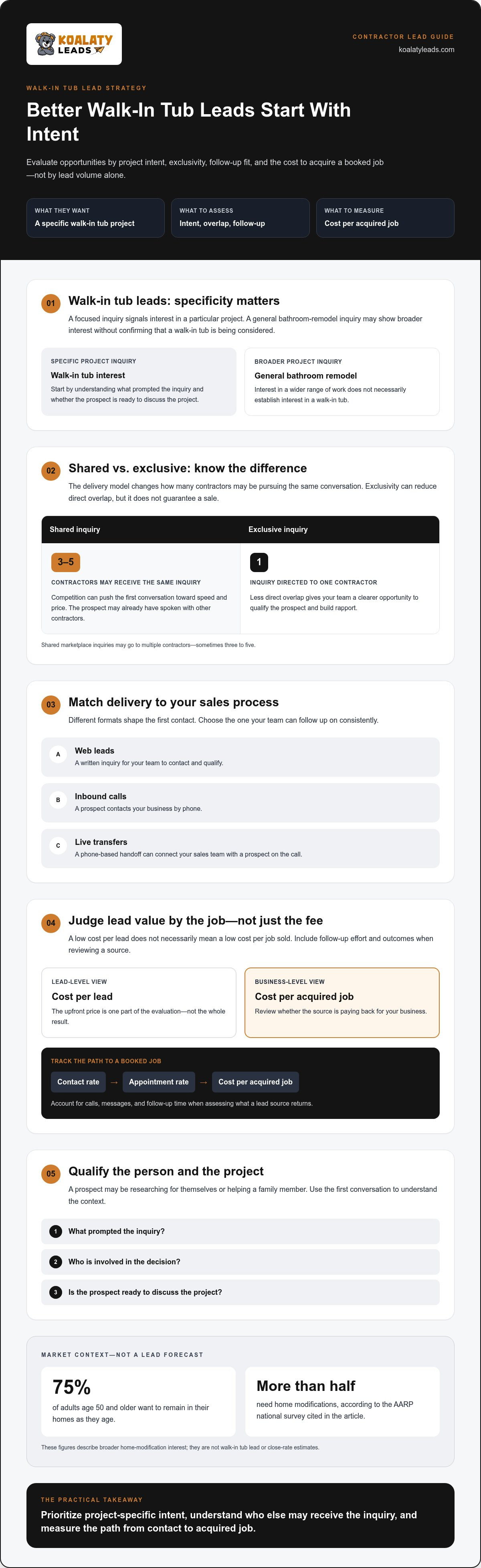
Walk in tub leads are inquiries from people considering a specific bathroom upgrade related to accessibility, safety, or changing mobility needs. That specific intent matters. Someone looking for a walk-in tub may have different priorities from a homeowner planning a general bathroom refresh, so a broad remodeling inquiry may not indicate interest in this particular project.
The sales conversation should start with the reason behind the inquiry. A prospect may be researching for themselves or helping a family member. If several contractors receive the same contact, the discussion can quickly shift from understanding the need to competing to make the first call or offer the lowest price.
This video shows a walk-in bathtub drain system and provides product context for this specialized category:
The Aging-in-Place Demographic
Research may involve a homeowner, an adult child, or another caregiver comparing options and coordinating next steps. In the first conversation, establish who is making the decision, what prompted the inquiry, and how the prospect wants to proceed. Accessibility may be the specific need driving the search, not just one feature among several in a broader remodel. An Accessible bathtub is designed around easier access for people with limited mobility, which helps explain why this lead category calls for focused conversations.
Specialized Leads vs. General Remodeling
Walk-in tub leads indicate interest in a particular project, while general bathroom remodel leads may come from prospects considering a wider range of work. During qualification, ask what prompted the inquiry, who is involved in the decision, and whether the prospect is ready to discuss the project with a contractor. A general remodeling inquiry may show broad interest without establishing that the homeowner is considering a walk-in tub.
Delivery method shapes the first interaction, too. Shared marketplace inquiries may go to multiple contractors, sometimes three to five, which can create pressure to respond first. Exclusive inquiries are directed to one contractor, while inbound calls or live transfers can connect a sales team with a prospect on the phone. Each format still depends on effective follow-up, but a specific inquiry and timely handoff give your team a clearer starting point than aged or broadly categorized data.
In 2026, evaluate this vertical by intent, exclusivity, follow-up process, and cost to acquire a booked job, not lead volume alone. A dedicated source for walk-in tub prospects can help keep your team focused on the need behind the inquiry and distinguish these opportunities from general remodeling interest.
Exclusive vs. Shared Walk In Tub Leads: The ROI Gap
Shared leads can put the same inquiry in front of several contractors at once. That creates pressure to call quickly, and you may be contacting a prospect who has already spoken with competitors. Exclusive delivery removes that direct overlap. It doesn’t guarantee a sale, but it gives your team a clearer opportunity to qualify the prospect and build rapport.
AARP’s AARP national survey reports that 75% of adults age 50 and older want to remain in their homes as they age, and more than half need home modifications. These findings provide context for the broader home-modification market, but they aren’t a walk-in-tub lead close-rate forecast.
The Hidden Cost of Shared Leads
Shared lead marketplaces may distribute one inquiry to four or five contractors. If you’re the fourth to call, the prospect may already be comparing quotes or may have stopped answering. To understand the real cost, include more than the lead fee. Consider the time spent calling, leaving messages, and following up when you assess what the source returns.
Track the funnel by source: attempts, contacts, appointments, estimates, and sold jobs. This helps show whether low-priced inquiries are using sales capacity without producing enough opportunities. Bid-to-appear models and aged data can involve different trade-offs, so confirm how a provider generates and delivers each inquiry before comparing costs.
How Exclusivity Changes the Conversation
With an exclusive inquiry, your team isn’t competing with several contractors for the same prospect at that moment. You can focus the first conversation on the reason for the request, who is involved in the decision, and whether the prospect is ready to discuss next steps. This supports a more consultative sales process instead of reducing the interaction to a quick price comparison.
Close-rate figures need context. Industry references put shared bathroom-remodel leads in a 5%–12% close-rate range, while the 20%–35% range cited for exclusive leads applies to tub-to-shower conversions, not verified walk-in-tub leads. Treat those figures as category-specific reference points, not a promise or a direct apples-to-apples forecast for your business.
| Lead model | What to weigh |
|---|---|
| Shared | Potentially lower cost per inquiry, with several contractors competing for the same prospect. |
| Exclusive | Higher lead cost may be offset by less direct competition; measure cost per acquired job to assess payback. |
Response speed matters, but there’s no verified basis for claiming that a 30-second delay automatically loses a sale. Set a clear follow-up process and track contact and appointment rates by delivery type. If you’re evaluating walk-in tub leads, discuss exclusive inquiries or live transfers with Koalaty Leads, then compare the terms and performance measures with your current source.
Analyzing the Economics: Cost per Lead and Payback
A lead’s sticker price doesn’t tell you whether it’s profitable. For walk in tub leads, compare the full cost of producing a sold job, including lead spend and the sales effort required to contact, qualify, and close prospects.
There isn’t one dependable price range that applies to every provider, market, and delivery model. Ask providers for current terms, then evaluate them against your close rate, gross profit per job, and available sales capacity. A higher upfront lead cost may still produce a lower acquisition cost if fewer inquiries are needed to win a job.
Lead Pricing Models Explained
Pay-per-lead charges for an inquiry delivered to your team. You handle follow-up and qualification, so results depend partly on your contact process and how well the inquiry fits your service. Confirm what counts as a billable lead and how the provider handles inquiries that don’t meet the agreed criteria.
Pay-per-call or live transfer centers on a phone conversation connected to your business. This can reduce the gap between inquiry and contact, but a call isn’t automatically a booked appointment or a qualified project. Ask what the delivery model includes, then track calls through to sold work. Koalaty Leads offers exclusive walk-in tub leads; ask the team whether live transfers are available for your needs and discuss the terms that apply to your market.
Calculate Your Allowable Lead Cost
Start with the gross profit you expect from a completed job, not the project’s total revenue. Then decide how much of that profit you can allocate to acquiring the job while still covering sales labor, overhead, and your target margin.
Maximum lead cost = gross profit per sold job × close rate per lead × share of gross profit available for acquisition. Use your own numbers, and keep close rates specific to the lead source and project type.
For example, at a hypothetical 15% lead-to-sale close rate, about 6.7 leads are needed per sale on average. The lead-spend portion of your acquisition cost is therefore roughly 6.7 times the cost of one lead, before sales labor and other expenses. This example doesn’t establish that any particular lead price is profitable. Your gross profit and operating costs determine the limit.
Review performance over a consistent period and compare sources using contact, appointment, close, and cost-per-acquired-job figures. If a source produces more volume but fewer sales, monthly spend can rise without improving payback. Discuss exclusive walk-in tub inquiries and available call options with Koalaty Leads, then assess them against your own job economics.
Lead Delivery Methods: Inbound Calls vs. Web Leads
For walk-in tub inquiries, delivery method determines what your team needs to do before a useful sales conversation can begin. A web lead requires follow-up; an inbound call or live transfer puts a phone conversation at the center of the handoff. Build your process around the format you choose so a promising inquiry doesn’t get lost between delivery and assignment.
Rather than assume calls convert at a fixed multiple of web forms, compare performance using your own records. Track whether each inquiry reaches the right person, what context is available at handoff, and whether the conversation advances to an appointment. Those details show how well each format fits your sales operation.
Speed to Lead: Build a Reliable Follow-Up Process
Web forms need a clear sequence: receive the inquiry, route it, assign an owner, and make contact. Set up notifications and CRM tasks so each lead has a named follow-up owner, including when the person first assigned is unavailable. If your team uses automation, make sure it creates an actionable task rather than another message the prospect may ignore.
For broader bathroom remodel leads, capture the requested project type during intake. This helps your team distinguish a walk-in tub inquiry from a general bathroom project before assigning it to a salesperson.
Live Transfers and Inbound Calls
A live transfer connects a prospect with your business during an active call; an inbound call is initiated by someone calling your business. Ask what questions are used to pre-qualify a transfer and what information accompanies it. Pre-qualification can give the salesperson useful context, but it doesn’t replace confirming project fit and next steps directly with the prospect.
Smaller teams may prefer a call flow that identifies who is available to answer. Larger teams can set routing rules by salesperson or department, then record the outcome in a shared system. In either case, decide who owns missed calls and how that person will follow up. Don’t assume every incoming call will be answered immediately.
Keep tracking practical. Record the source, assigned salesperson, contact outcome, appointment status, and eventual sale in your CRM. Confirm how a provider’s call or lead information can fit into your existing workflow, and review the process with your team before launch. Ask Koalaty Leads which delivery options are available and how they could fit your intake and tracking process.
Talk to Koalaty Leads about exclusive walk-in tub leads and live transfers
Scaling Your Remodeling Business with Koalaty Leads
Scaling your walk-in tub operation takes more than adding inquiries. Before choosing a lead source, consider how many new conversations your team can handle, who will own qualification, and how you’ll review results. A source can support growth only when your sales process can manage the opportunities it brings in.
Koalaty Leads provides exclusive leads across home improvement specialties, including walk-in tubs, and offers call-based lead services. As you assess whether the model fits your business, discuss the lead format, targeting options, and commercial terms directly with the team. Confirm available volume, territory, pricing, and onboarding details rather than relying on assumptions.
The Koalaty Difference
Specialization gives you a focused starting point for evaluating fit. Define what makes an inquiry useful to your team, such as the project type and the prospect’s readiness to speak with a contractor. Apply those criteria consistently when reviewing opportunities. This makes feedback more specific and helps distinguish a sourcing issue from a qualification or sales-process issue.
Pay-per-lead and pay-per-call are different ways to receive opportunities. Consider which format fits your staffing and call-handling process, and clarify the terms before getting started. Make sure your team records lead outcomes and shares relevant feedback so decisions about continued investment are based on your operating results.
Getting Started
Begin with a conversation about the work your company takes on, the markets you serve, and your capacity to respond to inquiries. Ask what targeting can be supported, how lead delivery works, and what information or tracking details are available. Confirm commercial terms and any process requirements directly with Koalaty Leads rather than making assumptions about service areas or integration.
When reviewing results, follow the full path from inquiry to completed sale. Look for bottlenecks in assignment, contact, qualification, and appointment setting, then adjust your internal workflow where needed. A disciplined review helps you decide whether a lead source supports your business goals.
Talk with Koalaty Leads about exclusive walk-in tub leads or available call options for your business.
Build a More Predictable Walk-In Tub Sales Pipeline
Better lead performance starts with looking beyond the sticker price. Compare sources by contact, appointment, and close rates, then measure cost per acquired job. Exclusive inquiries and live transfers can help your team avoid competing over shared inquiries and focus on direct conversations with prospects.
Koalaty Leads provides exclusive walk-in tub leads and offers live transfers and inbound calls for contractors. Review the delivery model and terms with the team, then decide whether the available options fit your sales process, market, and growth goals.
With clear tracking and a focused follow-up process, you can make more confident decisions about where to invest and build a stronger pipeline one qualified conversation at a time.
Frequently Asked Questions
How much do walk-in tub leads typically cost?
Lead prices vary by provider, market, and delivery model, so confirm current pricing and terms directly with the provider. Ask how a lead is defined, whether it’s exclusive, and how billing works. Then compare sources using your own cost per acquired job, based on contact, appointment, and close rates. A lower price per inquiry doesn’t necessarily mean a lower acquisition cost if fewer inquiries become sold jobs.
What is the difference between an exclusive lead and a shared lead?
An exclusive lead is delivered to one contractor, while a shared lead may be distributed to several contractors, sometimes four or five. With a shared inquiry, you may compete for the prospect’s attention and against other businesses’ bids. Exclusivity removes that direct competition for the same lead, but it doesn’t guarantee contact, an appointment, or a sale. Review each provider’s delivery terms before you buy.
How fast should I follow up with a walk-in tub lead?
Follow up as soon as your team can respond while the inquiry is still active. There isn’t a verified universal cutoff that guarantees a sale or a lost opportunity, so don’t treat a specific minute mark as a promise. Assign each new lead to a team member, set alerts for incoming inquiries, and track response time alongside contact and appointment rates. That will show how timing affects your results.
Do you offer live call transfers for walk-in tub contractors?
Koalaty Leads offers live call transfers and inbound calls for contractors, along with exclusive lead delivery. Ask whether a call-based option is available for your walk-in tub campaign and what terms apply. A live transfer connects a prospect with your team by phone, but a conversation isn’t automatically a qualified opportunity or booked appointment. Confirm how the transfer works and what information is available, then track calls through qualification, appointment setting, and sale.
What is a good close rate for exclusive walk-in tub leads?
There isn’t a verified universal close-rate benchmark specifically for exclusive walk-in tub leads. Results can vary with lead source, qualification, follow-up, sales process, and how you define a close. Track leads through each stage and calculate sold jobs divided by leads received over the same period. Keep walk-in tub results separate from broader bathroom projects so your comparison reflects the right type of opportunity.
Can I target specific regions for my lead generation?
Koalaty Leads serves contractors nationally, but that doesn’t establish that every territory or targeting setup is available. Discuss the markets you serve with the team and confirm what targeting can be supported before making a decision. Don’t assume exclusivity means a particular territory is reserved for your business. Evaluate the proposed targeting alongside delivery terms, lead handling, and your capacity to respond to inquiries.
How do exclusive leads compare with paid advertising platforms?
They’re different acquisition models. Paid advertising platforms can help contractors reach people searching for services, while an exclusive lead provider delivers an inquiry to one contractor rather than sharing it with multiple businesses. Compare how prospects are acquired, whether inquiries are shared, what you pay for, and how results are tracked. Use appointments, sold jobs, and cost per acquired job to assess performance across channels.
What information is included with each walk-in tub lead?
The exact information can depend on the delivery format, so confirm it with Koalaty Leads before you start. Ask what details accompany a web lead, what context is provided with a live transfer, and how the prospect’s project interest is established. Also clarify which fields are included, how lead delivery works, and what makes an inquiry billable. This helps your team prepare a consistent qualification process.
Need exclusive leads instead of shared ones? Koalaty Leads delivers qualified homeowners — web leads or live call transfers — to one contractor only.
Get Started