
Top Lead Generation Companies for Contractors: 2026 Guide

A lead isn’t profitable just because it arrives. Lead generation companies for contractors are worth considering when qualified inquiries can become booked jobs at a cost your margins support, and your team can respond and follow up promptly.
It’s reasonable to compare lead models carefully. Exclusive web leads give one contractor an opportunity to respond, while live inbound call transfers connect a caller directly with a business. Neither guarantees a sale. The value depends on trade and project fit, lead intent, your follow-up process, and your ability to close.
This guide explains how to assess paid lead services by cost per booked job, compare shared and exclusive lead models, and choose sources that fit your goals. You’ll also see how call handling and qualification affect results, what to track before increasing spend, and where to find construction leads, from paid platforms to referrals and inbound marketing.
Key Takeaways
- Judge paid lead sources by cost per booked job, not just cost per lead, and track results before increasing spend.
- Compare shared and exclusive leads by competition, response demands, and how each model affects your conversion costs.
- Match search marketing, advertising partners, platforms, referrals, and direct outreach to your trade and the projects you want.
- Build a consistent call-handling process so you can respond promptly, qualify the opportunity, and move suitable prospects toward an appointment.
- Explore exclusive roofing leads when you want a direct opportunity to connect with prospects in your trade.
Are construction lead generation services worth it?
Lead generation companies for contractors can be worth the cost when qualified inquiries become booked jobs at a cost your margins support. Compare sources by lead quality and conversion through your sales process, not by volume alone. Providers differ in how they attract prospects, qualify inquiries, and deliver opportunities.
Digital campaigns can attract prospects through paid search, social media, email, SMS, and organic search. Each channel reaches people differently, so track the source of every inquiry, contact attempt, appointment, and closed job. This shows which campaigns generate work that fits your trade.
For a rough market reference, contractor leads are typically offered in a range of $36 to $82, with a median of about $49. The source and terms behind each offer matter: a marketplace may sell a shared inquiry to four or five contractors, while an exclusive lead is assigned to one contractor. A lower cost per lead may still produce a higher cost per booked job if competition makes prospects harder to reach.
Compare channels before committing budget. Google Business Profile supports local visibility, while Google Search Console helps assess organic search impressions and clicks; Google Analytics can show how visitors use your site. Referrals and email marketing can also generate opportunities, particularly when past customers or trade partners know which projects you want. Give each channel a distinct tracking label, then compare qualified calls and booked jobs.
Evaluate a provider’s digital marketing expertise by asking what it actually does: SEO, content marketing, email campaigns, social media, paid search, or work with advertising partners. Look for a clear explanation of how those strategies attract contractors’ intended customers and how inquiry sources are tracked. A provider focused on roofing leads, for example, should be able to explain how its campaign reaches roofing prospects rather than presenting broad traffic as proof of lead quality.
Lead services differ in how they distribute inquiries and charge for them. Before choosing one, ask how an opportunity is delivered, what qualifies as a lead, and how the billing trigger is defined. Compare the terms with your sales process and capacity, rather than judging an offer by a promised flow of inquiries alone.
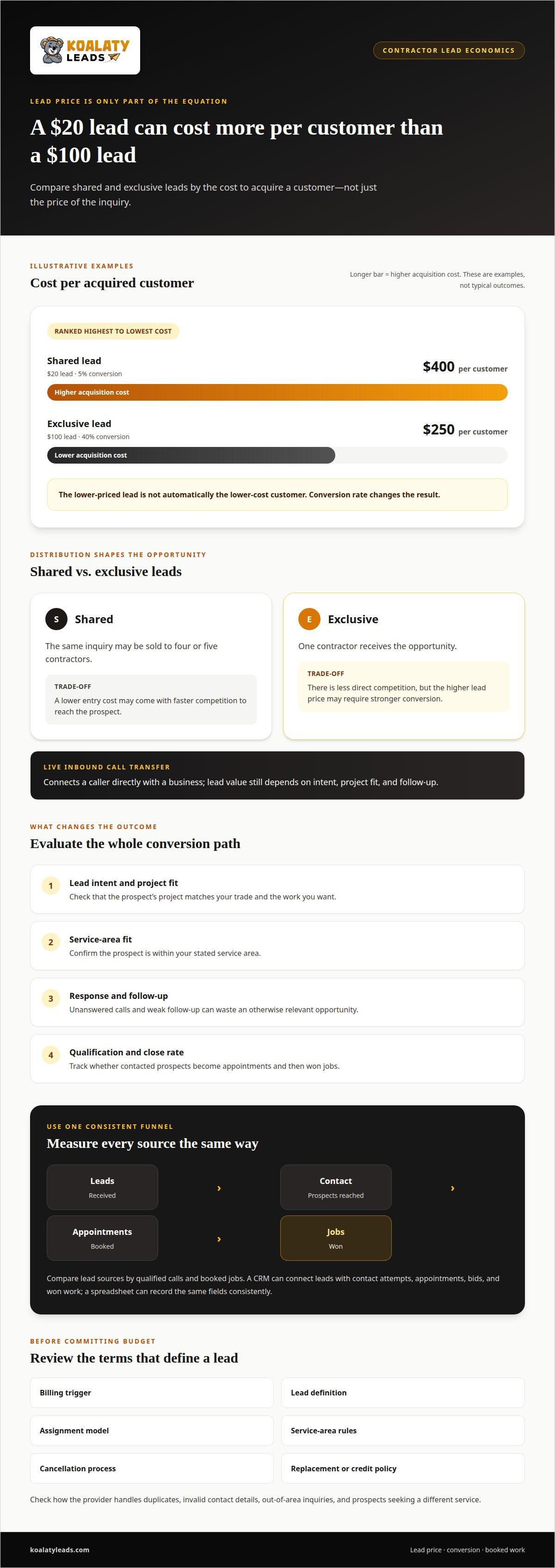
To compare conversion, use the same funnel for each source: leads received, prospects contacted, appointments booked, and jobs won. A lead source with strong qualification can still underperform if calls go unanswered; a lower-cost source can pay off when your team follows up and closes effectively. For example, at $40 per lead and one closed job for every four leads, the estimated acquisition cost is $160 per job.
Shared versus exclusive leads
Lead distribution affects response pressure and competition. Exclusive web leads are delivered to one contractor, while live inbound call transfers connect a caller directly with a business. The value still depends on lead intent, project fit, and whether the prospect is within the contractor’s service area.
Conversion math shows why price alone can mislead. A $20 shared lead converting at 5% costs $400 per customer; a $100 exclusive lead converting at 40% costs $250 per customer. These are examples, not typical outcomes. Your own cost per acquired job depends on qualification, follow-up, close rate, and project economics.
| Lead type | How it works | Key trade-off |
|---|---|---|
| Shared | Several contractors receive the same inquiry. | Lower entry cost may come with faster competition. |
| Exclusive | One contractor receives the opportunity. | Less direct competition, but a higher lead price may require stronger conversion. |
| Commercial project lead | A contractor finds a bid opportunity through a project platform. | Requires bid review, qualification, and estimating effort. |
For exclusive phone leads, the value is a direct conversation rather than a form submission waiting in an inbox. A live transfer can help your team establish project type, location, timing, and decision-maker status during the call. Your phone process still matters: unanswered calls and weak qualification can waste a relevant opportunity.
Commercial construction bids follow a different path from residential service inquiries. BuildingConnected and ConstructConnect help contractors find and organize project opportunities, while a CRM such as HubSpot can track bid stages and follow-up. Review each project’s scope, location, timeline, and trade fit before assigning estimating resources.
Contract terms should spell out the billing trigger, lead definition, assignment model, service-area rules, cancellation process, and any replacement or credit policy. Read how the provider handles duplicates, invalid contact details, out-of-area inquiries, and prospects seeking a different service. These terms determine your options when a paid lead does not meet the agreed criteria.
Dispute a questionable lead with a documented record. Save the lead ID, received time, call log, contact attempt, and the specific reason it falls outside the agreed definition. Submit the issue through the stated process and retain the response; a clear profile and accurate service area can also reduce mismatched project inquiries.
Use a CRM to connect each lead with contact attempts, appointments, bids, and won work; call-tracking software can identify the source of inbound calls. A spreadsheet can work for a smaller pipeline if it records the same fields consistently. Compare shared and exclusive opportunities using the same qualification rules, then assess which model produces more viable projects for your sales capacity.
Contractor lead generation platforms and their use cases
The right platform depends on the work you sell, the customers you target, and your sales capacity. Residential remodelers may use services that deliver homeowner project inquiries; commercial contractors often need bid and project databases instead. Treat each source as a different pipeline, not as an interchangeable lead generation service.
For residential work, lead services can deliver project inquiries to contractors. Their value depends on how an inquiry is delivered, how quickly your team responds, and whether the project fits your trade. A roofing contractor and a kitchen remodeler should assess category fit separately, even when considering the same source.
Commercial contractors have different sourcing needs. BuildingConnected and ConstructConnect help users identify and manage commercial project opportunities, including bid invitations. These are not the same as residential customer inquiries: evaluate project scope, location, bid deadline, and estimating effort before allocating staff.
Free tools can support lead generation without acting as paid lead services. Google Business Profile helps a contractor appear in local search and maps, while Google Search Console shows search visibility and website clicks. Use Google Analytics to review visitor behavior, then connect inquiry sources to your CRM so estimates and closed work can be traced back to the channel.
Platform pricing can follow several models. Pay-per-lead charges for each delivered inquiry; subscriptions charge for access or visibility; advertising bills for campaign activity; and pay-per-booking or commission ties payment to an appointment or job. As a reference, a $300 monthly platform subscription may make sense when it consistently produces a few qualified calls without separate per-lead fees.
| Model | Useful for | Watch the economics |
|---|---|---|
| Pay per lead | Contractors seeking inquiry volume they can respond to promptly. | Track qualified leads through booked jobs. |
| Subscription | Businesses seeking a more predictable platform expense. | Measure qualified calls against the recurring fee. |
| Commission | Contractors aiming to reduce upfront spending on unqualified inquiries. | A 10%-20% commission on a $500 job is one market example. |
| Paid advertising | Businesses that want to control campaign targeting and messaging. | Track spend, calls, appointments, and won jobs separately. |
Choose a source that matches your trade and ability to handle its leads. A small team may favor a manageable call flow, while a company with estimators can pursue more commercial bids. Start tracking each source in a CRM or spreadsheet, then compare qualified opportunities and acquired jobs before expanding spend.
How do I find construction leads?
Start by defining the work you want: trade, project type, service area, and capacity. A residential roofer seeking replacement projects needs different inquiries from a general contractor pursuing commercial renovations. Clear targeting helps lead services, project databases, and referral partners match opportunities to your business.
Choose a lead source by how closely its coverage and pricing model fit your service area and budget. Compare the project details it provides, how inquiries are matched, and whether your team can follow up and estimate the work. Then track each source through qualified opportunity, appointment or bid, and won project.
For commercial construction, Dodge Construction Network provides project data contractors can use to identify opportunities and follow project activity. BuildingConnected and ConstructConnect support project discovery and bid coordination. Use these tools to find relevant work, then review the project location, scope, timeline, and bid requirements before investing estimating time.
Match every opportunity against practical capacity. A project across your usual service area can add travel and scheduling demands, while a project outside your trade fit can consume estimating hours without a realistic path to work. Record location, project type, estimated scope, stated budget, decision-maker, and next step in a CRM such as HubSpot or a shared spreadsheet.
Project size matters as much as location. A small contractor may focus on residential home improvement inquiries that fit its crew and schedule; a firm with estimating staff may pursue larger commercial bids. Use Dodge project data or a bid invitation to screen for scope and timing, then assign only a qualified opportunity to an estimator.
Contractor profiles and qualifications can influence whether a project owner considers a bid. Keep your company profile current on the platforms you use, with accurate trade categories, service area, relevant project experience, and requested qualification details. Where an invitation calls for a license or other documentation, confirm your business meets that project’s stated requirements before bidding.
Build a second route through your network. Past customers, suppliers, general contractors, and trade partners may refer projects that fit your services. A short introduction to a general contractor’s estimator can clarify your trade focus and service area before a bid invitation arrives.
Use a repeatable screening process for targeted inquiries: confirm trade fit, location, project scope, schedule, budget information, and decision-maker access. Mark the source and outcome in your CRM, including why a lead was declined. Over time, those records show which channels produce viable projects and where your estimating effort pays off.
Call handling and lead qualification
A paid inquiry becomes a sales opportunity only after someone responds, confirms fit, and sets a clear next step. For a remodeling contractor, that means identifying the project type, location, scope, and decision-maker before assigning an estimator. Every inquiry should move through the same process, whether it came from a form, a referral, or an inbound call.
Set ownership before leads arrive. Assign a specific salesperson or on-call role to answer new inquiries, and define a backup for missed calls. Some call programs may consider a call billable if it goes unanswered for four rings or more, so make sure your team knows the provider’s billing definition and has a reliable call-routing process.
Use a short opening that confirms the caller’s request without turning the conversation into an interrogation. Ask which service they need, where the project is located, what work they’re considering, and who will make the decision. For example, a kitchen remodeling inquiry outside your service area should be marked as a mismatch before an estimator spends time on it.
Next, qualify timing and project readiness. A homeowner asking for an estimate may be ready to schedule, still gathering information, or contacting several contractors. Record the caller’s stated timeline, preferred next step, and any project details that affect fit; avoid treating a long call as a qualified opportunity unless it advances toward an appointment or estimate.
Tools make the handoff measurable. A CRM such as HubSpot can assign lead ownership and record call outcomes; call-tracking software can connect inbound calls to their source. If your team uses a spreadsheet, log the lead source, response attempt, contact result, qualification status, appointment, estimate, and final outcome in consistent fields.
Review the funnel by source, not just by call volume. Compare how many inquiries were answered, reached, qualified, booked, and won, then identify where opportunities stall. If calls are answered but few appointments follow, coach the qualification and scheduling conversation; if calls go unanswered, fix routing and coverage before buying more traffic.
Build a clear follow-up path for missed connections. Record each attempt in the CRM, set a next action, and stop once the prospect declines or the opportunity is clearly outside your services. A live inbound call transfer can create an immediate conversation, but the salesperson still needs to verify project fit and explain the next step.
Keep call reviews focused on observable actions: Was the caller’s project captured accurately? Did the salesperson confirm location and decision-maker? Was an appointment or follow-up agreed upon? Reviewing call notes and outcomes helps your team attract better-fit remodeling opportunities and improve the handoff from marketing to sales.
Koalaty Leads: Roofing Leads
Koalaty Leads gives contractors a direct option when they want exclusive home improvement leads or live call transfers. For roofing businesses, roofing leads can support a focused pipeline without relying only on shared inquiries. The right fit depends on your trade, service area, and ability to respond and qualify prospects.
Contractors focused on other remodeling work can also explore Window Replacement Leads, Bathroom Remodel Leads, and Kitchen Remodeling Leads. These options are relevant when you want inquiries aligned with the projects your team is equipped to estimate and sell.
Contact Koalaty Leads to discuss exclusive web leads or live inbound call transfers for your trade and market.
Put Your Next Lead Source to Work
Choose a source that fits your target projects, then evaluate it against your team’s capacity and sales process. The right choice among lead generation companies for contractors depends on how well the opportunities fit your business and how effectively your team follows through.
Use your lead tracking to identify the next practical improvement, whether that means refining qualification, strengthening call ownership, or adjusting which opportunities your estimators pursue. Contact Koalaty Leads to discuss exclusive web leads or live inbound call transfers for your trade and market.
Contact Koalaty Leads to discuss your options
Keep building a pipeline your team can work with confidence.
Frequently Asked Questions
How many exclusive phone leads can I expect to get each week?
Weekly call volume depends on your trade, targeting, market demand, and ability to handle new inquiries. There isn’t one weekly figure that applies across contractor businesses. Before setting a sales target, consider how many calls your team can answer and qualify without delaying estimates. Koalaty Leads offers live inbound call transfers, and you can discuss your trade and market when planning lead generation.
How soon will I start getting phone leads?
The timing of the first phone lead depends on campaign setup, targeting, and demand for your trade and market. A specialized project type may attract inquiries differently from broader targeting. Prepare your call routing and sales process before the campaign begins, so your team can capture project details and agree on a next step when an inquiry comes in. Avoid planning around an assumed start date.
How will I receive leads?
Koalaty Leads delivers exclusive web leads and live inbound call transfers. Web inquiries provide prospect details for follow-up, while a live transfer connects a caller directly with your business. Delivery can also use API integration and data-management tools. Choose the handoff that fits your sales workflow, then make sure the team responsible for new inquiries knows where to find and record them.
Quick answer: What are the best lead generation websites for contractors?
No single website is best for every contractor; fit depends on your trade, project type, and lead distribution model. Lead services may provide residential project inquiries, commercial bid opportunities, or local visibility. Compare the project details provided, how inquiries are delivered, and how your team can track outcomes. Choose a source that aligns with your sales process, not simply one that promises more activity.
What are the best lead generation companies for contractors in the United States?
The best fit depends on your trade, preferred lead format, and follow-up capacity, rather than a universal ranking. Lead generation companies for contractors use different models, from project inquiries to exclusive web leads and live calls. Koalaty Leads focuses on exclusive home improvement leads and live inbound call transfers. Compare each option by how opportunities reach your team and how you’ll measure qualified prospects through to closed work.
Which lead generation services specialize in roofing, HVAC, plumbing, electrical, and general contracting?
Specialization varies by provider and trade. Koalaty Leads focuses on home improvement opportunities, including roofing, HVAC, and plumbing. Electrical and general contracting are distinct categories, so identify a provider whose focus matches the projects your business performs. For a mixed-trade company, separate incoming inquiries by service line to see which opportunities fit each team and estimating process.
How much do contractor leads cost by industry and location?
Lead costs vary with trade, location, project intent, exclusivity, and delivery method. A phone call and a web inquiry can involve different qualification and handling needs, while local competition can affect campaign economics. Compare sources using cost per qualified opportunity and cost per acquired job, rather than treating every inquiry as equal. Track trade and market separately to see which combinations produce workable returns.
Do lead generation companies charge per lead, monthly fees, or a percentage of revenue?
Lead services can use different pricing models. Koalaty Leads uses a pay-per-lead model for exclusive web leads and live inbound call transfers. Before choosing a service, identify the billing trigger and how your team records lead acceptance, appointments, and closed jobs. That makes it easier to connect the charge to the opportunity and evaluate its role in your sales pipeline.
Need exclusive leads instead of shared ones? Koalaty Leads delivers qualified homeowners — web leads or live call transfers — to one contractor only.
Get Started