
Solar Leads: The Solar Installer's Buying Guide

Solar Leads: The Solar Installer's Buying Guide focuses on a practical question: which opportunities deserve your team’s time and investment? The value of a lead depends on the prospect’s intent, how the opportunity reaches your sales team, and your ability to follow up.
Cost per lead is a useful starting point, but it doesn’t show which opportunities can turn into profitable jobs. A stronger assessment considers contactability, sales outcomes, and the effort required to move each opportunity through your process.
This guide explains how to evaluate solar leads by intent, delivery model, and operational fit, so you can make more confident decisions about where to invest and how to measure results.
Key Takeaways
- Assess solar leads by prospect intent, service fit, and your team’s capacity to follow up.
- Match the delivery format to the first action your sales rep can take, whether that’s calling a record or answering a live transfer.
- Compare exclusive, shared, aged, and bid-to-appear models by timing, competition, and follow-up responsibility.
- Track each opportunity from first contact through acquired job to see which sources support stronger sales economics.
- Use your team’s response capacity and handoff process to guide decisions about lead partners and scaling.
Solar Leads: What Makes an Opportunity Worth a Contractor’s Attention?
Useful solar leads for installers align a prospect’s intent with your services and your team’s capacity to respond. A lead is a prospect record or conversation that can enter your sales process, but receiving one doesn’t mean the person is ready to buy.
Judge the opportunity, not just the record. A name and contact details are a starting point; the next step is finding out whether the prospect’s interest supports a relevant sales conversation.
For broader context on the subject behind these inquiries, see the Solar Energy Overview. The distinction matters: interest in solar energy generally isn’t the same as interest in discussing a project with an installer.
This video offers additional context on generating opportunities for a solar business:
What does solar lead intent mean for an installer?
Intent describes a prospect’s apparent interest and readiness for a solar sales conversation. A form submission or inbound call signals interest, but it doesn’t independently verify project fit. Use the first exchange to understand what prompted the inquiry and whether your business can address it.
A high-intent solar lead is a prospect whose expressed interest supports a timely, relevant sales conversation, not a guaranteed sale. That definition keeps expectations grounded. Your team still needs to make contact, clarify the request, and decide whether the opportunity fits the work you take on.
Keep the distinction clear in your lead review: a signal is evidence of interest, while a qualified opportunity is one your team has assessed through direct communication. Don’t treat a source label or a completed form as proof of readiness.
Why lead volume alone can mislead
A large delivery count can look productive while leaving important questions unanswered. If records go untouched, prospects can’t be reached, or inquiries fall outside your service and sales capacity, the total says little about the conversations your team can actually have.
For example, compare two periods: one produces many records but few completed conversations; another produces fewer records that your team consistently works and advances. The raw count favors the first, but conversations and completed jobs reveal more about acquisition performance. This is why it helps to track what happens after delivery, not just what arrives.
Capacity is part of lead value. A live conversation needs someone available to handle it, while a prospect record needs clear ownership and follow-up. If your team can’t act on the opportunities arriving, increasing volume may simply add unworked records.
Set a practical standard for evaluation: look beyond delivered leads to contact, meaningful sales conversations, and jobs acquired. Those outcomes show whether the opportunities and your follow-up process are working together.
How Solar Leads Are Captured and Delivered to Sales Teams
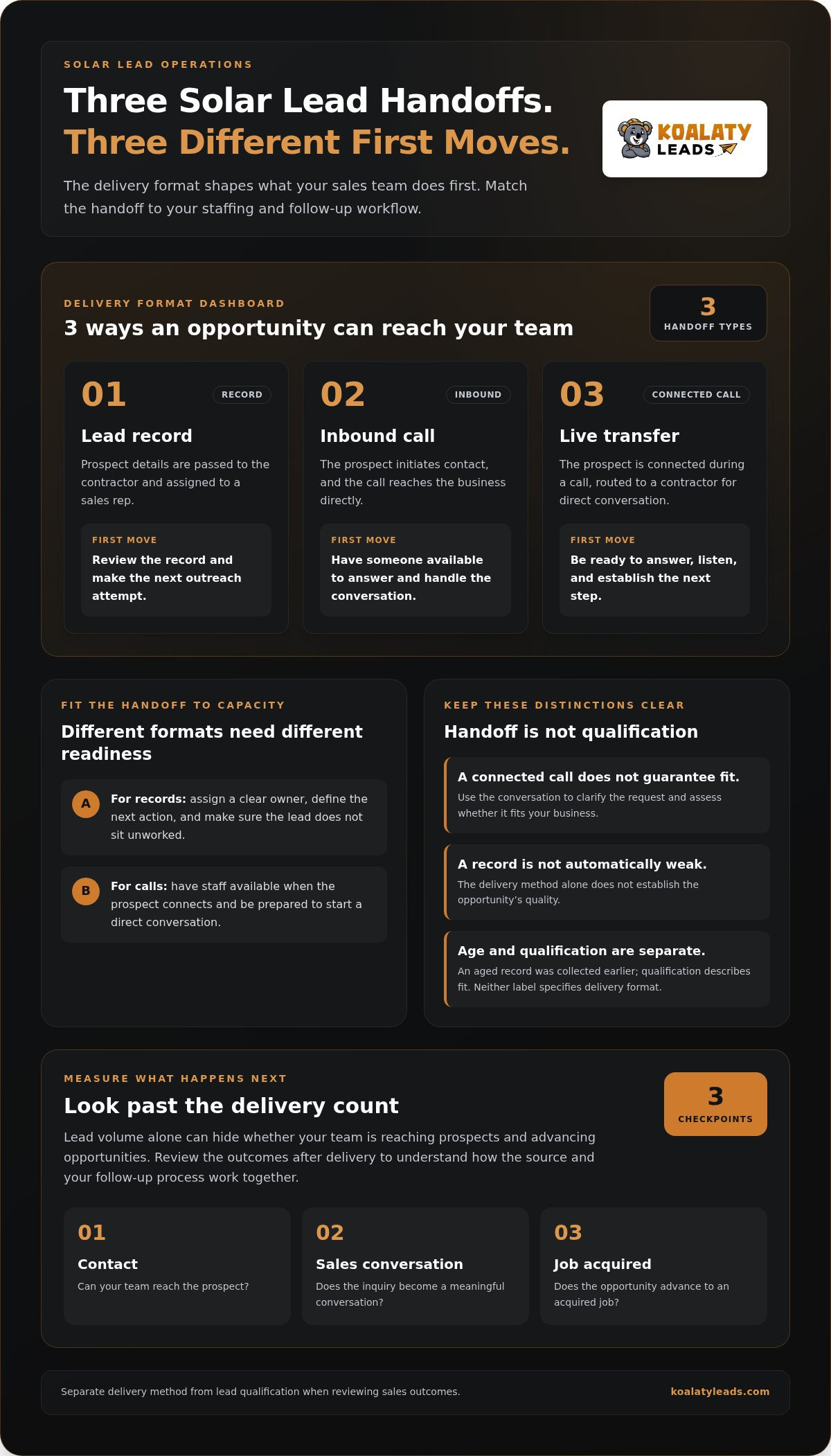
Capture and delivery are separate steps. A contact record gives a rep information to follow up on, an inbound call starts with the prospect reaching your business, and a live transfer routes a call to your team for a direct conversation. Each format sets up a different first action.
The handoff affects how you staff and organize sales activity. A record needs an assigned owner and an outreach task; a connected call needs someone available to speak. The U.S. Department of Energy Solar Initiatives provides context on solar technologies and research, while the table below focuses on the lead’s path into your sales operation.
| Delivery format | Contact context | Handoff type | Immediate follow-up need |
|---|---|---|---|
| Lead record | Prospect details are passed to the contractor | Information is assigned to a sales rep | Review the record and make the next outreach attempt |
| Inbound call | Prospect initiates contact with the business | Call reaches the business directly | Have someone available to answer and handle the conversation |
| Live transfer | Prospect is connected during a call | Call is routed to a contractor for direct conversation | Be ready to answer, listen, and establish the next step |
These formats describe the handoff, not the opportunity’s quality. A connected call doesn’t guarantee fit, and a record isn’t automatically weak. Keep delivery method separate from lead qualification when reviewing sales outcomes.
Qualification and age are separate considerations, too. A qualified solar lead refers to how well an opportunity fits your business; the label doesn’t tell you whether it arrives by phone or as a record. An aged record was collected earlier, but that doesn’t specify how it’s delivered. Track these attributes separately to understand what your team is receiving.
Match the handoff to team readiness
Calls require staff availability when the prospect connects. If your team is occupied, the chance to start a direct conversation may pass. Record-based follow-up needs clear ownership, a defined next action, and a process for making sure the lead doesn’t sit unworked.
Koalaty Leads offers solar lead delivery options, including inbound calls and live call transfers. Teams considering different lead delivery services can compare each handoff with their staffing and follow-up workflow.
Exclusive vs. Shared Solar Leads: Compare the Trade-Offs
Lead models differ in who receives an opportunity, when it reaches a contractor, and how much competition may surround the prospect. Comparing those mechanics helps you judge the follow-up workload behind each source, not just the label attached to it.
| Model | Recipient count | Timing | Competition for attention | Follow-up responsibility |
|---|---|---|---|---|
| Exclusive lead | Delivered to one contractor | As provided through the delivery arrangement | No other contractors receive that same delivered opportunity | The receiving contractor contacts and works the prospect |
| Shared lead | May be distributed to multiple contractors | Depends on the source and handoff | Other contractors may pursue the same prospect | Each recipient is responsible for its own outreach |
| Aged record | Depends on how the record is distributed | Collected before it is delivered | Depends on recipient count and how recently others have followed up | The contractor may need to reestablish context and interest |
| Bid-to-appear model | Contractors gain visibility or access through a bidding process | Visibility depends on the platform’s allocation process | Other businesses may also compete for attention on the platform | The contractor follows up after receiving access to the opportunity |
For a wider view of solar market developments that may shape prospect conversations, see Solar Industry Trends from SEIA. If you’re weighing delivery options, consider how each model fits your team’s follow-up process.
What exclusivity changes in the sales conversation
Exclusive delivery gives one contractor responsibility for pursuing the opportunity, without other recipients working that same delivered lead. That can make ownership clearer: your team handles outreach, learns what the prospect needs, and decides what to do next.
It doesn’t guarantee an appointment, a sale, or a particular return. Intent, fit, contactability, and execution still matter. Treat exclusivity as a delivery condition that reduces direct competition for the same opportunity, not as proof that the prospect is ready to buy.
How to read marketplace and aged-lead trade-offs
Some platforms use bid-to-appear models, where a contractor’s bid influences visibility or access. Lead flow can depend on platform allocation and competition for placement. Aged records were collected earlier, so reps may need to clarify the original inquiry and whether the prospect remains interested.
Keep recipient count, record age, and access method separate in your reporting. A record can be aged and exclusive, or current and shared. That distinction helps your team interpret results fairly and assign the right follow-up approach.
Measure Solar Lead Performance from First Contact to Acquired Job
Measure solar leads through the full sales path, not just the moment they arrive. A consistent record of contact attempts, appointments, sales, and acquired jobs helps you identify where performance changes and whether lead spend is producing outcomes your business values.
Cost per acquired job is more informative than cost per lead alone because it connects acquisition spend to the jobs your sales process actually produces. Use your own verified figures, and keep observed results separate from assumptions.
Build a lead-to-job tracking view
Log every opportunity in your CRM or sales log with its source, delivery format, and date received. Choose an attribution window that fits your sales cycle, apply it consistently, and avoid comparing sources using different tracking rules.
Then record the stages in order:
- Lead received: Record the source, format, and assigned rep.
- Contact attempted and made: Log each outreach attempt and whether it produced a two-way conversation.
- Appointment set: Note whether a conversation advanced to a scheduled sales appointment.
- Sale closed: Record whether the opportunity became a sale under your team’s definition.
- Job acquired: Track the milestone your business uses to count the job as acquired, and link it back to the original lead.
This sequence makes drop-off visible. If records are being worked but conversations aren’t happening, that’s a different issue from appointments that fail to advance or sales that don’t become acquired jobs.
Use unit economics to guide decisions
Define the measures plainly. Contact rate is the share of received leads that result in a two-way conversation. Appointment rate is the share that become appointments, using a consistent denominator such as leads received or contacts made. State which one you use.
Close rate is the share of a defined group of opportunities or appointments that become sales. Cost per acquired job is the relevant acquisition spend divided by the number of acquired jobs attributed to that spend. Keep the denominator consistent, and don’t treat a sale and an acquired job as interchangeable unless your business defines them that way.
For a fuller view of efficiency, include lead spend and the sales labor and follow-up effort used to work those opportunities. For example, if one source requires more rep time per acquired job, include that effort in your comparison rather than looking only at lead charges. Use actual recorded inputs; label forecasts or hypothetical scenarios as assumptions.
Review results by source and delivery format, then use the pattern to adjust follow-up or budget decisions. A single isolated outcome can be misleading, so apply the same measurement rules over the attribution window you selected.
Choose a Solar Lead Partner That Fits Your Sales Operation
A good partner fit depends on more than whether a provider can deliver opportunities. Match the lead type and handoff to your services, available representatives, and follow-up process before increasing lead flow. More volume won’t help if calls go unanswered or assigned records aren’t consistently worked.
Start by defining what your team can handle now. Consider who owns new inquiries, who answers incoming calls, how reps record outcomes, and how much sales capacity is available alongside existing appointments and proposals. That operational picture gives you a practical basis for comparing delivery options.
Prepare the team before adding lead flow
Assign clear responsibility for each handoff. A call needs an available representative who can engage the prospect; a lead record needs an owner who will make contact and log the result. If ownership is unclear, opportunities can sit untouched or receive inconsistent follow-up.
Before scaling, establish a shared process for recording outreach attempts, conversations, appointments, and sales outcomes. Use the same stages and definitions across reps so managers can see where opportunities are progressing or stalling. Then compare expected lead flow with the team’s available time and service capacity, rather than assuming every new inquiry can be handled automatically.
A short readiness review can keep the decision grounded:
- Identify the person responsible for each new record or call.
- Confirm who can take phone conversations as they arrive.
- Use a consistent sales log or CRM process to capture attempts and outcomes.
- Set a lead-flow level the team can work without neglecting active opportunities.
Decide whether Koalaty Leads fits your next step
Koalaty Leads provides exclusive solar opportunities, inbound calls, and live call transfers. Exclusive delivery means an opportunity is delivered to one contractor, helping your team avoid competing with other contractors for that same delivered lead. Inbound calls and live transfers suit teams prepared to engage prospects by phone; record-based opportunities need a reliable process for follow-up.
Assess the full handoff: whether the opportunity aligns with your solar services, how it reaches your team, who handles it, and how your staff will record its progress. A fit between delivery and execution makes it easier to evaluate performance using your own sales outcomes, without assuming a particular result in advance.
Talk with us about your solar trade, sales process, and market as you consider the right next step. We can discuss exclusive opportunities and phone-based delivery options without treating lead volume or a particular outcome as a given.
Put Your Next Lead Decision to Work
Use your next buying decision to create a clearer growth path, not just a busier pipeline. Identify one change your team can evaluate, such as adjusting how an opportunity is handed off or clarifying who owns the next step. Give that decision a responsible owner and a review point, so it leads to learning rather than guesswork.
With solar leads, a disciplined approach gives your team room to refine its acquisition strategy as the business changes. Let your own results guide what to continue, adjust, or scale. The aim isn’t activity for its own sake. It’s a lead operation your team can manage with focus and confidence.
Bring your goals and sales process into a conversation with Koalaty Leads, and explore an approach that fits your business.
Make the next move with a clear plan and the confidence to build on what works.
Frequently Asked Questions
What are solar leads for contractors?
Solar leads are prospect records or conversations that give a contractor a potential sales opportunity. They can come from someone expressing interest, but that signal alone doesn’t establish readiness or fit. A rep can use the first exchange to understand what prompted the inquiry and whether it aligns with the company’s services. Track the lead’s source and outcome so future buying decisions reflect actual sales activity, not labels alone.
Are exclusive solar leads better than shared leads?
Exclusive leads can be a better fit for contractors who want their team to pursue an opportunity without other recipients working that same lead. Shared leads can put multiple contractors in contact with one prospect, so prompt, organized follow-up matters. Neither model guarantees a sale. Compare them using your team’s actual appointments, acquired jobs, and follow-up workload to see which approach fits your sales operation.
How much do solar leads cost?
There isn’t one standard price for solar leads. Cost can vary with the lead source, delivery format, age, and whether the opportunity is exclusive or shared. Rather than judging an option by its upfront price alone, compare the provider’s quoted cost with your own tracked results, including sales effort and acquired jobs. Koalaty Leads can discuss its solar lead options with contractors based on their business needs.
What is the difference between a solar lead and a live transfer?
A solar lead is the sales opportunity; a live transfer is one way that opportunity can reach your team. With a live transfer, a prospect is routed into a phone conversation with a contractor. A lead can also arrive as a record that your team follows up on. This distinction helps you plan staffing: evaluate the opportunity separately from the method used to connect with it.
How quickly should solar contractors follow up with leads?
Follow up as promptly as your team can manage, especially when a prospect has just initiated contact. Set a clear process so a call or new record has an owner, an initial action, and a documented next step. If the assigned rep is unavailable, define who handles the handoff. Consistent execution makes it easier to identify whether missed connections come from staffing, lead delivery, or follow-up habits.
How can I tell whether solar leads are profitable?
Evaluate profitability with a consistent attribution window and your company’s definition of an acquired job. Include the relevant lead spend and sales labor, then compare that total with the jobs attributed to the source. Don’t judge a source before its opportunities have had time to progress through your sales process. Record assumptions separately from completed outcomes so forecasts don’t get mistaken for measured results.
Need exclusive leads instead of shared ones? Koalaty Leads delivers qualified homeowners — web leads or live call transfers — to one contractor only.
Get Started