
Solar Leads for Sale: How to Buy High-Converting Leads

A low-priced solar lead isn't automatically a low-cost customer. There’s no single price for solar leads for sale: costs depend on your market, how the lead was generated and screened, whether it’s exclusive or shared, and whether you’re buying a lead or an appointment. Judge the opportunity by what it costs to acquire a job, not just by the price of one contact.
A higher-intent opportunity may cost more, but price alone can’t tell you whether it will pay back. Contact, appointment and close rates, along with average job value, all shape the return.
This guide explains how lead formats differ, what affects lead costs, and how to assess potential ROI using your own sales data. You’ll also learn what to measure in a small test before deciding whether to increase your investment.
Key Takeaways
- Compare lead costs by source, screening, and exclusivity, not by price alone.
- Confirm what “exclusive” means and how the lead was generated before weighing its value.
- Match your follow-up process to lead age; older prospects may need a different sales approach.
- Track contact, appointment, and close rates to understand your true cost per acquired customer.
- Test a small batch first and use the results to decide whether to expand your spend.
How much do solar leads and appointments cost in 2026?
The cost of solar leads and appointments depends on format, screening, market, and what the seller handles. Compare the sales work included, then measure how each option advances a prospect.
Lead and Appointment Formats
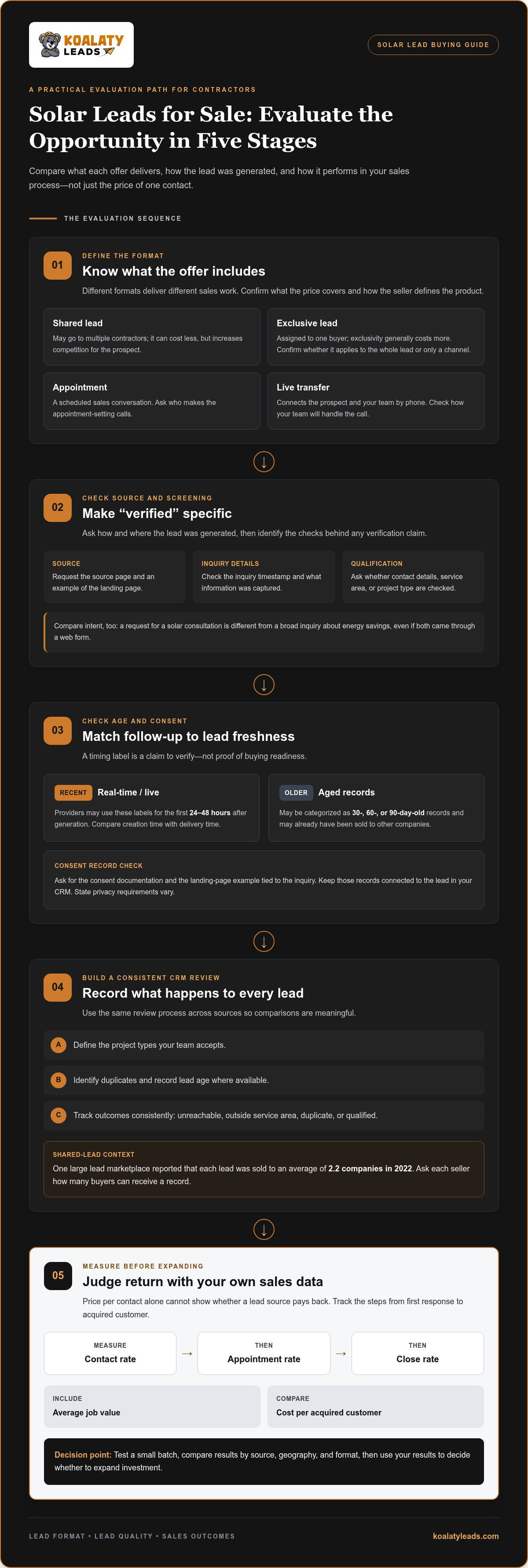
Shared leads may be distributed to multiple contractors, which can increase competition for a prospect. An exclusive lead is assigned to one buyer, while an appointment is a scheduled conversation. A live transfer connects the prospect and your team by phone. Shared leads can cost less; exclusivity generally costs more. Confirm what the price covers and how the seller defines exclusivity.
Appointment setting means booking a sales conversation. A scheduled appointment differs from an exclusive web lead or live inbound call transfer, so compare the actual deliverables and qualification details. Consider how each format fits your team’s process and the follow-up work it requires.
Local Market Costs and Availability
Lead costs and availability vary by state and local market. Competition among installers, prospect demand, targeting, and screening influence the offer. Compare campaigns by geography and format, so a difference in appointment-setting work isn’t mistaken for a difference in market costs.
The work required after delivery depends on the format. Check whether your team will follow up with a web lead or speak with a prospect through a live inbound call transfer. Those details help you compare offers and plan how your sales team will handle each opportunity.
Consent affects outreach and the records supporting it. The Telephone Consumer Protection Act (TCPA) is relevant to consent documentation; the FCC’s one-to-one consent rule was vacated by the Eleventh Circuit in January 2025. Under sellers’ Do Not Call rules, the relationship after an inquiry lasts three months. State privacy requirements also vary.
Before purchasing, ask how and where leads are generated, what consent documentation is provided, and whether you can review landing-page examples. Confirm whether the offer is shared, exclusive, or a scheduled appointment, and who makes the appointment-setting calls.
Tax policy can shape prospect conversations. According to the Internal Revenue Service, the U.S. federal tax credit for customer-owned solar systems ended on December 31, 2025. Under IRS Notice 2025-42, solar facilities that began construction by July 4, 2026 generally remain eligible beyond 2027, according to the Internal Revenue Service. Under IRS Notice 2025-42, a solar facility that misses the construction deadline generally must be placed in service by December 31, 2027, according to the Internal Revenue Service.
Verified and exclusive solar leads
“Verified” should describe specific checks, not serve as a quality label by itself. Shared, aged, or noncompliant solar leads can expose buyers to duplicate outreach, low response, and consent-record gaps.
Exclusive and Shared Lead Options
An exclusive solar lead is assigned to one buyer, reducing direct competition for that prospect. A shared lead can be distributed to multiple buyers, so several sales teams may contact the same person. One large lead marketplace reported that each lead was sold to an average of 2.2 companies in 2022.
That average illustrates why “shared” needs a precise definition. Ask vendors how many buyers can receive each record, whether exclusivity applies to the whole lead or only a channel, and how they handle duplicates. Compare those answers with your team’s capacity to respond and follow up; the right format depends on how you sell.
Real-time exclusive web leads combine a recent inquiry with single-buyer access. Before buying, identify the source page, the inquiry timestamp, and the information captured. Then confirm what “verified” means in practice, such as whether the vendor checks contact details or screens for service area and project type.
When comparing solar lead generation offers, write down the qualification criteria. For example, distinguish a prospect requesting a solar consultation from a broad inquiry about energy savings. Those indicate different levels of intent, even if both come through a web form.
Risks of Aged or Noncompliant Leads
Aged leads may be categorized as 30-, 60-, or 90-day-old records, and they may already have been sold to other companies. The risk is practical: a prospect may have moved on, already chosen an installer, or received several calls. Ask when the inquiry was generated and whether the record was previously distributed.
Noncompliant leads create another risk: missing or unclear consent documentation can make it difficult to establish what contact the prospect agreed to receive. Request the consent record and the landing-page example tied to the inquiry. Keep those records connected to the lead in your CRM.
Use a consistent review process for each offer. First, define the project types your team accepts. Next, agree on how your CRM will identify duplicates and record lead age where available. Finally, track outcomes such as unreachable, outside service area, duplicate or qualified, so your team can compare lead sources consistently.
Those checks help buyers separate exclusivity from verification. A lead can be exclusive yet poorly screened, while a shared lead can contain accurate details but bring multiple contractors into the same buying conversation. Evaluate each attribute separately, then compare the vendor’s definitions with the records your sales team receives.
Aged versus real-time solar leads
Real-time leads reach installers soon after an inquiry; aged leads come from older records. The difference changes how you prioritize follow-up, assess current interest, and plan the sales conversation.
Providers may describe leads as live or real-time during the first 24 to 48 hours after generation. Treat that label as a timing claim, then compare the record’s creation time with its delivery time. A short gap gives your team a clearer opportunity to respond while the inquiry is recent, but it doesn’t establish how ready the prospect is to buy.
Aged opt-in solar leads still begin with a person submitting an inquiry, but the original expression of interest may no longer reflect current plans. The record may have been generated earlier, and the prospect’s circumstances or preferred installer could have changed. Before buying, ask for the lead’s age category, original source, and the date the inquiry was captured.
Timing affects the sales workflow. Older cross-industry research from 2011 found that firms contacting online leads within an hour were nearly seven times as likely to qualify them as firms that waited longer. That finding is not solar-specific, but it underscores why a real-time delivery process needs an assigned responder, a prompt first call, and a clear follow-up record.
Solar prospects may spend months researching options before they’re ready to move forward. An older record can still be useful if your team treats it as an opening conversation rather than an immediate appointment. For example, ask whether the prospect is still considering solar, document the answer, and set the next follow-up based on their stated interest.
Compare lead-generation offers by more than age. Ask whether the record is exclusive, how the vendor defines real-time delivery, and whether the original opt-in details accompany each lead. An exclusive solar record may limit competition among buyers, but exclusivity doesn’t make an outdated inquiry current or replace your team’s qualification process.
Use a consistent test when assessing vendors: record each lead’s age, first-contact timing, response, qualification, and eventual outcome. Keep real-time and aged records in separate CRM categories so performance comparisons remain clear. If an aged lead receives credit under a vendor’s policy, record the reason and apply that rule consistently across the test.
Then set follow-up expectations by segment. Route fresh inquiries to the team member responsible for immediate contact; give older records a tailored re-engagement message and a clear next step. That structure helps installers judge whether lead generation supports their sales process, rather than assuming every record carries the same level of interest.
Return on investment from purchased leads
Measure purchased solar leads by cost per acquired job, not lead price alone. Track the full path: lead received, contact made, appointment held, proposal delivered and sale closed. Every paid lead counts as an acquisition expense, even if it never reaches your sales team.
Around 6% is a normal solar lead-to-sale conversion rate, though system pricing affects results. Use that figure as a reference point, not a target for every campaign. Your own qualified-lead rate, appointment show rate, close rate, and average job value show where the sales process creates returns or loses them.
Build a simple calculation from your actual campaign data. Divide total lead spend by the number of closed jobs to find cost per close. Then compare that cost with gross profit from those jobs, not contract value alone. Include sales labor and appointment-setting expenses if they’re part of your campaign.
Market benchmarks can help frame the review. Solar installers in competitive U.S. markets commonly aim to keep cost per close below $1,500. In emerging U.S. markets, common targets range from $800 to $1,300 per close.
Targets differ from company to company. A sales team with higher job margins may support a different acquisition cost than one with tighter margins. Compare actual gross profit, installation capacity and sales costs before deciding whether a campaign’s cost per close fits your business.
Separate lead performance by source and type in your CRM. For each batch, record total spend, contact rate, qualified prospects, appointments set, appointments held, proposals and closed jobs. Use consistent definitions: an appointment set isn’t an appointment held, and a booked meeting isn’t a sale.
Review the stages together. If contact rates are strong but few homeowners qualify, revisit targeting and qualification criteria. If qualified prospects book appointments but don’t close, examine sales follow-up, proposal timing and pricing. This helps you identify the weak stage instead of assuming the lead source is the problem.
Test a smaller batch before increasing lead volume. Compare its conversion rate, lead quality and customer acquisition cost with your current results, using the same tracking window and qualification rules. Continue only if the economics fit your margins and the sales team can handle the opportunities.
Finally, assess payback using revenue and delivery costs from closed jobs, not forecasted pipeline. A lead source can produce appointments without producing profitable installations. Review results by market and campaign so a strong segment doesn’t hide weak performance elsewhere.
Benefits of buying solar leads online
Buying solar leads online gives business owners a practical way to compare offers before assigning sales resources. Start with the actual deliverables: lead format, project type, qualification details and how records reach your team. A written comparison helps distinguish useful details from marketing labels and gives your sales manager a basis for selecting a test.
Document your campaign criteria, intended service area and delivery preferences before launch. For example, if your installers handle residential projects but not commercial work, include that distinction in your campaign brief so incoming opportunities fit your operating capacity.
Clear ownership within the sales team supports consistent follow-up. Assign each prospect to a representative, define the next action and log the outcome in your CRM. If a prospect requests a later call, record that preference so another representative can continue the conversation with context.
Use consistent qualification language across marketing and sales. A campaign may capture project type and location, while your sales team uses those answers to decide whether to schedule a consultation. Compare those details with actual sales outcomes to see whether the campaign reaches the customers your business intends to serve.
Campaign records make follow-up reviews more concrete. At the end of a test, compare delivered leads with the team’s outcomes and look for patterns, such as incomplete project details or mismatched service areas. Share those findings with the campaign owner before changing targeting, so adjustments address a documented issue rather than a hunch.
Lead buying can help owners manage capacity, too. Before accepting more opportunities, consider follow-up workload alongside representative availability and installation schedules. If the team is already committed, adjust the campaign plan before delivery so new prospects don’t wait without a clear next step.
Keep a simple decision log for each campaign: what criteria you selected, what the vendor delivered, and what your team learned. That record gives future buyers and managers a consistent reference when reviewing campaign changes. It also helps distinguish a sourcing issue from a handoff or sales-process issue.
Use these operational checks alongside your lead economics. An online workflow is useful only when the leads, sales capacity and follow-up process fit together. Set a review date before launch, then use campaign results to decide what to keep, adjust or stop.
Koalaty Leads: Roofing Leads
Koalaty Leads offers exclusive solar leads for contractors seeking opportunities aligned with their installation business. Its pay-per-lead options include exclusive web leads and live inbound call transfers, giving your team different ways to connect with solar prospects.
Use your campaign criteria and sales capacity to guide the conversation. Discuss the solar lead format that fits your process, then track outcomes separately from other service lines. Koalaty Leads also offers Roofing Leads, Window Replacement Leads and Bathroom Remodel Leads for contractors managing multiple divisions.
Visit Koalaty Leads to discuss solar lead options for your business.
Make your next lead decision count
Turn your campaign findings into a clear buying brief. Define the market you serve, the lead format your sales team can handle and the outcomes you’ll use to assess performance. That gives your next conversation a practical focus and helps you compare opportunities against your business priorities.
The right solar leads for sale should fit how your team qualifies prospects and moves them toward a project. Koalaty Leads offers Roofing Leads, Window Replacement Leads and Bathroom Remodel Leads for contractors growing those service lines. Discuss your trade and market with Koalaty Leads to explore the lead options that suit your goals.
Keep testing, track the results and build a lead strategy your team can execute with confidence.
Frequently Asked Questions
Are solar leads worth the high price?
Solar leads can be worth the investment when the resulting jobs produce enough gross profit to cover acquisition and sales costs. Assess the value of solar leads for sale by tracking each batch from delivery through closed installation. For example, compare campaign cost with gross profit from completed jobs, then account for expenses such as sales labor. A lead’s price alone can’t show whether the campaign is profitable.
I’ve tried solar leads in the past. Why haven’t I succeeded?
Weak results can come from a mismatch between lead intent, follow-up and sales capacity. Review a past campaign record by record: note whether the contact information worked, the prospect wanted residential solar and a representative followed up. Then examine where opportunities stalled, such as before qualification or after a proposal. This helps identify whether targeting, response handling or the sales process needs adjustment.
What makes a qualified residential solar lead?
A qualified residential solar lead gives your team relevant information to decide whether a sales conversation makes sense. Look for valid contact details, stated interest in residential solar and a project location your installers can serve. Also consider whether the prospect understands why your team is calling. Keep those criteria consistent in your CRM so sales representatives classify incoming inquiries the same way.
What are the best solar lead companies in 2026?
There isn’t one best fit for every installer; compare each company’s lead source, qualification process, delivery format, and reporting. Koalaty Leads offers exclusive solar leads and live inbound call transfers, with lead qualification through a 13-point stack. Evaluate a provider against your own sales process, including how its records reach your team and how you’ll measure qualified opportunities and closed jobs.
What contact rate can you expect from solar leads?
Contact rates vary with record accuracy, prospect availability, lead age and your team’s response process. Calculate yours by dividing leads that result in a two-way conversation by total leads received, using the same definition across campaigns. For example, track an unanswered call separately from a wrong number or a prospect who declines. That breakdown shows whether the main issue is reachability or interest.
What is the conversion rate from leads to set appointments?
Koalaty Leads states that standard leads have a 15-25% appointment-set rate, while organic and paid-search leads have a 30-40% appointment-set rate. Treat an appointment set as a scheduled meeting, not a meeting that happened or a sale. Track those stages separately in your CRM to see whether prospects attend and whether your team advances them to proposals.
What kinds of solar leads are available to buy?
Buyers can encounter residential or commercial inquiries, web submissions, scheduled appointments, and phone connections, depending on the source and campaign. Each format gives your team a different starting point: a web record requires outreach, while a connected call begins with a live conversation. Define the project type and contact format your sales process can handle before comparing offers.
What types of solar leads are for sale: exclusive, shared, real-time, or aged?
Those labels describe different attributes. Exclusive means assigned to one buyer; shared means distributed among multiple buyers. Real-time describes prompt delivery after an inquiry, while aged identifies an older record. A lead can be both exclusive and aged, so treat distribution and timing as separate checks. Koalaty Leads provides exclusive opportunities, not shared leads.
Need exclusive leads instead of shared ones? Koalaty Leads delivers qualified homeowners — web leads or live call transfers — to one contractor only.
Get Started