
Roofing Lead Generation: Strategies to Scale Your Business

Lead generation for roofing scales when you balance paid opportunities with referrals and local marketing, then judge each source by lead exclusivity, contact rate, close rate, and cost per acquired job. The right mix depends on your market, sales capacity, and the kinds of roofing jobs you want to win.
More leads alone won’t fix an unreliable pipeline. You need opportunities your team can respond to quickly and a clear way to see which sources turn into profitable work. This guide compares common lead sources and pricing models, explains the trade-offs between shared opportunities and exclusive leads or live calls, and covers free ways to strengthen online lead acquisition. Use it to decide where to invest, what to track, and when a professional lead partner may fit your growth plan.
Key Takeaways
- Compare provider-managed advertising, search ads, social media, phone, email, direct mail, and free channels based on how well they fit your roofing business.
- Assess lead costs alongside contact, appointment, and close rates to understand what each source may contribute to customer acquisition.
- Use free online resources and a strong review profile to support visibility and build trust with potential customers.
- Weigh exclusive leads, shared opportunities, and live transfers by competition, speed to contact, and the sales process each requires.
- Explore how exclusive roofing leads and live transfers could fit your trade and market.
Lead Generation for Roofing: Paid and Organic Sources
Roofing contractors can build a pipeline through provider-managed advertising, local search, social media, and direct outreach. The mix should fit the jobs the company wants and the sales capacity available to handle new inquiries. Providers can coordinate campaign setup and lead routing, while the contractor supplies service details, target areas, and follow-up preferences.
For Google Ads, a provider can group search terms by service intent, such as roof replacement or storm-damage inspections. Location settings and ad extensions help align campaigns with the company’s service footprint. A provider can review search terms and inquiry sources, then adjust targeting when ads attract requests outside the work the roofing team wants.
Social media campaigns reach people in a different way. Ads can feature project photos, seasonal services, or a specific roofing offer, while organic posts can showcase completed work and useful company information. Paid placements buy distribution; organic content builds a visible profile over time.
Providers can coordinate phone and email handling so incoming inquiries reach the right sales staff. For example, a phone lead might be routed to the estimator handling that service area, while email delivers the request details for follow-up. Direct mail can complement digital outreach, such as sending a roofing services postcard to selected homes near a completed project.
Neighborhood targeting works best when the campaign’s geography matches the contractor’s actual operations. A provider can separate ad groups or landing pages by service area, then review which areas produce qualified requests. For instance, a company serving several towns can track each area independently instead of treating all inquiries as one undifferentiated campaign.
Free channels can support paid activity. A maintained Google Business Profile, useful service-area pages, and consistent organic social posts give searchers more context about the contractor. Providers can coordinate these assets with advertising so a prospect who sees an ad can also find accurate business details and relevant examples of the company’s work.
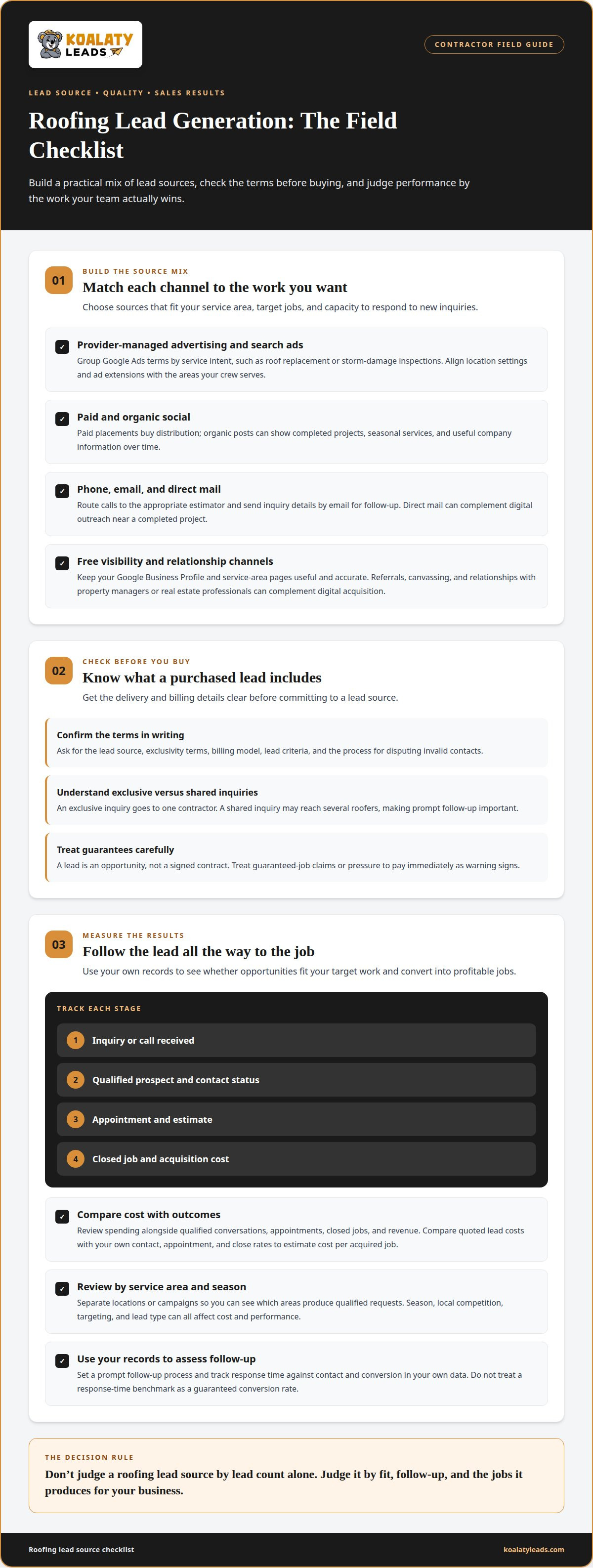
Buying roofing leads carries risks such as shared inquiries, outdated contact details, unclear service requests, or sellers who overstate what delivery includes. Before paying, get the source, exclusivity terms, billing model, and invalid-contact credit policy in writing. Treat guaranteed-job claims or pressure to pay immediately as warning signs; a lead is an opportunity, not a signed contract.
Separate lead delivery from sales outcomes when reviewing performance. Track inquiries, calls, qualified prospects, booked appointments, estimates, and closed jobs. This shows whether the opportunities fit your target work and whether your team is converting them, rather than relying on clicks or lead counts alone.
How Much Does Roofing Lead Generation Cost?
Roofing marketing costs vary by channel, service area, season, targeting, and lead type. Compare spending with qualified conversations, appointments, closed jobs, and revenue. A high lead count is not enough to show that a source is producing value.
Purchased leads create a direct acquisition expense; organic search and social content require time and ongoing work. A smaller roofing business may focus on one service area, while a larger team may separate campaigns by service and coverage. Local competition and seasonal demand can also affect advertising budgets, so the same campaign setup may perform differently across markets.
Lead pricing reflects what the buyer receives. An exclusive inquiry goes to one contractor, while shared inquiries may reach several roofers and require prompt follow-up. Compare quoted costs for each type with your contact, appointment, and close rates to estimate cost per acquired job; pricing and results vary by market and provider. Before committing, understand the lead criteria, billing model, and process for disputing invalid contacts. To discuss whether exclusive roofing leads or live transfers fit your trade and market, talk with Koalaty Leads.
Organic search can reduce reliance on paid placements, but it still takes time and resources. Useful service information, accurate Google Business Profile details, and relevant roofing content can support visibility. Organic social posts can show completed work or explain services, while paid promotion adds targeted distribution.
Location and season can influence roofing demand. After severe weather, a contractor may emphasize storm-related services; before winter, inspections may be more relevant. Use targeting that reflects the areas your team serves, and review which locations generate qualified inquiries.
Track each opportunity in a CRM or reporting system, including its source, contact status, appointment, estimate, sale, and acquisition cost. Set a prompt follow-up process and measure how response time relates to contact and conversion rates in your own records; do not treat any response-time benchmark as a guaranteed roofing conversion rate.
Testimonials can support a provider’s marketing, but they do not establish typical results. Review reporting that separates inquiries, appointments, and sales, with the channel and reporting period identified. Your own records can show how a source performs for your company and whether its cost aligns with the value of the jobs won.
Referrals, canvassing, and partnerships can complement digital acquisition. A provider may coordinate outreach around completed projects, while a roofing contractor develops relationships with property managers or real estate professionals. Phone and door-to-door outreach must follow applicable requirements; use compliant contact practices and honor requests to stop communication.
Free Resources for Roofing Lead Generation
Free resources won’t replace a full acquisition plan, but they can strengthen the channels that bring roofing inquiries. Use Google Business Profile, useful website information, project photos, and customer reviews to help prospective customers find and assess your business.
Start with your Google Business Profile. Keep roofing services, phone number, hours, and service areas accurate, then use posts to feature seasonal services or completed work. Add project photos with brief descriptions so searchers can understand the work your team does before contacting you.
Organize your website around the services and areas your roofing team actually covers. Give each service clear, useful information, such as explaining what a roof replacement involves separately from storm-related inspections. Keep contact details easy to find and the information on each page specific to its purpose.
Reviews are another practical asset. Research reports that 92% of people read online reviews before contacting a company, and 74% say good reviews make a local business more trustworthy. Reviews can help prospects assess a contractor after finding the business through search or advertising, giving reputation a supporting role in lead acquisition.
Build review requests into the closeout process. After a completed job, send a thank-you email with a direct link to the company’s Google review page, or include a QR-code card with the warranty packet. Make the request clear and neutral; never script a review or pressure customers to leave only positive feedback. Consistent, authentic feedback gives future prospects a fuller picture.
Review volume and rating both matter as visible trust signals. Roofing companies with 50 or more Google reviews and a rating of 4.5 stars or higher are identified as markers of local visibility and customer trust. Research also reports that 47% of consumers won’t consider businesses with fewer than 20 reviews. Treat these figures as directional benchmarks, not guaranteed ranking thresholds.
Providers can support review management by organizing requests, monitoring new feedback, and helping the contractor respond professionally. A specific reply can acknowledge the customer’s experience without disclosing private details. Keep responses timely and consistent, and use recurring feedback to improve communication, estimate follow-up, or the handoff between sales and production.
Social proof can also appear in organic posts and website content. With permission, a provider can feature a customer comment alongside a completed-project photo, then use that content across the company’s social platforms. Optimize posts for the service area and work shown. This connects reputation with local targeting without presenting advertising claims as customer testimony.
Free tools work best when someone owns the process. Assign a team member to update your Google Business Profile, request reviews after completed jobs, and keep contact details consistent across your website and profiles. Track calls and form inquiries by source to see whether better visibility supports real sales conversations.
Compare Roofing Lead Generation Options
Roofing lead options differ in cost structure, competition, control, and follow-up demands. Compare the source and buying model separately: an agency may manage advertising, while a lead provider may deliver inquiries directly. The right comparison starts with the opportunities your sales team can handle and the jobs your roofing business wants.
Search advertising can put your company in front of people looking for roofing services. Results depend on targeting, local demand, and campaign management. Organic search takes ongoing work to build visibility and can support inquiries without paying for each click. Track both sources so you can compare outcomes.
| Option | How it works | Main trade-off |
|---|---|---|
| Google Ads | Paid search campaigns target roofing queries and locations. | Offers control over targeting, but costs continue as ads run. |
| Organic local search | Website pages and business profiles support unpaid visibility. | Builds presence over time, rather than delivering instant placement. |
| Shared leads | An inquiry may be sold to four to five contractors. | Lower competition control means speed and sales execution matter. |
| Exclusive pay-per-lead | One contractor receives the individual lead. | Less direct competition for that inquiry, with a cost per lead. |
| Live call transfers | A caller is connected to a contractor by phone. | Immediate conversation requires staff ready to answer. |
Managed advertising is different from buying individual leads. An advertising service may manage campaigns, while your company handles the resulting inquiries and sales follow-up. Exclusive web leads and live inbound call transfers provide a direct way to receive opportunities, with the lead format shaping how your team responds.
When comparing lead offers, look for exclusive web leads or live inbound call transfers. An exclusive web lead goes to one contractor, while a live inbound call transfer connects a caller directly with the contractor. Neither format removes the need to qualify the opportunity, respond promptly, and track its outcome.
Compare providers on operational details, not promotional claims. Review lead definitions, source attribution, exclusivity, billing structure, and the process for disputed contacts. For managed campaigns, ask how reports separate clicks, calls, qualified inquiries, appointments, and closed work. A provider’s dashboard should help your team connect spend to sales outcomes.
Reviews and a complete business profile shape the buyer’s path. A roofing contractor with accurate information and strong reviews may give prospects more context after an ad or search result creates awareness. Treat profile quality as a supporting asset, not a substitute for qualified opportunities or a reliable sales process.
Choose the model that fits your capacity. A team ready to answer calls may benefit from live transfers; a company with disciplined follow-up may prefer delivered leads. If your priority is building longer-term local presence, organic search and reviews can complement paid opportunities. Compare results by cost per acquired job, not lead count alone.
Roofing Leads from Koalaty Leads
Koalaty Leads provides exclusive roofing leads and live inbound call transfers for contractors seeking new sales conversations. These options can suit a roofing business with capacity to handle more opportunities and a process for following up with prospects seeking roofing work. Choose the format that fits your trade, serviceable ZIP codes, and sales process.
With an exclusive lead, the inquiry is provided to one contractor rather than shared among competing roofers. That gives your team the opportunity to handle the conversation without competing for the same lead through a shared distribution model. Exclusivity does not replace qualification or follow-up; your team still needs to understand the request, assess fit, and move the prospect through its sales process.
A live inbound call transfer connects a caller with the contractor by phone. It suits teams that can answer and speak with a prospect in real time. Decide who will handle calls, how your team records each conversation, and how staff will follow up if an estimate or another discussion is needed.
Before discussing options, define the work you want more of. For example, a roofing company may want inquiries for a particular service, or may be focused on specific communities within its service market. Clarifying those priorities helps keep the conversation grounded in your actual capacity, sales goals, and the jobs your team is equipped to pursue.
Evaluate each opportunity from initial contact through qualification, appointment, estimate, and final sales outcome. This helps you see whether the lead format fits your response workflow and where opportunities progress or stall. Judge performance using your own results rather than assuming a particular lead will produce a job.
The right arrangement should make sense for your operation, not just add names to a pipeline. A team with dedicated phone coverage may prefer live conversations, while another may be better prepared to manage delivered inquiries through its existing follow-up process. Discuss the trade, market, and lead format together to determine which approach aligns with your business.
Koalaty Leads also provides leads for other remodeling trades, including Windows, Bathroom Remodeling, and Kitchen Remodeling. Roofing contractors can keep the discussion focused on opportunities that fit their service area, capacity, and sales goals. Clear expectations help you assess whether the lead format belongs in your acquisition mix.
To discuss exclusive roofing leads or live transfers for your trade and market, talk with Koalaty Leads.
Frequently Asked Questions
Why buy roofing leads online?
Online leads can add a trackable source of sales opportunities beyond referrals and repeat business. A roofing owner can review where an inquiry originated, how quickly the team responded, and whether it led to an appointment or sale. That information helps compare acquisition channels using actual business outcomes. Online lead sources can also help a contractor reach prospects actively looking for roofing services, rather than relying only on existing customer relationships.
Do roofing companies need a specialized agency?
No. A specialized provider can be useful if your team needs roofing-focused inquiries and a clearer process for handling them, but it isn’t a requirement for every business. Consider how your staff qualifies requests, schedules estimates, and follows up. Koalaty Leads provides exclusive roofing leads and live inbound call transfers. Its lead qualification uses a 13-point stack, giving contractors a defined qualification process to understand.
How much do roofing lead generation companies charge?
Charges depend on the provider’s model, lead type, targeting, and what the service includes. A pay-per-lead arrangement charges for delivered leads, while advertising management can involve separate campaign and media costs. Koalaty Leads uses a pay-per-lead model for exclusive web leads and live inbound call transfers. Compare what counts as a billable lead and how the provider handles contacts outside your service area.
How much do roofing marketing services cost?
There isn’t one standard cost for every roofing marketing service. The total depends on the work involved, such as campaign management, advertising spend, content production, or lead delivery. Separate provider fees from media spend, then track the resulting inquiries through booked appointments and sold jobs. This helps a roofing business assess its actual acquisition cost instead of comparing marketing plans by headline price alone.
What roofing lead generation strategies can a provider manage for your company?
A provider may support paid search, social media advertising, email, and lead delivery, depending on its service model. For lead generation for roofing, Koalaty Leads lists traffic sources including Facebook, Instagram, TikTok, YouTube, Google, Yahoo, and Bing, alongside organic and paid search leads. Track the source of each delivered opportunity to see how it performs.
How much does roofing lead generation cost per lead in the U.S.?
There is no single U.S. cost per lead that applies to every roofing campaign. Pricing can vary with lead source, demand, geographic targeting, and the size of the serviceable area. Koalaty Leads prices leads on a pay-per-lead basis, with costs varying by serviceable ZIP-code volume. Compare the specific lead format and billing terms with your team’s capacity to respond and convert inquiries.
Which roofing lead sources have the highest conversion rates?
Koalaty Leads lists organic and paid-search leads as its highest-intent lead types, with a 30-40% appointment-set rate. Its standard leads have a 15-25% appointment-set rate, and 40-50% of appointments convert to sales. Appointment setting and sales conversion are separate stages, so track both in your CRM. Use your own closed-job data to determine which source performs best for your roofing business.
How can a provider support roofing lead generation through SEO and Google Business Profile?
A provider can support lead generation for roofing by aligning local search pages with the services your team wants to sell, keeping Google Business Profile information consistent, and tracking calls or forms from organic discovery. For example, reporting can distinguish profile-driven calls from website inquiries and paid-search contacts. Koalaty Leads lists organic leads among its traffic sources and delivers exclusive leads and live inbound call transfers.
Need exclusive leads instead of shared ones? Koalaty Leads delivers qualified homeowners — web leads or live call transfers — to one contractor only.
Get Started