
Pay Per Performance Lead Gen: Scale Your ROI Risk-Free

Pay per performance lead generation ties payment to an agreed lead or sales outcome rather than clicks or impressions. Pricing may be based on qualified leads, subscriptions, or booked jobs, and each model assigns costs and responsibilities differently.
For contractors, the payment trigger is only one part of the decision. A lead’s trade, location, project fit, and delivery format all affect whether it can become a real sales opportunity. A lower inquiry cost means little if the lead does not match your work or your team cannot follow up effectively.
This guide compares pay-per-lead, live-transfer, subscription, retainer, and appointment-based pricing. It explains how exclusivity affects competition, how qualification and dispute terms shape what you pay for, and how to connect lead costs with contact, appointment, and close rates. Use these comparisons to assess acquisition costs against the value of the jobs you win. The goal is to clarify what counts as a billable result, what your sales team must handle, and which measures show whether a campaign is producing worthwhile opportunities.
Key Takeaways
- Compare pricing models by what triggers payment, from lead delivery to a live call or booked job.
- Set qualification criteria around trade, service area, project intent, and handoff so lead quality is clear.
- Track contact, appointment, and close rates to see whether lead spend is turning into acquired jobs.
- Weigh the added competition on shared leads against the sales-team responsiveness exclusive opportunities require.
- Explore how exclusive leads and live transfers from Koalaty Leads may fit your trade and market.
What Pay per Performance Lead Generation Means for Contractors
For contractors, this model ties payment to an agreed lead or sales action, not exposure alone. Its value depends on whether inquiries match your trade, service area, and capacity to follow up.
Lead Qualification and Geographic Targeting
Lead qualification checks whether a prospect’s request matches your work; geographic targeting limits delivery to places your crews serve. Together, these filters help determine whether a contact could lead to a viable estimate. A window replacement request outside your service area may reflect genuine interest but still be unusable for your business.
Useful criteria include trade, project type, location, and the prospect’s stated interest. BANT stands for budget, authority, need, and timeline, but it comes from broader sales qualification. For residential contracting, prioritize project fit and service-area match rather than treating a homeowner like a corporate buying committee. State these criteria before a pay per performance lead generation campaign begins.
Lead Quality and Qualification Disputes
Lead quality means whether a delivered inquiry matches the campaign’s agreed criteria, not whether the prospect eventually buys. Disputes may involve duplicate records, incorrect contact details, the wrong trade, or an out-of-area request. Clear definitions distinguish a genuinely mismatched lead from an opportunity that simply did not convert.
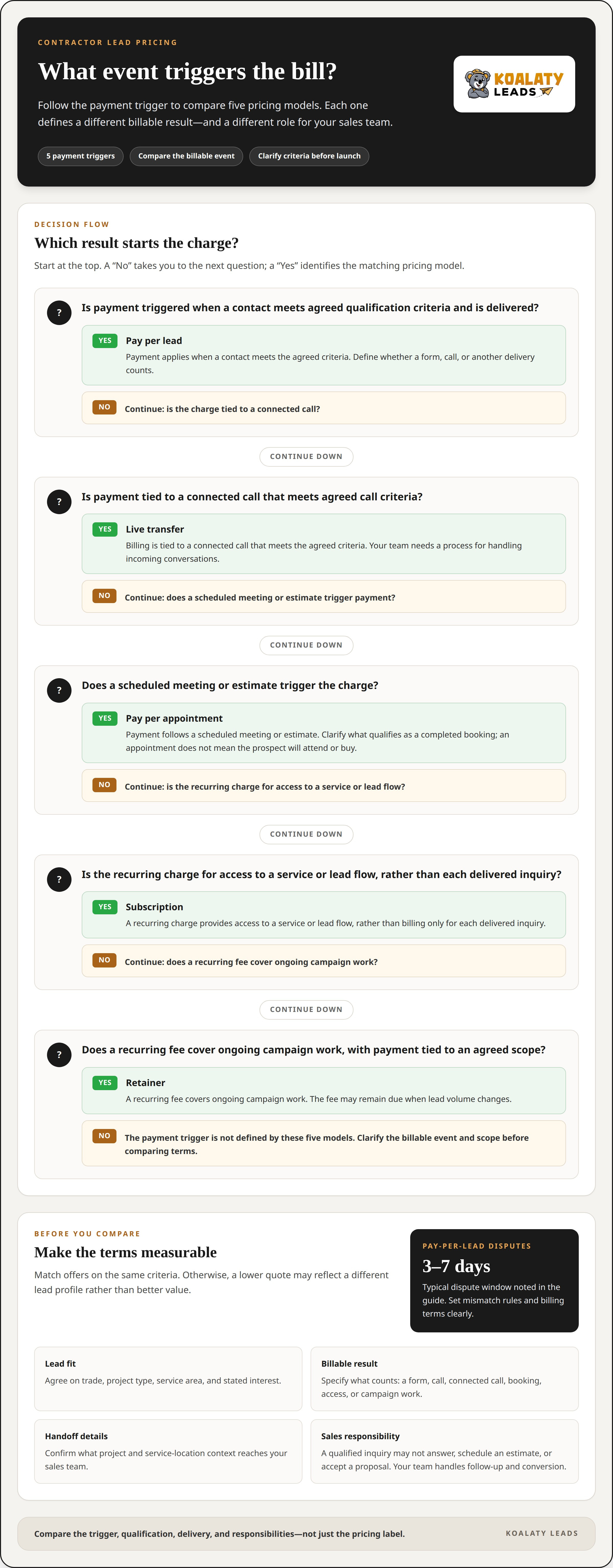
Typical pay-per-lead dispute windows are 3-7 days. In the United States, contracts should set out billing, lead-data use, and responsibility for consent. Privacy and consent requirements depend on the campaign, jurisdiction, and contact method; California’s CCPA is one relevant privacy framework for some consumer-data practices. Don’t assume that a prospect’s interest alone settles whether a contact can be used for outreach.
Qualification and Lead Handoff
Handoff is the point when an inquiry meeting agreed criteria reaches your sales team, either as contact information or a live call. Useful context includes the requested project and service location. Without it, an estimator may need to repeat basic questions before assessing fit, slowing the transition from marketing opportunity to sales conversation.
Setting up a campaign means defining the billable action, qualification criteria, targeting, tracking, and delivery method. Give the provider your trades, service areas, project types, capacity, and disqualifiers. For example, specify whether a particular project type falls outside your work. Then establish which details accompany each handoff and how mismatches are documented. These decisions make a pay per performance lead generation agreement easier to assess and manage.
The model ties payment to a defined result, but it does not eliminate risk. A qualified inquiry may not answer, schedule an estimate, or accept a proposal. Your team remains responsible for sales follow-up and conversion, while clear targeting and documented criteria help prevent avoidable disagreements about what was delivered.
Pay per Performance Lead Generation Pricing and Models
Pricing depends on the event that triggers a charge, from receiving a qualified inquiry to booking an appointment. Compare the billing trigger, included work, and sales-team responsibilities before deciding which model fits.
Retainer and Performance-Linked Pricing
A retainer pays for ongoing campaign work, while performance-linked pricing ties payment to an agreed result. Retainers can support consistent management, but the fee may remain due when lead volume changes. Performance pricing links spend to a defined event, yet the contractor still handles sales conversion. This distinction matters when deciding which activities belong in the provider’s scope and which results your team controls.
Several models use distinct payment triggers:
- Pay per lead: Payment applies when a contact meets agreed qualification criteria. The contract should define whether a form, call, or another delivery counts.
- Live transfer: Billing is tied to a connected call that meets the agreed call criteria. Your team needs a process for handling incoming conversations.
- Pay per appointment: Payment follows a scheduled meeting or estimate. Terms should clarify what qualifies as a completed booking.
- Subscription: A recurring charge provides access to a service or lead flow, rather than billing only for each delivered inquiry.
- Retainer: A recurring fee covers ongoing campaign work, with payment tied to the agreed scope rather than a specific lead.
These structures distribute risk differently. A lead-based campaign ties charges to delivery, while a retainer can cover work done before leads arrive. Appointment billing moves the trigger further into the sales process, but it does not mean the prospect will attend or buy. A performance incentive may also reward a provider for meeting an agreed target. Define the metric and measurement period so both sides interpret results consistently.
Factors Affecting Lead Pricing
Lead pricing can reflect trade, project type, service-area targeting, audience intent, exclusivity, and qualification depth. A narrow campaign seeking a specific project in a limited area differs from one accepting a broad range of inquiries. Compare offers with matching criteria; otherwise, a lower quote may reflect a different lead profile rather than better value.
Source and verification affect the opportunity you are buying. Generic lists may include contacts without current project interest, while activity-based outreach can charge for actions such as clicks. AI tools can help identify patterns in campaign data, but optimization still depends on accurate tracking and useful qualification rules. Assess whether adjustments improve relevant inquiries, not just activity or volume.
Service Pricing and Credits
A credit policy explains when a billed lead can be disputed and what adjustment follows. Terms may address duplicate records, incorrect details, or mismatches with agreed criteria. A credit is not automatically a cash refund, so the written policy should specify the outcome and the documentation needed for a review.
Before launch, align the billing event, lead profile, tracking source, and dispute process. Keep campaign records tied to delivered inquiries, then compare charges with the agreed criteria. Clear definitions help distinguish a billable lead from a delivery error and make acquisition reporting more useful. Judge a pricing model by its written terms and the business outcomes you can track, not its label alone.
Compare Cost per Lead With Cost per Acquired Job
Cost per lead shows what you pay for an opportunity; cost per acquired job shows what you pay to win work. Compare both with contact, appointment, and close rates before judging a campaign or agency.
Industry Cost-Per-Lead Benchmarks
U.S. B2B cost-per-lead benchmarks vary by industry and channel, so use them as context, not a contractor quote. Across B2B industries and channels, the average was around $84 per lead in 2025 benchmarks and a 2026 report. Google Ads averaged about $70, while LinkedIn averaged about $110 per lead in the cited benchmarks.
Industry spreads can be wide. In 2026 figures, paid-only leads averaged $761 in financial services, $784 in legal services, and $310 in B2B SaaS. Those figures describe different markets and buying processes; they aren’t home-service lead prices. For contractors, the useful comparison is between opportunities with similar trade, geography, intent, and qualification criteria.
A booked appointment also differs from a raw inquiry. Qualified appointment-setting leads in home services were listed at $150-$300 per lead in 2026, but that category figure shouldn’t be treated as a quote for your campaign. Check what the billing event means before comparing it with a form lead or a connected call.
Calculating and Reducing Cost Per Lead
Cost per lead is campaign spend divided by delivered leads. Cost per acquired job is spend divided by jobs won from those leads. Track each stage separately: leads received, prospects reached, appointments set, estimates delivered, and jobs closed. This shows whether the biggest loss happens during contact, scheduling, or sales follow-up.
Then work backward from acceptable acquisition cost. A 2026 example sets a maximum acceptable cost per lead at $1,125 for a $15,000 customer lifetime value, a 25% close rate, and a 30% lead-to-opportunity rate. Treat that as an example, not a universal target. Your job value, margins, repeat work, and sales conversion shape the ceiling your business can support.
Providers can lower CPL by improving targeting, refining qualification, and removing sources that deliver poor-fit opportunities. But a lower CPL does not automatically improve return. If fewer prospects answer or book, acquisition costs may rise even as lead prices fall. Compare channels using the same definitions and track each group of leads through to closed jobs.
Use a consistent reporting window for each campaign, then compare lead costs with booked appointments and won work. If one source produces fewer leads but more closed jobs, its higher CPL may still result in a lower cost per acquired job. That is the measure that connects marketing spend to contractor revenue.
Exclusive Versus Shared Leads for Contractors
Lead exclusivity affects who competes for a prospect’s attention and how your sales team can respond. Compare it with lead intent, contact format, and your capacity to follow up.
Exclusive leads go to one contractor; shared leads may be sold to four to five contractors. Lead prices vary by trade, market, and provider, so a lower unit price does not automatically mean a lower acquisition cost when partnering with Koalaty Leads.
| Lead type | Competition and price | Best operational fit |
|---|---|---|
| Exclusive lead | One contractor receives it; price varies by trade, market, and provider. | A sales team able to respond and follow through consistently. |
| Shared lead | Four to five contractors may receive the same inquiry; unit cost may be lower. | A team prepared to compete quickly for the prospect’s attention. |
| Live transfer | A call connects the prospect with a contractor; billing terms depend on the agreed call criteria. | Staff available to answer and handle calls as they arrive. |
With an exclusive roofing inquiry, your estimator can focus on the project without another contractor pursuing that same lead through the same delivery. Exclusivity does not guarantee a sale; audience interest, project fit, and follow-up still shape the return.
Shared leads trade reduced competition for a potentially lower entry cost. When four or five contractors receive one request, response speed and sales-team availability can matter more. A low cost per lead may be offset by more attempts to reach the prospect or a lower chance of winning the job.
Live transfers change the handoff, not necessarily the lead’s exclusivity. The prospect connects by phone, giving your team a chance to discuss the request in real time. Confirm whether a transfer is exclusive or shared and what counts as a billable call; the format alone does not answer either question.
For a fair comparison, track each type separately from delivery through closed work. Record lead cost, successful contact, appointments, estimates, and jobs won. Then calculate acquisition cost by dividing spend by jobs won. Compare that result with job value and margin, not just lead volume.
For example, a shared campaign can deliver more inquiries but fewer appointments per lead. An exclusive campaign may cost more upfront yet produce a better acquisition cost if your team converts more opportunities. The reverse can also happen when follow-up is slow or demand is weak.
Choose based on your sales capacity and audience, not a headline price. Shared leads may suit teams built for fast, repeated outreach; exclusive opportunities may better fit contractors who value focused follow-up. Live transfers make most sense when someone can take the call and handle the conversation promptly.
How Koalaty Leads Supports Contractors
Koalaty Leads gives contractors access to exclusive leads and live call transfers, connecting lead acquisition with a real sales opportunity. It’s a relevant next step when you’re comparing models and want to discuss lead options for your trade, rather than judging campaigns by clicks alone.
The distinction matters operationally. An exclusive lead is delivered for one contractor, while a live transfer connects a prospect by phone. Both offer a direct opportunity, but they place different demands on your sales team: one requires prompt follow-up after delivery, while the other requires someone ready to handle the call.
Koalaty Leads’ relevant lead options include roofing leads, window replacement leads, bathroom remodel leads, and kitchen remodeling leads. These are examples of distinct trades and project types, not interchangeable audiences. A roofing contractor and a kitchen remodeler need different inquiries to match their work.
Before choosing a format, define what makes an opportunity useful to your business. Your trade, service area, project types, qualification criteria, and sales capacity all shape the decision. Also identify the outcome you will use to assess value, such as successful contact, an appointment, or a job won.
Then consider your team’s response process. If your sales staff can take incoming calls, a live transfer may fit the way you handle new prospects. If your process starts by reviewing a delivered inquiry and following up, an exclusive lead may fit better. Neither format removes the need to track contact, appointments, and closed work.
Understand pricing and campaign terms before evaluating return. Compare the defined billable event and lead criteria with your own results, then measure cost per acquired job instead of relying on lead volume alone. A clear comparison helps you decide whether the opportunity and your follow-up process are aligned.
Bring your trade, target service area, and preferred lead format to the conversation. This gives you a practical basis for discussing whether exclusive leads or live transfers fit your current sales operation. Base the decision on your team’s ability to respond and the results you track, not an assumed price or promised outcome.
Talk with Koalaty Leads about exclusive leads or live transfers for your trade and market.
Frequently Asked Questions
What Should You Look for in a Pay-Per-Lead Vendor?
Look for written billing criteria, clear lead records, and a defined dispute process. You should be able to identify each inquiry’s trade, project type, service area, and source. For example, your team can compare a delivered roofing inquiry with its campaign record, then track whether it became an estimate or a sale. These details make billing and performance easier to assess.
What Does Performance-Based Lead Generation Mean?
Pay per performance lead generation ties payment to an agreed outcome, such as a qualified lead, connected call, or appointment. The contract should define exactly what counts as that outcome. A form inquiry and a scheduled estimate are different milestones, even if both enter the same sales funnel. Treat the pricing model as a billing structure, not a promise that every paid opportunity will generate revenue.
How Does a Performance-Based Lead Campaign Work?
A campaign begins with an agreed audience, service area, lead criteria, billing event, and delivery process. Leads or calls are then delivered and recorded against those terms. Your sales records can show whether an opportunity progressed from initial contact to estimate and closed work. Separating these stages helps identify whether a problem lies in targeting, lead fit, or follow-up, rather than treating every missed sale as a lead-quality issue.
What Pricing Models and Average Costs Apply to Performance-Based Leads in the United States?
Common structures charge per lead, connected call, or appointment; some marketing arrangements use a retainer or subscription instead. Average costs vary with trade, geography, source, qualification, and the event being billed, so a single figure can mislead. Compare pay per performance lead generation using equivalent deliverables. A booked estimate, live call, and submitted form are distinct opportunities with different levels of sales engagement.
Which Industries Commonly Use Performance-Based Lead Generation?
Home services, professional services, B2B software, and enterprise solutions use outcome-linked campaigns when they can define a meaningful conversion event. Contractors may track estimate requests or calls, while a software company may assess qualified prospects. The model fits best when the campaign’s target audience and delivery criteria align with the business’s sales process. For contractors, trade match and service-area fit are central to that alignment.
How Do Pay-Per-Lead and Pay-Per-Appointment Pricing Compare?
Pay-per-lead billing applies to a qualifying contact; pay-per-appointment billing applies when a meeting or estimate is scheduled. The appointment model places the billable event later in the sales process, but the terms should clarify what makes a booking valid. For example, an appointment outside your service area may not help your crew. Compare each structure by its billing trigger and how your team records completed appointments.
How Can You Assess a Provider’s Lead Quality and Verification Process?
Compare delivered records with the agreed campaign criteria, then review duplicates, contact accuracy, trade fit, and location fit. Koalaty Leads qualifies leads through a 13-point stack before delivery. Your CRM can add another layer of practical assessment by recording whether your team reached the prospect and what happened next. Verification checks the inquiry against its criteria; it doesn’t establish whether the prospect will ultimately buy.
How Can Businesses Choose a Reputable Performance-Based Lead Provider?
Choose a provider with clear written terms, a defined billing event, and reporting that supports your sales process. Koalaty Leads uses a pay-per-lead model and provides exclusive web leads or live inbound call transfers. Pay per performance lead generation is easier to evaluate when its criteria and delivery format are clear from the start. Compare those terms with your trade, targeting needs, and team’s ability to follow up.
Need exclusive leads instead of shared ones? Koalaty Leads delivers qualified homeowners — web leads or live call transfers — to one contractor only.
Get Started