
Pay Per Lead Roofing: Scale Sales with Exclusive Leads

The cheapest roofing lead can become the most expensive job to win. With pay per lead roofing, you pay for each lead; with Google Ads, you pay for clicks. The useful comparison is how many contacts become qualified conversations, appointments, and sold roofs.
Look beyond the price on a rate card. Shared leads can put several roofers in competition for one prospect. Exclusive leads are delivered to one contractor, but you still need to reach the prospect and convert the opportunity.
This article compares Google Ads, pay-per-lead pricing, and exclusive leads, then explains how contact and close rates affect the cost of acquiring a job. It also covers the billing terms to examine, including what qualifies as a lead and how charges for wrong numbers, renters, or no-shows are handled. Base your decision on sales economics, not the lead price alone.
Key Takeaways
- Compare lead sources by the cost of qualified conversations and acquired jobs, not just the advertised price per lead.
- Shared leads can create direct competition for the same prospect; exclusivity changes that dynamic but doesn’t replace effective follow-up.
- Clarify exactly what triggers a charge, from an inquiry or approved lead to an inspection or live transfer, before budgeting.
- Review lead qualification, delivery, billing, and credit terms so you can judge whether the arrangement fits your sales process.
- Exclusive roofing leads or live transfers may suit contractors looking for a different lead model; fit depends on your market and how your team handles incoming opportunities.
What Does Pay Per Lead Roofing Cost?
Roofing lead costs depend on qualification, delivery, and whether an inquiry is shared or exclusive. Compare the billable lead with the sales time and outcomes it produces.
Lead providers generate inquiries through advertising and other channels, then may qualify them for project fit, contact details, and service area. To assess return on investment, track qualified conversations, appointments, closed jobs, and total acquisition cost.
Qualified Roofing Conversations
A qualified conversation connects your team with a real prospect seeking roofing work you perform in your service area. It gives you more useful context than a raw form submission, which may not confirm project fit or provide a reachable contact. For example, a valid contact requesting a service you do not offer is not a sales-ready roofing opportunity.
Shared Leads and Lead Quality
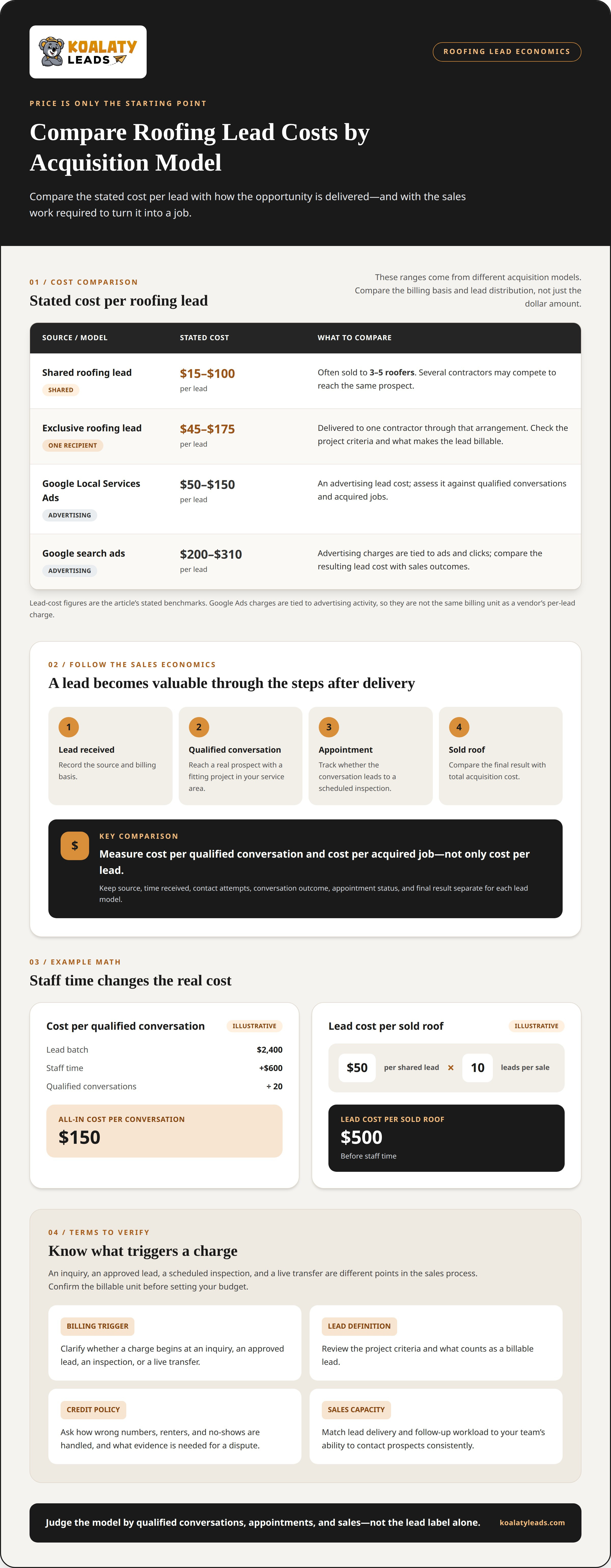
Shared roofing leads in the United States typically cost about $15-$100 per lead in 2026 and are often sold to 3-5 roofers. Exclusive roofing leads cost $45-$175 per lead, according to the client’s stated pricing. Shared inquiries can put several contractors in competition for one prospect; compare both models by qualified conversations and sales, not just by invoice price.
Credits and No-Shows
A wrong number, renter, or missed appointment can take sales time without producing a job. Before buying, find out whether these cases qualify for credits, what evidence is required, and how to submit a dispute. A written policy helps your team distinguish invalid contact details from a prospect who simply decides not to proceed.
Google Local Services Ads leads for roofers typically cost about $50-$150 per lead in 2026; Google search ads leads typically cost about $200-$310 per lead in 2026. These benchmarks differ from vendor lead pricing because Google Ads charges are tied to advertising leads or clicks. Exclusive replacement lead pricing should also be evaluated by its written project criteria and billing terms.
Calculate all-in cost per qualified conversation. In an illustrative example, a $2,400 lead batch plus $600 in staff time, producing 20 qualified conversations, equals $150 per conversation. A $50 shared lead with a 1-in-10 close rate costs $500 in leads per sold roof, before staff time.
| Option | Typical cost | Comparison point |
|---|---|---|
| Shared roofing lead | $15-$100 per lead | Often sold to 3-5 roofers |
| Exclusive roofing lead | $45-$175 per lead | Compare project criteria and billable definition |
| Google Local Services Ads | $50-$150 per lead | Advertising lead cost |
| Google search ads | $200-$310 per lead | Advertising lead cost |
Choose the model that suits your sales capacity and delivers a sustainable cost per acquired job.
Compare Shared and Exclusive Roofing Leads
Shared and exclusive roofing leads differ in how many contractors receive the same opportunity. That distinction changes the sales environment, but it doesn’t determine whether a prospect is qualified or ready to book.
With a shared inquiry, several contractors may contact the same prospect. Your team might reach them after another roofer has already spoken with them, or while other calls are still coming in. That makes the response process important: who follows up, how the conversation is documented, and whether contact continues after the first attempt.
An exclusive inquiry is delivered to one contractor through that lead arrangement. This removes competition from other buyers of the same inquiry, but your team still needs to reach the prospect and determine whether the project is a fit. Exclusivity concerns distribution, not a promise that the prospect will answer, schedule an inspection, or choose your company.
Assess each model against your team’s actual capacity. A roofing business with staff ready to respond and follow up may be able to work shared opportunities effectively. A team that wants to focus its sales time on inquiries not distributed to other buyers may prefer exclusive leads. Either way, slow follow-up can weaken an opportunity before a conversation starts.
Track performance separately for each lead model. Mixing shared and exclusive inquiries makes it harder to see which approach generates appointments or sales. Record the source, time received, contact attempts, conversation outcome, appointment status, and final result. These details give your sales manager a clearer picture of workload and follow-up performance.
Consider how each arrangement fits your operating rhythm. During busy periods, a team with limited capacity may struggle to pursue several competing inquiries at once. During slower periods, that same team may have more time to follow up. The useful comparison is not simply which model costs less, but which one your staff can work consistently.
- Shared: Consider whether your team can handle prospect competition and maintain timely follow-up.
- Exclusive: Consider whether receiving an inquiry without competing buyers suits your sales workflow and capacity.
When comparing contractor lead-generation models, consider distribution, delivery, and billing alongside your own sales records. Choose an approach that fits your team’s ability to follow through, then judge it by completed conversations and sales rather than the lead label alone.
Compare Roofing Lead Units and Billable Terms
A lead agreement’s billable unit determines when an inquiry affects your budget. An inquiry, an approved lead, a scheduled inspection, and a live transfer are different points in the sales process. Match the billing trigger to what your team can track.
An inquiry-based charge may begin when a homeowner submits a form or makes an initial call. This can make monthly spending easy to calculate, but your team may still need to review the inquiry to assess project fit. Read the agreement’s definition carefully so a submitted contact record is not treated as interchangeable with a sales-ready opportunity.
With an approved-lead model, billing follows a review or acceptance step. The contract should define what qualifies for approval, such as roofing project fit, usable contact information, and a serviceable location. It should also explain how disputed approvals are handled. These details help your manager reconcile invoices with the leads your team received.
Inspection-based billing needs a precise trigger. A scheduled inspection and a completed inspection are different milestones: a prospect might cancel, reschedule, or be unavailable. Confirm which event creates the charge and how changes are recorded. Vague payment terms make it harder to forecast monthly costs against completed appointments.
A live transfer connects a prospect’s call to your team while the prospect is available to speak. The agreement should define a completed transfer and explain how it treats a disconnected call or misdial. Because this model centers on an immediate conversation, it may suit a team prepared to answer incoming calls rather than rely only on later callbacks.
To build a practical forecast, list each possible billable event and link it to an outcome tracked in your sales system. Estimate monthly spending from the units you expect to receive, accounting for seasonal demand and staff capacity. Do not compare one provider’s inquiry charge with another’s completed-inspection charge as if they were the same product.
If you’re weighing phone-based opportunities against web inquiries, talk with Koalaty Leads about whether exclusive leads or live transfers fit your roofing team’s process.
Before agreeing to a model, make sure the terms answer these points:
- Charge trigger: Identify whether billing starts at submission, approval, a scheduled inspection, or a connected call.
- Recordkeeping: Confirm what information supports the charge and how your team can match it to its records.
- Exceptions: Define how cancellations, duplicate contacts, and invalid calls affect the invoice.
- Payback review: Compare spend with booked inspections and completed jobs, not only delivered units.
A clear billable unit makes budgeting more useful and invoice reviews more straightforward. Choose a model whose billable event your team can track consistently, from receipt through the final sales outcome.
How to Evaluate a Roofing Lead Vendor
Common risks include unclear lead definitions, shared distribution, stale inquiries, and charges for invalid contacts. Contractors also need clear credit terms for wrong numbers, renters, and no-shows.
Start with the written definition of a billable roofing lead. It should distinguish a new inquiry from a qualified prospect and explain how service-area fit is determined. A homeowner outside your coverage area, for example, is not a local opportunity. Ask how duplicates and repeat submissions are handled.
Next, establish how leads are delivered and what “exclusive” means. A provider may deliver a form submission, phone inquiry, or live transfer. Each format creates different follow-up demands for your sales manager. Confirm whether the same prospect is delivered to another contractor and whether older inquiries are clearly identified.
Billing terms should specify the charge trigger, invoice timing, and dispute process. If a fee applies when an inquiry arrives, you may be billed before confirming project fit. If billing follows approval, the agreement should define approval criteria and the records used to support them. Match each term to your lead-tracking process.
Credit policies deserve as much attention as cost per lead. Get the process for disputing wrong numbers, duplicate inquiries, renters, and no-shows in writing. Confirm the evidence required, the submission deadline, and whether an accepted credit reduces a later invoice. These details help your manager forecast spending without assuming every disputed lead will qualify.
Use this review sequence before signing:
- Read the definition: Identify project type, service-area requirements, contact details, and exclusions.
- Map delivery: Confirm whether each lead arrives by form, call, or live transfer, and whether it is shared or exclusive.
- Trace billing: Find the event that makes a lead billable and the invoice schedule.
- Review credits: Record eligible reasons, required proof, and the dispute process.
- Model payback: Compare expected lead spend with qualified conversations, appointments, and sold jobs.
Examine the buying structure too. A long contract can limit adjustments when roofing demand shifts by season or crew capacity changes. A bid-to-appear model may tie visibility to bidding activity, while an aggregator marketplace may distribute inquiries among contractors. Understand the model before comparing average lead costs.
Finally, assess performance using your own records rather than broad conversion claims. Track the source, contact outcome, appointment, sale, and credit decision for each lead. This lets you compare the actual cost per acquired job and identify whether weak results stem from qualification, delivery, or follow-up. Clear terms make the review actionable.
Koalaty Leads Roofing Leads
Koalaty Leads provides exclusive roofing leads and live inbound call transfers for contractors looking to reach prospects. These options may suit your team if you want exclusive web leads or prefer a live phone conversation over an inquiry that requires separate follow-up.
An exclusive lead and a live inbound call transfer support different sales workflows. An exclusive lead is not shared with other contractors through that lead arrangement. Your team still needs to make contact, confirm project fit, schedule an appointment, and follow up. Exclusivity changes the competition around an inquiry, not the work required to turn it into a roofing job.
A live inbound call transfer puts the phone conversation first by connecting the prospect’s call to your team. It may suit a business with staff ready to answer and discuss the project as the call arrives. It may be a less natural fit if your team relies on scheduled callbacks or cannot consistently handle incoming calls. Choose based on your actual sales coverage, not an assumed conversion outcome.
Before deciding, map the lead format to your process. Identify who receives new inquiries, who qualifies them, and who books inspections. Then review how your team records the source, contact, appointment, and sale outcomes. This information helps you assess payback over time without treating every inquiry or call as a closed job.
For a contractor considering pay-per-lead roofing, the key trade-off is how your team wants to engage prospects. An exclusive inquiry gives your staff an opportunity to follow up directly; a live inbound call transfer puts the phone conversation at the center. Neither format removes the need to assess project fit or track sales results.
Koalaty Leads may suit your sales operation if you want to explore exclusive roofing leads or live inbound call transfers. A useful discussion can focus on your roofing trade, the market you serve, how your staff handles incoming opportunities, and which format best fits your workflow. Clarify the lead definition and billing terms so the expected charge aligns with what your team receives.
If your roofing team is ready to consider a different lead model, talk with Koalaty Leads about exclusive leads or live transfers for your trade and market.
Frequently Asked Questions
Do I pay for leads that go nowhere?
The answer depends on the agreement’s billable event and credit policy. A lead billed at submission may still be charged if the prospect does not answer; other arrangements may base billing on approval or a connected call. Before buying, identify how the terms treat duplicates, incorrect contact details, prospects outside your service area, and cancellations. Then compare invoices with your records of contacts, appointments, and closed jobs.
How should roofers compare third-party lead prices?
Compare the cost of acquiring a roofing job, not just the quoted lead rate. Track each source separately, including staff time, contact outcomes, appointments, and sales. For example, a source with a higher inquiry price could still be more economical if your team spends less time pursuing unsuitable prospects. Use the same tracking period and job definitions across sources to reflect your actual sales process.
Is pay per lead better than a monthly plan?
Neither model is automatically better; the right fit depends on how charges align with your pipeline and budget. Per-lead billing ties spend to delivered opportunities, while a monthly plan may bundle services or set a recurring fee. Compare what each fee covers, whether unused capacity carries forward, and how easily you can adjust spending. Don’t judge either arrangement without factoring in sales labor and acquired jobs.
How much do pay-per-lead roofing leads cost in the U.S.?
Broad 2026 market ranges are about $15-$100 per shared roofing lead and $60-$220 per exclusive roofing lead. These are market ranges, not a quote for any particular provider. The price alone won’t show your likely return: the lead’s fit, contactability, competition, and your team’s close rate all affect cost per acquired job. Compare those outcomes before setting a purchasing budget.
What factors affect roofing lead prices by location and job type?
Roofing lead prices can vary with demand, competition for inquiries, and the type of work requested. A specialized project lead may be priced differently from a general residential inquiry, depending on the provider’s sourcing and qualification terms. Coverage boundaries matter too: a prospect outside your operating area has little value to your sales team. Compare leads only when service area and project type align.
What roofing companies and platforms sell pay-per-lead leads?
Roofing prospects may come through lead-generation agencies, online marketplaces, advertising platforms, or providers offering exclusive inquiries and live inbound call transfers. These models can differ in sourcing, qualification, distribution, and billing. Focus your comparison on delivery format, whether the inquiry is exclusive, and what triggers a charge. Those details matter more than a provider’s category label.
What should roofers check before signing a pay-per-lead contract?
Check the written lead definition, delivery method, exclusivity terms, billing trigger, invoice schedule, and credit process. Confirm how the agreement handles duplicate inquiries, invalid numbers, out-of-area prospects, cancellations, and no-shows. Make sure your sales manager can reconcile delivered leads against invoices and track appointment and job outcomes. Clear records make it easier to evaluate performance and address billing disputes.
Need exclusive leads instead of shared ones? Koalaty Leads delivers qualified homeowners — web leads or live call transfers — to one contractor only.
Get Started