
Pay Per Lead Generation Companies: How to Vet One

Don’t choose a lead provider by its quoted price alone. Pay per lead generation companies should be judged by whether their opportunities turn into profitable jobs, not simply by how many inquiries they deliver. A low-cost shared lead may go to other contractors at the same time, while exclusive leads and live transfers follow different delivery models.
Provider fees can be difficult to compare when billing terms and lead formats differ. A more useful measure is what you spend to acquire a job, based on your own contact, appointment, close, and job-value data.
This guide offers a practical checklist for reviewing lead ownership, delivery timing, trade fit, and reporting. It also explains how to track spend from first contact through appointments and closed jobs, so you can assess payback and choose a provider that fits your team’s sales process.
Key Takeaways
- Compare pay per lead generation companies by lead ownership, delivery format, and reporting, not just the quoted fee.
- Understand how shared leads, exclusive leads, live transfers, and inbound calls differ before choosing a model for your sales team.
- Review sample lead fields and confirm trade fit, prospect intent, and geographic targeting before committing.
- Measure performance through contact, appointments, closed jobs, and cost per acquired job to judge whether lead spend pays back.
- Set team capacity and callback processes first so relevant opportunities don’t go unanswered or lose momentum.
What pay per lead generation companies sell contractors
Pay per lead means a contractor pays a provider for a defined prospective-customer inquiry, rather than paying only for advertising exposure. The billable event might be a form submission, a qualified inquiry, or a phone call. Before buying, ask pay per lead generation companies to explain in writing what triggers a charge.
A lead provider delivers inquiries under agreed billing and delivery terms. That differs from advertising software, which helps you run or manage campaigns; an agency, which may manage marketing without charging for each lead; and a directory, which lists businesses and may route inquiries among them. The broader idea of lead generation covers finding and developing potential customers, but the provider’s contract determines what you actually receive.
For an overview of how pay-per-lead terms relate to lead quality and marketing return, watch this video:
What counts as a billable lead?
Get the billable event in writing. Confirm whether you’re charged for a form submission, phone call, live transfer, or appointment, and what makes that event billable. Ask how the provider handles duplicate inquiries, wrong-trade requests, and records with incomplete or unusable contact details. A clear definition makes invoices easier to verify and providers easier to compare.
How provider models differ
An exclusive lead is allocated to one contractor under the provider’s stated terms. A shared lead is distributed to multiple contractors, so ask how many may receive it and when. Neither label proves that a prospect is ready to buy. Check the inquiry’s source, timing, and requested work.
A live transfer connects a prospect with your team by phone. A lead delivered for later follow-up requires your team to make the first call or send the first message. That difference affects staffing: assess whether someone can take transferred calls and how quickly your team can respond to delivered inquiries. Lead quality still depends on fit, intent, timing, and follow-up. Review the provider’s home improvement lead services against those criteria, not the label alone.
How to compare pay per lead generation companies fairly
Compare the written terms behind each option, not broad claims about “high-quality” leads. The same label can mean different things from different providers, so line up ownership, format, qualification, delivery timing, and reporting before judging the fee.
| Lead option | Exclusivity | Format | Qualification and timing to verify | Reporting to request |
|---|---|---|---|---|
| Shared lead | May be distributed to multiple contractors. Ask how many can receive it. | Often a submitted inquiry for follow-up. | Confirm the requested trade, job details, and when the inquiry is sent. | Ask for delivery time, source, and any duplicate or invalid-lead process. |
| Exclusive lead | Allocated to one contractor under the provider’s stated terms. | Often delivered as contact details and inquiry information. | Verify the trade and service-area scope, and how soon delivery follows submission. | Check whether you can review lead details and delivery records. |
| Live transfer | Confirm who else, if anyone, may receive the opportunity. | A caller is connected to your team during the interaction. | Ask what screening occurs before transfer and what counts as billable. | Request call records and the provider’s billing criteria. |
| Inbound call | Confirm whether the call is routed only to your business or shared. | A call comes in for your team to answer. | Clarify how calls are routed, what caller details are captured, and how missed calls are recorded. | Ask what call activity and source details appear in reports. |
Exclusive and shared leads: what to verify
Ask whether “exclusive” applies to the specific lead, your trade, and the stated service area. Confirm when it’s delivered and whether another contractor can receive it. Delivery to one recipient can limit direct competition for that inquiry; shared distribution may mean more contractors are following up. Weigh that difference against your team’s ability to contact and qualify prospects. For example, trade specialists such as LeadQueens structure their services around exclusive leads in sectors like construction and installation, illustrating how clear lead ownership terms work in practice.
Live transfers, inbound calls, and form leads
A live transfer connects a caller to your team, while a form lead is generally sent for a later callback. An inbound call is routed to your business, so ask how the provider distinguishes it from a transfer in its process and billing terms. Check what caller details and qualification notes come with each format, then match the option to your staffing, call-answering coverage, and sales workflow.
For a fair test, use the same definitions and review period across providers. Track contact, appointments, closed jobs, and reporting completeness, not just the number of leads delivered. If you’re weighing exclusive leads or live transfers for your trade, discuss your lead options with Koalaty Leads.
The contractor checklist: vet terms, fit, and lead economics
Before choosing among pay per lead generation companies, check whether their leads match the work you want, the areas you serve, and how your team sells. Then evaluate the provider using written terms and your own sales results, not lead volume or broad quality claims.
Questions to ask before choosing a provider
Get clear answers before you commit. Ask how the provider defines a qualified inquiry, what “exclusive” covers, and which event triggers a charge. Confirm how leads arrive, what fields and reports you’ll receive, and how the provider reviews a disputed or problematic lead. Clarify commitments and policies directly. Don’t assume a term applies if it isn’t documented.
Use this checklist to test operational fit:
- Trade fit: Does the inquiry request work your business performs, such as roofing rather than a different service?
- Prospect intent: What did the person request, and what details indicate the project type or scope?
- Geography: Can you confirm the service location falls within the area your team is prepared to cover?
- Delivery format: Does the lead arrive as a form, inbound call, or live transfer, and can your team handle it?
- Evidence: Can you review sample lead fields and a sample report before purchase?
Sample records show what your sales team will need to work an opportunity. Look for consistent fields that connect delivery to outcomes, such as lead date, contact attempts, successful contacts, appointments, and job status.
Measure economics beyond cost per lead
Record lead spend, successful contacts, appointments, closed jobs, and the value of the work won. Calculate contact rate as successful contacts divided by leads received, appointment rate as appointments divided by successful contacts, and close rate as acquired jobs divided by appointments. Use the same denominator across providers so the comparison is meaningful.
To calculate cost per acquired job, divide lead spend by the number of jobs acquired from those leads during the same period or cohort. For example, if you’re reviewing leads delivered in a particular month, track their outcomes consistently rather than comparing that spend with jobs from an unrelated time frame. A lower cost per lead can still result in a higher cost per job if fewer inquiries become paying work.
Use your own results to judge whether the spend fits your average job value and business economics. Review performance regularly, while allowing enough time for leads in the same group to progress through follow-up and sales.
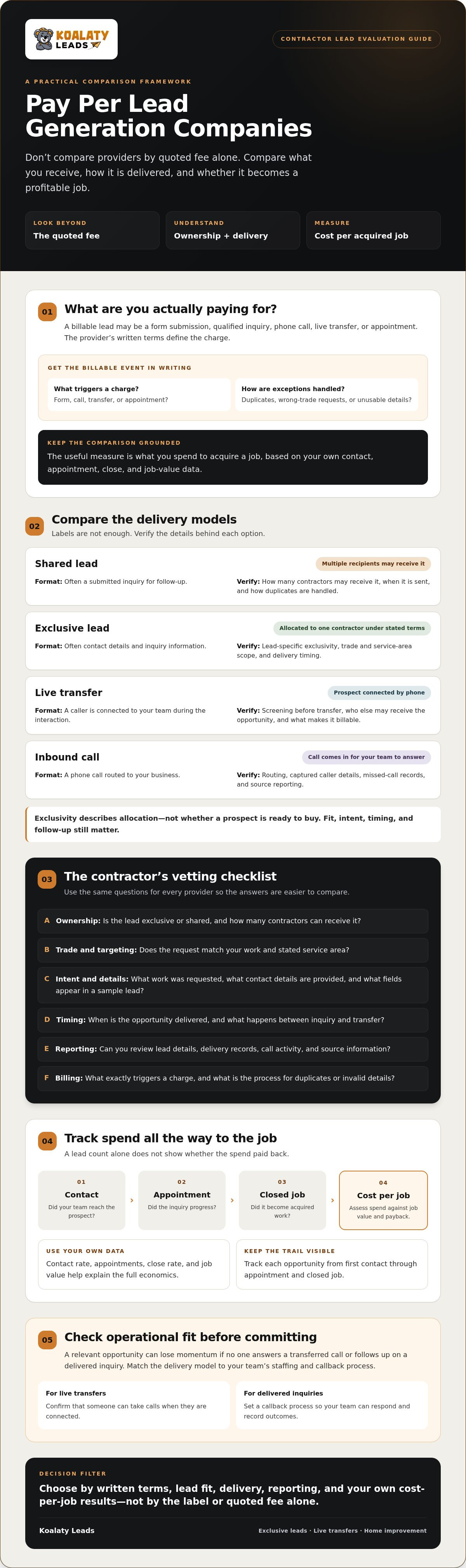
Check operational fit before you commit to a lead company
A lead can match your trade and service area but still go cold if your team can’t answer, qualify, estimate, and follow up. Before choosing a provider, match the expected lead flow to the people and process you have available to work it.
Use a practical sequence: set your team’s capacity, define the jobs you want, choose a delivery format, run a controlled test, then review the results. A contractor focused on roofing replacement, for example, may need different qualification details and follow-up steps than a business pursuing broader home improvement lead options. The provider’s roofing lead services can help illustrate how trade fit should shape your evaluation.
Match lead delivery to sales capacity
Start with the workflow. Decide who answers incoming calls, how new inquiries are assigned, and who owns the next follow-up if the first contact doesn’t connect. If your team is estimating or working on job sites, establish a reliable way to record and return calls.
Choose a format your team can handle consistently. A live transfer requires someone ready to take the call; a form submission requires a clear callback process. Set an internal response target that fits your staffing, then track whether the team follows it. No universal response window guarantees a conversion.
Use a controlled evaluation period
Define the test before the first lead arrives. Agree on the trade, target job types, service area, delivery format, and outcomes you’ll track. Keep the scope focused enough to identify what’s working, but review enough lead records to spot recurring patterns instead of reacting to a single result.
Use consistent status definitions in your CRM or tracking sheet, such as received, contacted, appointment set, estimate completed, won, and lost. Record reasons for disqualification or loss when your team can identify them. This helps distinguish lead-fit issues from missed calls, delayed follow-up, or gaps in the sales process.
Review records and outcomes together. If relevant inquiries aren’t becoming conversations, examine call handling and callback ownership before changing the targeting. If contacts are happening but the jobs don’t fit, revisit the requested work, geography, and qualification details. Make changes based on observed results, not assumptions.
Choose a pay per lead partner around your trade and growth goals
The right partner is one whose written terms, lead format, and targeting fit the work your business wants and the sales process your team can support. Verify what counts as a billable lead, choose a delivery model your team can handle, and judge performance by cost per acquired job rather than lead count alone.
Koalaty Leads provides exclusive leads and live-transfer options for home improvement and home service contractors. These formats can suit different workflows: an exclusive lead is allocated to one contractor under the provider’s terms, while a live transfer connects a caller to a team member ready to take the call. Neither format guarantees a sale or a specific return.
When exclusive leads or live transfers may fit
Exclusive delivery may suit contractors who want an opportunity allocated to one contractor rather than distributed to multiple businesses. A live transfer may work for a team with someone available to answer and qualify a connected call. If your staff is often estimating or working on job sites, confirm how calls are handled and whether another lead format better fits your coverage.
Trade requirements matter, too. An HVAC contractor, for example, can assess HVAC lead options by considering the intended services, target jobs, and service area. Compare what’s offered with your own requirements, not a general promise of quality or conversion.
What to prepare for a provider conversation
Bring the details that will help you assess fit and clarify terms:
- Trade and target jobs: Specify the work you want inquiries for, including the projects your team can take on.
- Markets served: Identify the service areas you’re prepared to cover and ask how targeting is defined.
- Sales capacity: Explain who can answer calls, qualify prospects, schedule appointments, and follow up.
- Tracking measures: Bring your current contact, appointment, close, and cost-per-acquired-job measures, if available.
- Delivery format: State whether your team can consistently work form leads, inbound calls, or live transfers.
Ask the provider to explain applicable billing, qualification, delivery, and reporting terms directly. Review those details alongside your team’s capacity, then track inquiries through appointments and acquired jobs to see whether the economics support your goals. This gives you a grounded way to compare pay per lead generation companies without relying on assumptions.
Choose a lead partner you can measure
Evaluate pay per lead generation companies by the terms behind each lead, the delivery format your team can support, and the results that matter to your business. Lead volume and cost per lead are only part of the picture. Track contact, appointments, closed jobs, and cost per acquired job to see whether the investment fits your goals.
Koalaty Leads provides exclusive leads rather than shared leads, with options including pay-per-call, live transfers, and inbound calls. Before choosing a format, confirm how it works for your trade and market, what counts as billable, and how your team will follow up and measure outcomes. Clear terms and consistent tracking help you make an informed decision.
Bring your target jobs, markets, sales capacity, and current tracking process into the conversation. You can discuss which options may fit your business without making assumptions about price, lead volume, or results.
With a clear process and the right measurements, you can make lead decisions with confidence and build toward growth that works for your team.
Frequently Asked Questions
What does a pay per lead generation company do?
A pay per lead generation company delivers prospective-customer inquiries to a contractor and charges according to an agreed billable event. That event might be a form submission, qualified inquiry, call, or transfer, depending on the provider’s terms. Before buying, confirm what information comes with each opportunity, how it’s delivered, and how duplicates or inquiries outside your trade are handled. The provider supplies opportunities; your team still qualifies, follows up, and sells.
How much do pay per lead generation companies charge?
There’s no single price that applies across trades and delivery formats. A provider’s quote may depend on whether leads are exclusive or shared, how they’re delivered, and what qualification is included. Ask for an itemized explanation of the charge and the event that triggers billing, then compare it with your contact, appointment, close, and cost-per-acquired-job results. Koalaty Leads can discuss applicable terms for your trade and market directly.
Are exclusive leads better than shared leads for contractors?
Exclusive leads go to one contractor under the provider’s stated terms, while shared leads may be distributed to multiple contractors. Exclusive delivery can mean less direct competition for the same inquiry, but it doesn’t guarantee that the prospect fits your work or becomes a job. Compare ownership, prospect intent, timing, and your team’s follow-up capacity. Koalaty Leads provides exclusive leads rather than shared leads.
What should I ask a pay per lead company before signing up?
Ask how the provider defines a qualified lead, exclusivity, and a billable event. Confirm whether you’ll receive forms, inbound calls, or live transfers, what details accompany each opportunity, and what reporting is available. Ask how duplicate, wrong-trade, or incomplete inquiries are reviewed. Read all applicable terms and commitments before agreeing. Don’t assume a credit policy, cancellation option, or other condition exists unless the provider confirms it in writing.
How do I calculate the ROI of purchased contractor leads?
Start with cost per acquired job: divide lead spend by the number of jobs won from those leads over the same period or cohort. Also track contact rate, appointments, close rate, and job value so you can see where leads progress or drop off. To assess return, compare revenue or gross profit from acquired jobs with lead spend and other relevant sales costs. Use your own results, not generic benchmarks.
Can live transfer leads work for a small contracting team?
They can fit a small team if someone is available to answer connected calls and handle the next sales steps. If your staff is often on job sites, estimating, or already speaking with customers, a live transfer may arrive when nobody can take it. Check your call coverage, assignment process, and follow-up tracking first. Koalaty Leads offers live transfers, but outcomes depend on fit and your team’s ability to respond.
How many pay per lead companies should I compare?
There’s no fixed number you need to compare. Build a manageable shortlist and ask each provider the same questions about ownership, format, qualification, delivery, reporting, and billing. Compare written terms and trackable outcomes, not just headline cost per lead. If proposals use different definitions, ask for clarification before ranking them. A consistent comparison helps you choose a model your team can work and measure.
Need exclusive leads instead of shared ones? Koalaty Leads delivers qualified homeowners — web leads or live call transfers — to one contractor only.
Get Started