
Pay Per Lead Agency Guide: Choosing Your Best Partner

A part-time test can work when the leads match your service area and your team can respond consistently. A pay per lead agency should explain what qualifies as a billable inquiry, how billing works, and how it handles credit requests. Geographic fit matters too: inquiries outside your coverage can take up time without creating viable opportunities.
A focused test can show whether the model fits your sales capacity and schedule. Clarify the terms before assessing results, and set up a practical way to track what happens after each inquiry arrives. That gives you a sound basis for deciding whether to continue, adjust, or pause.
This guide explains how pricing, lead qualification, credit policies, and billing can shape your choice of agency. It also covers how geographic targeting affects which leads your business can handle. Use the framework to consider a part-time start and assess whether the arrangement supports your growth goals, rather than treating lead volume alone as proof of value.
Key Takeaways
- Compare per-lead charges with subscriptions and retainers by weighing exclusivity, trade, and how payment aligns with performance.
- Look beyond lead volume: understand how leads are sourced, screened, and sold before judging whether they fit your sales process.
- Set clear eligibility, verification, credit, and billing rules to make disputed leads easier to assess.
- Match geographic targeting to the areas your crews can serve, and consider how landing pages and calls affect lead fit.
- Choose a buying model that suits your capacity to respond, including whether a focused part-time test makes sense for your business.
Compare Pay Per Lead Agency Pricing and Lead Costs
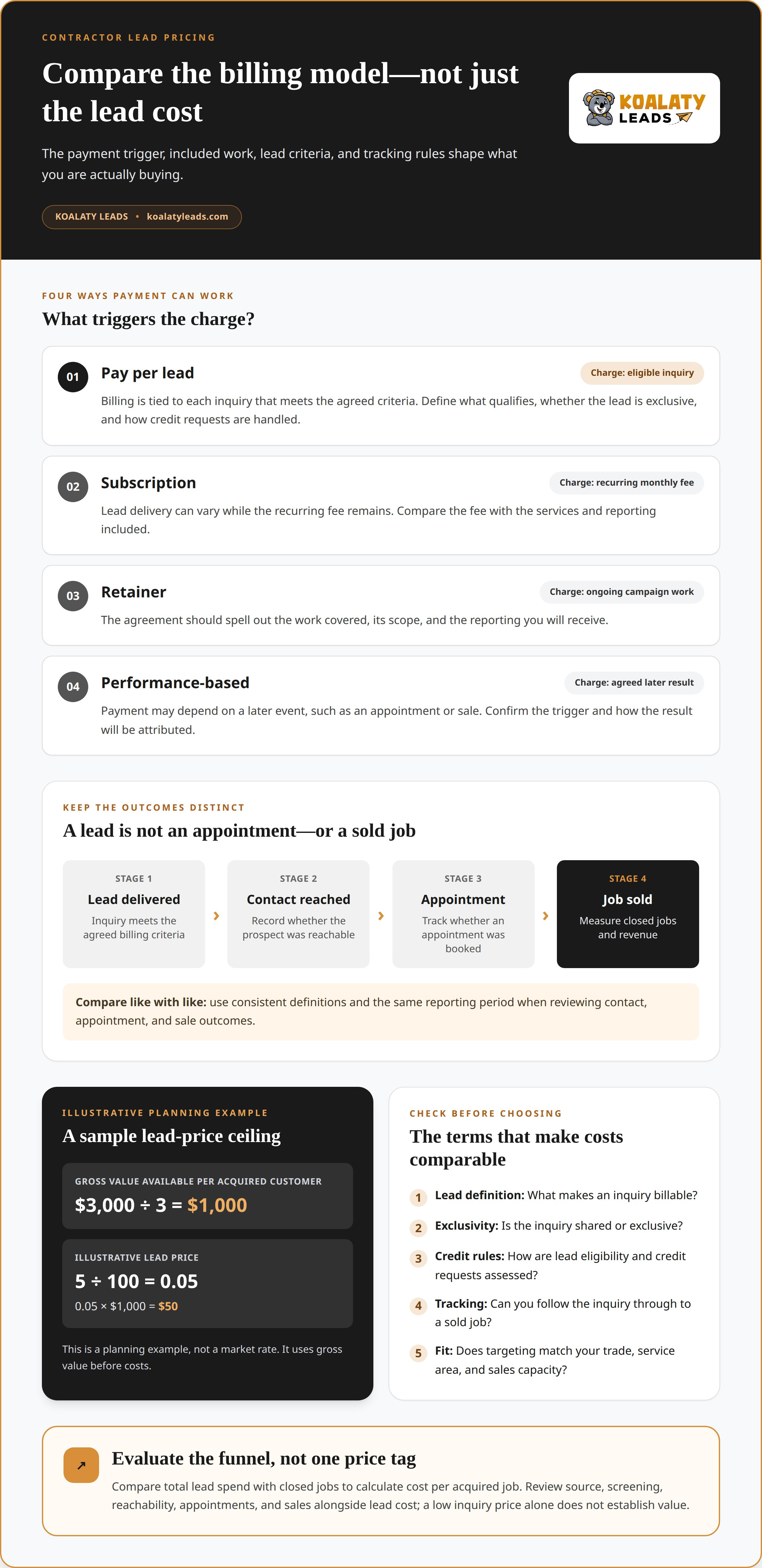
Pay-per-lead pricing charges for each lead that meets agreed billing criteria. Subscriptions and retainers instead charge recurring fees, so compare the payment trigger, work included, and performance measures before choosing.
A subscription gives a client a recurring monthly charge, even when lead delivery varies. A retainer usually covers ongoing campaign work rather than individual inquiries. Both can support predictable budgeting, but the contract should explain what work and reporting the fee covers. For example, compare the monthly commitment with your sales team’s capacity and the funnel activity you can track.
Performance-Based Pricing
Pay-per-lead pricing bills for an eligible inquiry, while performance-based pricing can tie payment to a later event, such as an appointment or sale. Koalaty Leads’ service model is strictly pay-per-lead. Define the billing trigger precisely: a delivered lead, booked appointment, and closed job are distinct outcomes with different attribution and tracking needs.
Industry and Exclusivity Pricing
Industry and exclusivity can change lead costs substantially, so prices in one trade are poor benchmarks for another. For example, exclusive personal injury leads range from $200 to $600 per lead, while shared personal injury leads range from $50 to $150. Mortgage refinance leads also differ: exclusive leads range from $25 to $75, compared with $8 to $20 for shared leads.
Exclusivity affects who receives an inquiry. Koalaty Leads delivers exclusive web leads and live inbound call transfers to one contractor, rather than sharing leads. Assess the cost against appointments and acquired jobs, not by treating the lowest inquiry price as the best value.
| Pricing option | Payment basis | Key comparison |
|---|---|---|
| Pay per lead | Each eligible inquiry | Lead criteria and exclusivity |
| Subscription | Recurring monthly fee | Fee versus included service |
| Retainer | Ongoing campaign work | Scope and reporting |
| Performance-based | Agreed later result | Attribution and trigger |
A simple calculation can help set a ceiling. In a hypothetical example, an average order value of $3,000 divided by three gives $1,000 as the gross value available per acquired customer before costs. If 5 out of 100 leads convert, the conversion rate is 0.05; multiplying 0.05 by $1,000 produces a $50 illustrative lead price. This is a planning example, not a market rate.
Choose by matching the agreement to your operating model. If you want costs tied to inquiries, examine the lead definition and credit terms. If you need predictable monthly spending, compare the subscription or retainer scope with the work delivered. In every case, use the same trade, sales outcome, and time frame when judging value.
How Agencies Source and Qualify Contractor Leads
Agencies generate contractor inquiries through channels such as Google search campaigns, referral partners, and lead-generation websites. Choose an agency that explains its sources, screening steps, billing criteria, and performance tracking; US lead generation can also involve rules covering marketing, calls, and personal information.
Lead Generation for Home Services
For a home-service business, lead generation turns demand for a specific trade into an inquiry a contractor can follow up on. A website might collect a roofing request, then screen for service type, location, and contact details before routing it. Those criteria help distinguish a usable prospect from an inquiry outside the contractor’s work or service area.
Agencies may generate inquiries through paid search, landing pages, or other campaign sources. Website design affects what the visitor understands and submits: a page focused on one service can ask relevant questions, while a broad page may attract mismatched requests. Ask for a clear description of the source and qualification process, not just a claim about lead volume.
Lead Quality and ROI Measurement
Measure the path from inquiry to revenue: record whether the lead was reachable, booked an appointment, and became a sold job. Compare outcomes by source and trade, then calculate cost per acquired job using total lead spend and closed jobs. This tests commercial value; a raw inquiry count only reports activity.
To measure quality and ROI, use consistent definitions for contact, appointment, and sale, then review the same reporting period. A lead priced at $25 is not automatically valuable; its return depends on conversion and job revenue. This example illustrates why buyers should assess the full funnel, not a single cost-per-lead figure.
Lead contracts can reward different behaviors. A seller paid for every submitted inquiry may prioritize volume, while a performance-based arrangement tied to appointments may favor appointment setting. Neither structure proves quality by itself: loose screening can inflate counts, and a narrow definition of success can overlook leads that need follow-up before converting.
Evaluate performance claims by asking what each result measures, which sources produced it, and whether it reflects your trade and market. Separate leads delivered from contacts reached, appointments set, and jobs closed. Compare like with like; a revenue claim without spend, attribution rules, or a stated conversion stage cannot show campaign return.
Before buying, clarify whether inquiries are exclusive or shared. Shared leads may be sold to 2 to 5 buyers, so speed and competition can affect your sales team’s opportunity to connect. Confirm that reports identify the source, submission details, and qualification outcome. Then assess whether the agency’s screening matches your own definition of a serviceable prospect.
Set Credit Rules and Resolve Lead Billing Disputes
Credit decisions depend on written eligibility criteria, documented lead details, and a consistent review process. Agencies serving specific US industries or local markets typically define their coverage by trade, audience, and service area.
Lead Verification and Qualification
Verification checks whether an inquiry contains usable information; qualification checks whether it matches the contractor’s business criteria. A valid phone number, for example, does not by itself show that the request matches the trade. Agree on how service type, location, and contact details fit your lead criteria.
Keep the submitted record and its source details available for review. A timestamp, service request, and location can help explain how a lead was qualified. Verification establishes whether information is usable, while qualification establishes whether the inquiry fits the agreed audience.
Lead Screening
Screening applies the agreed criteria before delivery or during a later billing review. A local business might accept inquiries only for certain services and service areas. In that case, a request for a different trade or an excluded location may be ineligible, while a qualified prospect who doesn’t answer is a sales outcome, not automatically a screening failure.
Clarify how duplicates, missing details, and mismatched requests are handled. For instance, two submissions from one prospect may need a different ruling from two people at one property. Consistent categories make tracking more useful and give both sides the same basis for assessing billing questions.
Agency Risks and Complaints
Common concerns include duplicate inquiries, poor contact details, unclear screening, and disagreement over credits. Volume alone can hide these problems: a campaign may deliver many records without enough qualified opportunities. Ask how the agency records lead source and screening results, and how its billing review distinguishes an invalid inquiry from a prospect who simply doesn’t convert.
Before delivery starts, document what qualifies for a credit, what evidence supports a request, and how the decision appears on an invoice. Specify whether the review covers wrong-service requests, out-of-area inquiries, duplicates, or invalid contact details. Keep sales results separate from eligibility: a lost job does not by itself show that the inquiry failed the criteria.
Pay-per-lead and retainer models also create different billing questions for local businesses. A per-lead charge depends on the agreed definition of an eligible inquiry. A retainer pays for an ongoing scope of campaign work, so clarify what that scope includes and how activity is reported. In either model, track spend and acquired jobs separately to understand their effect on profit and growth.
For a disputed charge, compare the record with the written criteria. Review the requested service, location, contact details, and available submission information. Then classify the issue before deciding: a wrong trade is different from an unanswered call. A consistent process gives billing discussions a clear basis.
Target the Right Geography for Home Improvement Leads
Geographic targeting determines whether an inquiry falls inside the area your crews can serve. A precise market definition connects traffic, landing pages, phone calls, and billing to real service boundaries.
Define the locations your business can serve and match incoming lead locations against that coverage. Contact Koalaty Leads to confirm available coverage and applicable terms for your market.
Search intent and job location can differ. Someone may search while away from home or submit a request for a property outside your coverage. For a roofing inquiry, the property address matters more than the searcher’s current location. Specify which location field determines eligibility so the lead’s geography can be assessed consistently.
Traffic targeting shapes who reaches an offer. When reviewing lead records, compare each property location with the areas your business can serve. Confirm coverage and applicable terms with Koalaty Leads before deciding whether a market fits your business.
Landing pages should make geography clear before someone submits an inquiry. A page naming a service area can help set expectations, but its claims should match the contractor’s real coverage. For example, a page should not imply coverage across an entire state if crews only serve selected communities. Local relevance matters; accurate boundaries matter more.
Phone calls need the same geographic logic as form submissions. A caller may ask about a property outside the target area, so the call’s eligibility should depend on the agreed service boundary and requested work. Clarify whether a call is billable based on its originating area, the property location discussed, or another defined criterion.
“Only pay” has value only when the payable event and eligible territory are defined. Specify whether a charge applies to every inquiry, only to inquiries within listed locations, or to leads meeting additional qualification rules. Separate an out-of-area request from an in-area prospect who does not book. Those outcomes are different, even if neither becomes a job.
Use a simple market review before launch: map serviceable communities, identify excluded locations, align landing-page language, and confirm how phone calls and forms record property location. Then review delivered leads against that map. If your business adds or removes service areas, update the targeting and page language together, so incoming demand still fits current crew coverage.
The key takeaway: match lead locations to the work your crews can serve, and track how each inquiry progresses through your sales process. Geographic fit helps you judge whether paid demand represents workable opportunities, not just inquiries associated with a familiar place name.
Talk With Koalaty Leads About Exclusive Leads and Live Transfers
Koalaty Leads helps contractors connect lead purchasing with their trade, market, and sales process. Its exclusive web leads and live inbound call transfers offer distinct ways to receive opportunities, whether your team prefers to follow up on a submitted inquiry or speak with a caller directly.
The right lead format depends on how your team handles new demand. A contractor with staff ready to answer calls may value live inbound call transfers, while a business that manages inquiries through its own sales process may prefer exclusive web leads. Choose the contact method your team can handle consistently.
Trade fit matters, too. Koalaty Leads offers home improvement lead services for contractors across relevant specialties. For example, roofing, window replacement, bathroom remodeling, and kitchen remodeling each involve different customer requests and sales conversations. A lead should match the work your company is equipped to sell and complete.
Before discussing leads, define the market you serve and the kind of inquiry your team wants. Consider the services you want to grow, your coverage, and whether live inbound call transfers or exclusive web leads better fit your follow-up process. These details make the conversation specific to your business, rather than a generic discussion about lead volume.
Align the lead criteria with your sales workflow. An inquiry should reflect the trade and location you’re targeting, while your team’s follow-up determines whether it progresses to an appointment or job. Clear criteria help you assess performance using outcomes that matter to your operation.
Billing and credits deserve the same attention. Discuss how a lead is defined, how exclusivity applies, and how inquiries outside the agreed criteria are handled. Clear terms help distinguish a mismatch in trade or geography from an in-area prospect who simply does not move forward.
For a part-time start, consider whether your schedule allows you to follow up during the periods you can take on new opportunities. Live inbound call transfers require someone ready to handle a call; exclusive web leads need a dependable response process. Choose the approach that fits your current capacity, then evaluate it against your sales results.
Koalaty Leads provides exclusive web leads and live inbound call transfers for contractors. Bring your trade, coverage, preferred contact method, and lead criteria into the conversation. These details give you a clear basis for discussing how the pay-per-lead model fits your operation.
Talk with Koalaty Leads about exclusive leads or live transfers for your trade and market.
Frequently Asked Questions
Can a contractor test pay-per-lead leads part-time?
Yes, a contractor can start part-time if someone can handle inquiries during the agreed delivery periods. Set a manageable lead pace, assign follow-up ownership, and track whether each inquiry receives a prompt response. For example, a contractor with limited weekday availability should avoid accepting calls when nobody can answer. Judge the test by qualified conversations and booked appointments, not lead count alone.
What tools does a contractor need to manage pay-per-lead leads?
A basic setup includes a customer relationship management system, a call log, and a way to track lead source and outcome. Record each inquiry’s arrival, response attempt, contact result, appointment, and sale. A spreadsheet can work at low volume if one person updates it consistently; a CRM becomes more useful when multiple salespeople need clear ownership and shared records.
How can a contractor estimate profit from pay-per-lead leads?
Estimate profit by subtracting lead spend and job delivery costs from revenue generated by jobs attributed to those leads. Track the path from inquiry to sale, then compare the result with leads from other sources. Include labor, materials, and sales costs when calculating job contribution. A channel can produce revenue yet still underperform if its acquired jobs leave too little profit.
Why might a contractor stop using pay per lead?
A contractor may stop if the leads repeatedly fall outside the company’s trade, service area, or sales capacity, or if acquired jobs fail to justify the spend. Changes in staffing or seasonal workload can also make a lead source harder to manage. Before ending a campaign, review outcomes by source and lead type; a mismatch in targeting may call for a different setup.
What is a pay per lead agency and how does it work?
A pay per lead agency generates inquiries for businesses and charges according to an agreed definition of a billable lead. For contractors, that definition can cover the requested service, contact details, and location. Koalaty Leads provides exclusive web leads and live inbound call transfers for home improvement contractors. The contractor’s team follows up and works each opportunity through its sales process.
How much do pay per lead agencies charge in the United States?
There is no single rate across agencies, trades, lead sources, and qualification terms. Koalaty Leads lists exclusive leads at $45-$175 per lead; its price depends on the service and targeting. Organic and paid search leads start at $150 /CPL and may increase based on demand. Treat these as Koalaty Leads pricing, not a universal market rate or a quote for every campaign.
What factors affect pay per lead pricing by industry and lead type?
Pricing can vary with the trade, exclusivity, source, qualification criteria, and geographic demand. A live inbound call transfer differs from a web inquiry because the contractor receives a call rather than a submitted form. Search intent and targeting can also affect the rate. Compare options using the same trade, lead format, qualification rules, and billing definition to understand what each charge covers.
How do pay per lead agencies generate and qualify leads?
Agencies can attract inquiries through advertising and online forms, then screen submissions against agreed criteria before delivery. Koalaty Leads qualifies leads through a 13-point stack and provides exclusive opportunities, including web leads and live inbound call transfers. For a contractor, the practical distinction is whether the inquiry matches the work and market being targeted, and whether the team can follow up effectively.
Need exclusive leads instead of shared ones? Koalaty Leads delivers qualified homeowners — web leads or live call transfers — to one contractor only.
Get Started