
Painting Lead Generation: Pro Strategies for More Jobs

A qualified painting lead is a reachable prospect whose project fits your business and is worth a sales conversation. Effective painting leads generation is about creating opportunities your team can pursue, not simply collecting names. The distinction matters: a full pipeline only helps when the inquiries align with the work you want to book and your capacity to handle it.
You need a clear way to judge where prospects come from and what happens after they raise their hand. This article explains how local visibility can put your business in front of painting prospects, how exclusive and shared distribution affect the sales process, and which lead-generation approaches contractors can use. It also covers the costs that shape payback, including the difference between paying for an inquiry and measuring the expense of winning a job. Use these points to assess whether a source supports your sales goals and gives your team opportunities that fit its painting services.
Key Takeaways
- Assess lead quality by project fit, service area, timing, and whether the prospect is ready to discuss an estimate.
- Build local visibility with accurate business listings, useful project photos, and a steady stream of customer reviews.
- Compare exclusive and shared opportunities by competition, speed of follow-up, and how much sales effort each requires.
- Track the path from first contact to booked job so you can judge lead sources by acquisition cost and payback, not lead price alone.
- Explore whether exclusive leads or live transfers fit your painting business and market.
How painting leads generation works through local marketing
Local marketing connects painting contractors with prospects already looking for nearby help. A useful foundation includes an up-to-date Google Business Profile, clear service details, and a website that makes it easy to request an estimate. Keep your business name, phone number, hours, and service locations consistent across profiles. Conflicting information can make prospects hesitate or send them to the wrong business.
Local SEO helps search engines match a business with relevant searches. Create website pages for the painting services and locations you actually serve, and keep those details aligned with directory listings. Separate pages for interior and exterior work clarify your focus. The goal is not broad traffic, but visibility among people whose project and location fit your business.
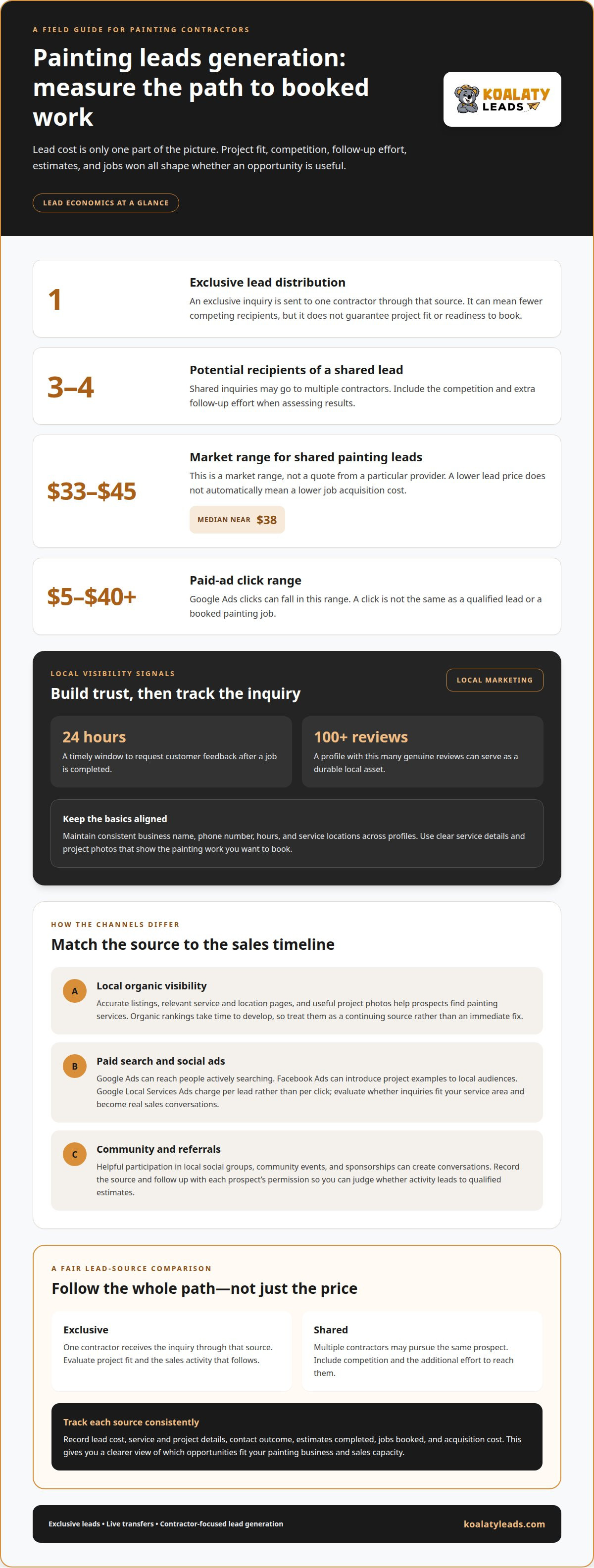
Project photos give prospects a concrete reason to consider a painting business. Use clear examples of completed interior and exterior jobs, with captions that identify the service and general project context. Reviews add another signal: requesting feedback within 24 hours of job completion gives customers a timely prompt. A profile with 100 or more reviews can serve as a durable local asset, provided feedback is genuine.
Google Ads can reach people actively searching for painting services, while Facebook Ads can introduce project examples to local audiences. Paid-ad clicks can range from $5 to $40 or more. Google Local Services Ads charge painting contractors per lead rather than per click. Their value depends on whether the inquiry fits the service area and turns into a real sales conversation.
Local social media groups can create referral opportunities through useful participation. Answer painting-related questions, share a relevant project example when group rules allow, or respond when a member asks for contractor recommendations. Avoid treating each group as an advertising board. A specific, helpful response is more likely to start a direct conversation than repeated generic promotions.
Community events and sponsorships can build face-to-face visibility among local residents. You might sponsor a neighborhood event or attend a home improvement gathering, then record inquiries and follow up with each prospect’s permission. Connect every conversation to the event in your tracking system. This lets you assess whether sponsorships lead to qualified estimates, rather than counting attendance alone.
Contractors assessing painting lead services can consider how local channels fit alongside purchased opportunities. Local organic rankings take time to develop, so they work best as a continuing source rather than an immediate fix. Review inquiries by source, service type, and estimate outcome. That record helps distinguish useful local visibility from clicks, profile views, or conversations that never become sales opportunities.
Exclusive versus shared painting leads
An exclusive painting lead goes to one contractor. A shared lead is distributed to multiple contractors, sometimes three or four. That difference affects who else may contact the prospect, how your salesperson prioritizes the inquiry, and how much follow-up may be needed to start a conversation.
Exclusive distribution means other contractors do not receive that inquiry through the same source. It does not establish whether the prospect is ready to book or whether the project fits your crew. For example, a lead for commercial interiors may not suit a business focused on residential exterior work. Project fit still depends on the information collected and your qualification process.
| Factor | Exclusive lead | Shared lead |
|---|---|---|
| Distribution | Sent to one contractor | Sent to multiple contractors |
| Competition | Fewer recipients competing through that source | Other recipients may pursue the same prospect |
| Qualification | Depends on project details and intake | Depends on project details and intake |
| Evaluation | Measure fit and resulting sales activity | Include competition and follow-up effort |
When an inquiry goes to multiple contractors, sales managers should account for that competition when evaluating performance. A prospect receiving several calls may be harder to reach than one handled through a single contractor’s sales process. Measure outcomes from the source through to booked work, rather than judging a lead by its arrival alone.
Market pricing for shared painting leads ranges from $33 to $45, with a median near $38. Treat that as a market range, not a quote from a particular provider. A lower per-lead amount doesn’t necessarily mean a lower cost to acquire a job. Include staff time, attempts to reach prospects, estimates completed, and sales won when comparing lead sources.
Qualification and distribution are separate questions. A shared lead can include useful details, while an exclusive lead can still lack enough information to establish fit. For either model, assess whether the inquiry identifies the service needed, location, project scope, and next step. These details help your team decide whether to schedule an estimate or direct its sales effort elsewhere.
Choose a model that matches your team’s capacity and sales approach. A contractor equipped to handle several inquiries at once may find shared distribution workable. A business seeking fewer competing recipients may prefer exclusive distribution. Compare results using consistent records: lead cost, contact outcome, estimates, jobs booked, and acquisition cost.
Focus your review on the work each source produces. For example, separate residential repaint requests from commercial project inquiries in your sales records, then compare which category advances to estimates and booked jobs. This helps distinguish a distribution issue from a mismatch in service type or sales handling. Base the comparison on your own completed lead-to-job tracking.
That makes distribution terms worth clarifying before you choose a model: shared inquiries may reach 3 or 4 competing painters, while exclusive delivery limits recipients through that source. Match the arrangement to your ability to respond promptly, qualify prospects, and maintain follow-up, then compare resulting booked work with the effort required.
What are the best ways for painting contractors to have leads generated?
Painting leads generation works best as a balanced pipeline, not a single source of inquiries. The Home Improvement Research Institute’s 2019 survey found that 88% of contractors get job leads through word of mouth. Pair referral activity with a paid source or steady follow-up on past customers, then track which channels produce estimates and booked work.
Build a referral process around completed projects. A provider can follow up with the customer, thank them, and make it easy to recommend the painting business to someone planning similar work. Painting referrals have been reported to convert between 30% and 50%, so record them separately from purchased leads. That distinction helps owners assess which opportunities deserve more sales attention.
Purchased leads can extend your reach beyond an existing customer network. Before assessing a source, define the work you want, such as residential exterior repainting or commercial interiors. Then track whether inquiries match those criteria and progress to estimates. Painting leads generation is more useful when the source aligns with the work your contractor accepts.
Lead handling shapes results after an inquiry arrives. Contacting a lead within five minutes can make a business as much as 21 times more likely to convert it than waiting 30 minutes. Set a clear handoff so someone on the sales team owns each new inquiry, records the conversation, and notes the next step. Use the same process across channels for a fair comparison.
Measure more than the number of estimates. Painters commonly quote 10 jobs to book three or four from purchased leads, while a separate example uses a one-in-eight close rate for purchased painting leads. These are different benchmarks, not a promise of what any contractor will achieve. Compare your own results by source, including contact, estimate, and booked-job outcomes.
Referrals, purchased inquiries, and customer reactivation each play different roles. A referral may arrive with trust already established, while a purchased inquiry may need more qualification before an estimate. Use consistent source labels in your sales records. This gives managers a clearer view of how each channel contributes to the pipeline and where follow-up time goes.
For a new painting business, pair an immediate inquiry source with longer-term website and SEO work. Starting both in the same month begins the organic ranking process while other channels can supply current opportunities. Review results monthly and adjust for the services your crews want to book. A measured mix builds your pipeline around actual estimates and sales, not lead volume alone.
How much does it cost to generate a painting lead?
There is no single fixed cost for a painting lead. The source, service area, competition, and billing model all affect the amount. A shared inquiry, an exclusive inquiry, a paid search click, and a booked estimate are different cost units. Compare them by the work they produce, not as interchangeable prices.
Paid search can charge for attention before a prospect becomes a lead. Clicks for painting-related paid advertising can range from $5 to $40 or more. A click may not produce contact details, a conversation, or an estimate. Google Local Services Ads bill painting contractors per lead rather than per click, so compare the actual billing unit before judging either channel.
Exclusive lead costs need to be considered in context. With shared inquiries, several contractors may compete for one prospect; an exclusive inquiry goes to one contractor. The purchase price alone does not show which model costs less per acquired job. Compare inquiries reached, qualified prospects, estimates set, and jobs won for each source.
| Cost measure | What it counts | Why it matters |
|---|---|---|
| Cost per click | A visit from a paid advertisement | Some visitors won’t submit an inquiry. |
| Cost per lead | An inquiry received through a channel | Lead fit and contactability affect its value. |
| Cost per estimate | Acquisition spend divided by estimates completed | Shows the expense of reaching a sales conversation. |
| Cost per acquired job | Acquisition spend divided by jobs won | Connects marketing expense to booked work. |
Use the same calculation for each channel: divide its total spend by the jobs attributed to it. Include advertising spend and lead charges in the channel total, then divide by the resulting booked jobs. Track contact and appointment rates along the way. If a source generates inquiries but few prospects answer or schedule, the cost per acquired job can rise even when each lead appears inexpensive.
Job value and margin determine whether the acquisition cost can pay back. Compare the cost of winning a job with the revenue and expected margin from its scope. A large exterior project and a smaller interior repaint may support different acquisition costs. Use completed-job records, not quoted amounts, to review actual return.
Keep the comparison window consistent across channels. Review each source monthly, separating new inquiries from estimates and won work. Seasonal shifts can change the mix of exterior and interior demand, so compare similar periods where possible. This gives owners a clearer view of whether lead spend supports booked painting jobs or merely creates activity.
On lead-generation platforms, shared painting leads can cost tens of dollars, with the vendor and metropolitan area affecting the exact price. Treat that figure as a starting point, not a measure of value: a shared inquiry may go to several contractors, while an exclusive inquiry goes to one. Before comparing offers, confirm whether the charge covers an inquiry, an estimate, or another billing unit. Then track the spend and resulting jobs under the same channel to keep the comparison tied to booked work, not the headline lead charge.
Discuss lead needs for painting contractors
Painting contractors evaluating lead options can discuss their needs with Koalaty Leads. The right fit depends on the work you take on, where you operate, and how your team handles new inquiries. Start with your business need: more estimate opportunities, closer alignment with your painting services, or a direct conversation with an interested prospect.
An exclusive web lead is delivered to one contractor rather than competing recipients. A live inbound call transfer connects a prospect and your team by phone, giving your salesperson a chance to discuss the project directly. Neither format replaces qualification. Your team still needs to establish whether the prospect’s location, project type, and timing match your business.
A useful discussion starts with your operating details. Identify the locations you serve, whether your focus is residential or commercial painting, and whether you want interior, exterior, or both project types. Explain how your sales team handles calls and estimates, too. These details frame a conversation around opportunities that fit your actual capacity, rather than a generic target for more inquiries.
Consider timing and scheduling as well. An exterior-focused contractor may want prospects whose project plans fit the upcoming work season, while an interior team may want to maintain estimate activity during quieter periods. Clarify which project scopes your crews accept and which inquiries are a poor fit. This sets practical boundaries without assuming every prospect is ready to book.
Set a consistent way to assess results before adding a new source. Track each inquiry, whether your team reached the prospect, whether an estimate was scheduled, and whether the job was won. Compare those outcomes with your existing channels and available sales capacity. A lead’s usefulness comes from its fit and the work it can produce, not merely from arriving in your inbox or on your phone.
Koalaty Leads also serves contractors in Roofing, Windows, Bathroom Remodeling, Gutters, Siding, HVAC, Kitchen Remodeling, Flooring, Solar, and Walk-In Tubs. For a painting business, keep the conversation centered on painting projects, your market, and the lead format you want to evaluate. Share clear information about your services and sales process, then ask whether exclusive opportunities or live inbound call transfers are available for your trade and market.
If you’re ready to discuss lead options for your painting business, contact Koalaty Leads to ask what may be available for your trade and market.
Frequently Asked Questions
What makes a painting lead "qualified"?
A qualified painting lead matches your service area, accepted project types, and ability to take on the work. It should also give your team a usable path to discuss the prospect’s needs, such as the type of painting requested and preferred next step. Koalaty Leads qualifies leads through a 13-point stack. Ask how the provider’s qualification process distinguishes a workable opportunity from a contact that doesn’t fit your business.
Can you target residential vs commercial painting?
Yes, residential and commercial painting can be distinct targeting criteria because they involve different project scopes and sales conversations. Specify the work your crews accept, such as residential interior repainting or commercial exterior projects. Koalaty Leads offers custom filters, so discuss how your preferred project type should shape the criteria. Keep your intake and sales process aligned with the work you are prepared to estimate.
Tired of racing three painters to the same phone?
Choose exclusive lead generation rather than shared distribution. Koalaty Leads delivers exclusive web leads and live inbound call transfers, not shared leads. Exclusive delivery means other contractors do not receive the same inquiry through that source, but it does not replace prompt, professional follow-up or project qualification. With a live inbound call transfer, your team can speak with the caller directly and establish whether the request fits your services.
How can a provider use Google Business Profile and local SEO to generate painting leads?
You can support local discovery by keeping your Google Business Profile and website information consistent, with accurate services and service areas. Location-focused pages can clarify whether your business handles interior painting, exterior work, or both. Relevant project photos and authentic customer reviews help prospects assess your business before contacting you. Treat local SEO as a longer-term channel, and track whether organic inquiries become qualified estimates.
How can a provider use referrals and reviews to generate painting leads?
Make referrals easier by giving past customers a clear way to recommend your painting business and inviting genuine reviews after completed projects. For example, a follow-up message can thank a customer and invite honest feedback without scripting praise. Record referral and review inquiries by source, then track them through contact, estimate, and booked job. This shows which relationships produce suitable work.
How can painting contractors assess lead qualification and follow-up when choosing a lead provider?
Ask how the provider screens each inquiry, what project details accompany delivery, and how quickly the lead reaches your team. Koalaty Leads uses a 13-point stack for qualification and provides exclusive web leads or live inbound call transfers. Compare the information received with your actual intake needs, such as project category and service-area fit. Then track contact attempts, scheduled estimates, and closed work using the same process for each source.
Need exclusive leads instead of shared ones? Koalaty Leads delivers qualified homeowners — web leads or live call transfers — to one contractor only.
Get Started