
Master Lead Generation for Home Improvement Success

Master Lead Generation for Home Improvement Success Lead generation for home improvement works best when each opportunity matches your trade, service area, and project capacity. Measure results by signed jobs, not lead volume alone. To see whether a channel pays off, compare its cost with your cost per acquired job and track contact, appointment, estimate, and close rates.
It’s reasonable to question whether lead-generation services are worth the spend. The answer depends on how well the leads fit the work you want and how reliably your sales process turns conversations into jobs. This article explains how local targeting and project matching shape lead quality, what affects acquisition costs, and which conversion metrics reveal where a campaign is working or losing momentum. You’ll also see how exclusive leads and live transfers fit into a contractor’s options, so you can make a decision based on trade, market, and measurable results rather than lead volume alone.
Key Takeaways
- Assess a lead program by how it manages campaign testing, lead flow, and spending, not just by its lead count.
- Compare exclusive, shared, and marketplace models by competition for each opportunity and how costs are charged.
- Match campaigns to your trade, service area, and project criteria so inquiries are more relevant to your business.
- Track each stage from first contact through estimate and sale to identify where prospects drop off.
- Consider Koalaty Leads’ exclusive leads and live transfers as options for your trade and market.
How Lead Generation for Home Improvement Contractors Works
Lead generation for home improvement contractors works by attracting, qualifying, and routing inquiries according to trade, location, and project fit. Campaign controls and sales tracking then show whether those inquiries become profitable jobs.
Home Improvement Lead Generation Platforms
There’s no single best platform for every U.S. contractor. Google Ads, Local Services Ads, local search, social advertising, and aggregator marketplaces differ in targeting, lead ownership, and spending control. Compare how each channel defines a lead, whether inquiries are exclusive, and how results are tracked. When evaluating local SEO and Google Business Profile efforts, look for reporting on service-area fit, qualified calls, booked estimates, and attributable jobs, not rankings alone.
Lead Qualification and Follow-Up
Qualification starts with the details that determine whether an inquiry fits your business: requested project, location, timing, and contact information. Forms and call screening can capture these details before routing an opportunity. Your sales team can then record follow-up attempts, conversations, appointments, estimates, and outcomes in one tracking system. This sequence distinguishes uncontacted inquiries from genuine sales opportunities.
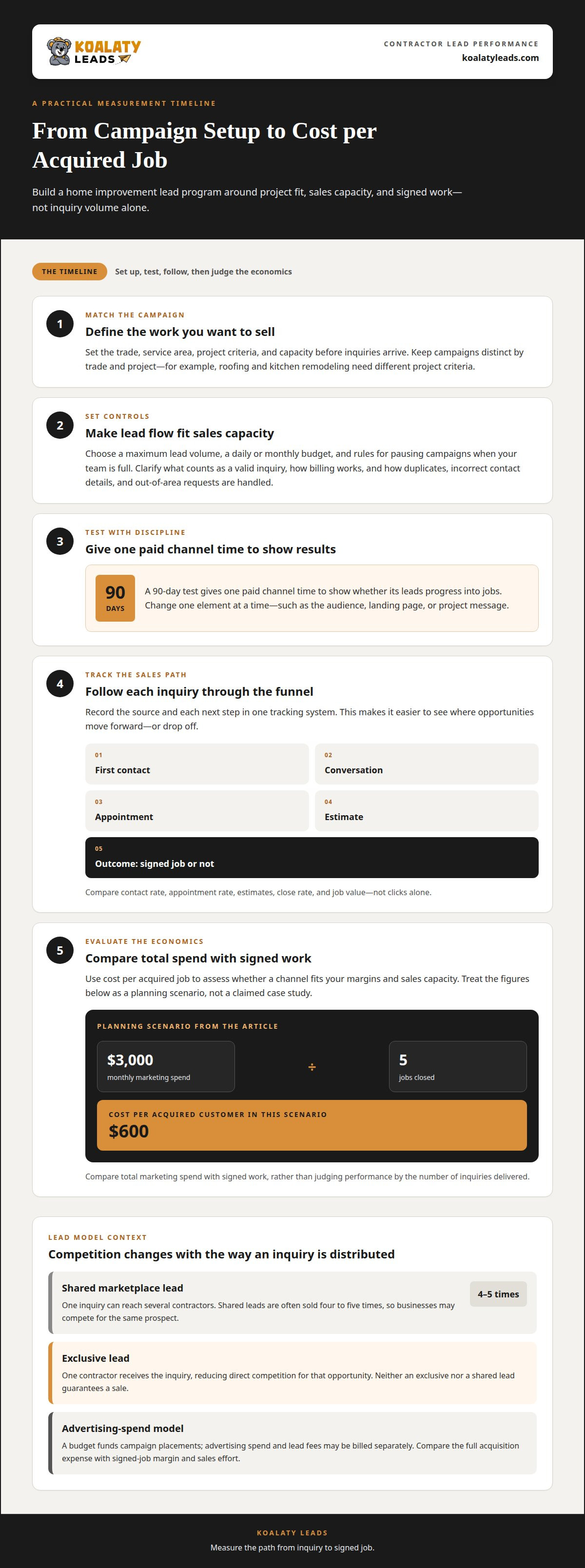
Campaigns can be tested by changing one element at a time, such as the audience, landing page, or project message. Track whether each change brings better-fit inquiries and booked appointments instead of judging results by clicks alone. For example, roofing and kitchen remodeling campaigns need different project criteria. Separate tracking helps identify which audience and message generate qualified opportunities.
Set spending controls before a campaign expands. A contractor can define a maximum lead volume, a daily or monthly budget, and rules for pausing campaigns when sales capacity is full. A 90-day test gives one paid channel time to show whether its leads progress into jobs. Compare total marketing spend with signed work, not simply the number of inquiries delivered.
Use a planning scenario to understand contractor economics, not as a claimed case study. A home improvement contractor spending $3,000 per month and closing five jobs has a $600 cost per acquired customer. Track lead source, contact rate, appointment rate, estimates, close rate, and job value. These steps show whether a channel’s cost fits your margins and sales capacity.
Are Home Improvement Lead Generation Services Worth It?
They can be worthwhile when the lead model fits your sales capacity and project margins. Contact rules depend on the channel and applicable federal and state requirements; lead records should preserve consent details and permitted contact methods.
Lead Purchase Evaluation Criteria
Before buying, understand what qualifies as a valid inquiry and how billing works. Clarify how duplicate records, incorrect contact details, and out-of-area requests are handled. Also understand how lead credits are assessed, whether each lead is exclusive, and what reporting is provided. These details help you judge whether the lead price reflects opportunities your team can pursue.
Project-Specific Remodeling Leads
Kitchen, bathroom, and basement leads aren’t interchangeable. A kitchen inquiry might concern cabinetry or a full renovation, while a bathroom request may describe a focused remodel. Basement projects can involve different scopes and sales conversations. Match intake questions and routing to the project, then assess whether inquiries suit your crews and estimating process.
Shared and Exclusive Lead Options
Aggregator marketplaces may distribute an inquiry to multiple contractors. Shared leads are often sold four to five times, so several businesses may compete for the same prospect. Exclusive leads go to one contractor, reducing competition for that inquiry. Neither model guarantees a sale, so compare billing terms, lead ownership, and the sales effort required.
| Model | How it works | Key trade-off |
|---|---|---|
| Shared marketplace lead | One inquiry can reach several contractors | More competition to make contact |
| Exclusive lead | One contractor receives the inquiry | Less direct competition, with no guaranteed sale |
| Advertising-spend model | Budget funds campaign placements | Spend and lead fees may be billed separately |
Local and Seasonal Lead Costs
Demand and acquisition costs can change with local competition, service area, project type, and season. When comparing markets, separate these factors instead of treating a national average as a reliable forecast. Seasonal conditions may affect when homeowners seek certain work, while competition influences campaign costs. Compare the same trade, geography, and lead definition across periods.
Clarify whether a quoted charge covers the lead, advertising spend, or campaign management. Then compare your total acquisition expense with signed-job margin and sales effort. This helps show whether a source is commercially viable, even if its headline fee seems attractive.
Targeted Local Advertising and Project Matching
Paid search and social ads can both generate home improvement inquiries, but they reach prospects differently. Google Ads can connect with people actively searching for a contractor, while Facebook and Instagram can introduce a project offer to a local audience. Measure both by qualified inquiries and booked appointments, not clicks alone.
Start with your service area. Set campaign boundaries your crews can cover, using cities, counties, or ZIP codes as appropriate. Then separate campaigns by trade and project, such as roof replacement, kitchen remodeling, or HVAC installation. Clear separation helps route inquiries to the right estimator and makes results easier to compare.
Search advertising responds to expressed intent. A person searching for a bathroom remodel contractor is signaling a different need from someone searching for roofing work. Match the ad and landing page to that query. The $30 to $100 or more per click figure should not be treated as an established benchmark without a source relevant to your market. Track inquiries and booked work rather than counting visits alone.
Facebook and Instagram advertising can place a project-specific message in front of a selected local audience. A campaign can invite interested people to submit a form or call. Keep the offer, intake questions, and destination page aligned. A kitchen remodeling ad should lead to a relevant inquiry path, not a generic page that focuses on another trade.
If you’re weighing paid campaigns against direct opportunities, Koalaty Leads offers exclusive leads and live transfers for contractors seeking opportunities matched to their trade.
Project matching depends on the details collected and how inquiries are routed. Capture the project type and service location, then connect the response with the appropriate sales team. A CRM or tracking software can record campaign source, appointments, and signed jobs. Accurate outcome tracking matters more than the dashboard used to organize the records.
Use the same business outcome to compare channels. Search traffic may bring clicks without suitable inquiries, while social campaigns may attract interest outside your project criteria. Review the source, project type, service-area fit, and sales outcome together. Then adjust keywords, audience settings, or intake questions to improve the match.
Keep targeting aligned with crew capacity. If your team has limited kitchen-remodeling capacity, focus campaign criteria on the projects it can pursue. The goal isn’t the broadest audience, but a clear path from relevant advertising to a sales-ready opportunity.
Google Ads is suited to reaching people actively searching for a contractor, while Facebook and Instagram can introduce project offers to a selected local audience. The best fit depends on the project and sales goal; compare platforms by qualified inquiries and booked appointments.
Without a provided source, the claims that U.S. spending on home upgrades was projected well over half-a-trillion dollars in 2024 and above $615 billion by 2029, or that contractors over $3 million yearly may devote 20% of marketing to Google Ads or Local Services Ads, should not be treated as established figures.
How Providers Target Home Improvement Leads
Campaigns can be targeted around the work you sell, the properties you serve, and your service area. Clear criteria distinguish suitable inquiries from homeowners seeking another project or a location your crews can’t reach.
Project type shapes the campaign. Separate roofing, kitchen remodeling, and HVAC inquiries instead of routing them through one broad home-services campaign. Specific messaging and intake fields identify the requested work, which matters when separate estimators or crews handle different projects.
Property details add another layer of fit. For example, a campaign can distinguish single-family homes from multifamily properties if your business serves only one category. You can also capture details relevant to the project, such as whether the homeowner wants a replacement or a larger remodel. These fields help determine whether an opportunity matches your capacity and sales process.
Budget qualification should connect the prospect’s expectations with the contractor’s project range. A remodel valued at $30,000 or more is one situation where Google Ads may make sense. Campaigns can state the type of work offered and use intake questions to identify project scope. This helps separate a full renovation inquiry from a request for a narrower service.
Location targeting should follow your actual service area, not broad regional labels. ZIP codes, cities, or selected counties can focus campaigns on reachable prospects. If you serve a limited radius, avoid paying for inquiries beyond that footprint. Location criteria also help route leads to the right branch or sales team.
Keep lead charges separate from advertising budgets. With pay-per-lead, you pay according to the agreed lead billing model; with paid advertising, the media budget funds placements such as Google Ads. Management fees may also be separate. Ask for itemized reporting that distinguishes media spend, provider charges, and leads attributed to each campaign.
Compare targeting by outcomes, not audience size alone. Track the source, project type, service-area fit, contact status, and resulting appointment for each inquiry. If a campaign attracts many homeowners but few eligible projects, adjust its location boundaries, project wording, or intake criteria. This gives the next campaign iteration a clear purpose.
Measure Contact, Appointment, Estimate, and Close Rates
Track each lead from the first contact attempt through a signed job. Separate contact, appointment, estimate, and close rates to identify where prospects drop away. A campaign can generate inquiries but still lose profitability if calls go unanswered or estimates don’t convert.
Start with contact rate: leads reached divided by leads received. Keep attempted calls, successful conversations, and unreachable contacts distinct in your CRM. Then calculate appointment rate using contacted leads as the denominator. Record booked and completed appointments separately so cancellations aren’t counted as sales opportunities.
Next, measure estimates issued against completed appointments. This shows whether qualified conversations advance to a written proposal. Track close rate from estimates to signed jobs, and also compare wins with leads your team actually spoke with. Home improvement contractors commonly close 15% to 35% of the leads they speak with. A rate above 50% may reflect exceptional performance or a warm-referral-only sample.
Use consistent definitions across sources and trades. For example, compare roofing inquiries with roofing inquiries, not kitchen remodeling leads that follow a different sales process. Tag each record by campaign, project type, and outcome. Review the same stages each reporting period to see whether contact, appointments, estimates, or closing needs attention.
Then connect conversion to acquisition cost. Divide campaign costs by signed jobs to calculate cost per acquired job, including applicable lead or advertising expenses. A planning example: with $4,000 gross profit per job and 15 percent allocated to acquisition, the maximum affordable acquisition cost is $600 per signed job. This is a planning limit, not a quoted lead price.
At a 20 percent valid-lead-to-job close rate, about five valid leads are needed per job. Under the same $600 acquisition limit, that works out to $120 per valid lead before sales labor and other campaign costs. Compare that threshold with your actual campaign economics, then account for estimates that don’t close.
Profitability depends on job margin, not close rate alone. A campaign with fewer appointments may still perform well if it produces higher-value signed work at an affordable acquisition cost. Review contact-to-appointment, appointment-to-estimate, and estimate-to-close results together before changing budgets or sales follow-up.
Talk With Koalaty Leads About Home Improvement Leads
Koalaty Leads gives contractors a way to explore exclusive home remodel leads and live transfers for their business. It can be a fit when you want opportunities aligned with your trade and market, without relying only on broad advertising campaigns or shared inquiries.
Start by defining what your sales team can handle: the projects you want, the service area you cover, and the kinds of conversations your team can take. A roofing contractor, for example, may prioritize replacement projects, while a remodeling company may focus on kitchen or bathroom opportunities.
Koalaty Leads offers roofing leads, window replacement leads, bathroom remodel leads, and kitchen remodeling leads. These examples show how a broad home improvement strategy can be organized around distinct project categories rather than one general contractor message.
Exclusive web leads and live inbound call transfers support different sales workflows. With an exclusive web lead, your team follows up on the inquiry directly; a live transfer connects a call to your business. Consider which format fits your staffing, availability, and follow-up process. The right choice depends on how your team responds and moves prospects toward estimates.
Before deciding, bring practical details into the discussion: your trade, target service area, project focus, and current sales capacity. Your contact rate, appointment rate, close rate, and cost per acquired job help frame the business outcome to evaluate. These measures keep the decision focused on signed work rather than lead count alone.
Koalaty Leads is a relevant option for contractors evaluating exclusive opportunities and live transfers alongside existing lead sources. A focused conversation can center on the work you want to pursue and how incoming opportunities fit your operation. Project fit and sales handling matter, so don’t treat every lead channel as interchangeable.
If you’re considering exclusive leads or live transfers for your trade and market, talk with Koalaty Leads.
Frequently Asked Questions
How often are the leads refreshed?
Live inbound call transfers are routed in real time, while web leads arrive as inquiries are submitted rather than on a scheduled batch refresh. For operational tracking, record each lead’s submission or transfer timestamp. Then distinguish new inquiries from aged records and duplicates in your CRM. This gives sales managers a practical way to review freshness and compare response outcomes by lead source.
What are the best lead generation strategies for home improvement contractors?
A strong lead generation strategy for home improvement contractors matches channel to intent and project. Google Ads can capture active searches, while Facebook and Instagram can introduce a project offer to a targeted audience. Separate campaigns by trade, then compare qualified appointments and signed jobs. Align campaigns with the work your sales team can handle instead of judging performance by clicks or inquiry volume alone.
How much do home improvement leads cost by source and service type?
Exclusive leads cost $45-$175 per lead, while organic and paid-search leads start at $150/CPL and may increase based on demand. Pricing varies with serviceable ZIP-code volume, so the source and campaign scope matter. Treat these as distinct pricing contexts, not interchangeable figures. Compare the applicable lead charge with any separate advertising-spend budget, then assess cost per signed job for the trade you sell.
What is the average conversion rate for home improvement leads?
There isn’t one conversion rate that applies across every source and sales process. Koalaty Leads reports a 15-25% appointment-set rate for standard leads and 30-40% for organic and paid-search leads; 40-50% of appointments convert to sales. Appointment setting and lead-to-sale conversion use different denominators. Track valid leads, booked appointments, completed estimates, and signed jobs separately to understand your own results.
How do exclusive leads compare with shared leads for contractors?
Exclusive leads go to one contractor, while shared leads may be sold to four to five contractors. The practical difference is competition for the same prospect. Compare more than the price per inquiry: track contact rates, appointments, and cost per signed job for each model. A lower lead fee may not mean a lower acquisition cost if reaching the prospect and winning the work requires more sales effort.
How can a home improvement business calculate lead generation ROI and customer acquisition cost?
Calculate customer acquisition cost by dividing total campaign and sales-acquisition expenses by signed jobs. Include applicable advertising spend, lead charges, and sales labor, using consistent periods and attribution rules. To calculate ROI, subtract campaign costs from the gross profit attributed to those jobs, then divide by campaign costs. Separate results by source and trade so a strong campaign doesn’t hide an unprofitable one.
How can contractors generate home improvement leads through local SEO and Google Business Profile?
Evaluate local SEO and Google Business Profile efforts by service-area fit, qualified calls, booked estimates, and attributable jobs, not rankings alone.
Need exclusive leads instead of shared ones? Koalaty Leads delivers qualified homeowners — web leads or live call transfers — to one contractor only.
Get Started