
Lead Generation for Contractors: A Strategic Guide

More leads won’t fix an unpredictable pipeline if they’re shared, hard to reach, or a poor fit. Effective lead generation for contractors balances dependable sources with lead costs and fast sales follow-up, then measures results by completed jobs, not inquiry volume.
When lead flow rises and falls, scheduling gets harder. Paid inquiries can also create a costly guessing game: how many turn into conversations, appointments, and profitable work? A low cost per lead may look attractive, but it doesn’t tell you what you spent to acquire a job or whether the revenue covered that cost.
This guide shows you how to build a practical pipeline around your trade, sales capacity, and target economics. You’ll compare lead sources and delivery models, including shared leads, exclusive leads, and live transfers, then learn what to track from first contact through completed-job revenue. You’ll also see how prompt, consistent follow-up helps you make more of the opportunities you already pay to generate. The goal isn’t more activity for its own sake. It’s a repeatable system that gives you clearer decisions about where to invest and how to grow.
Key Takeaways
- Build lead generation for contractors around a reliable pipeline, not a target number of inquiries.
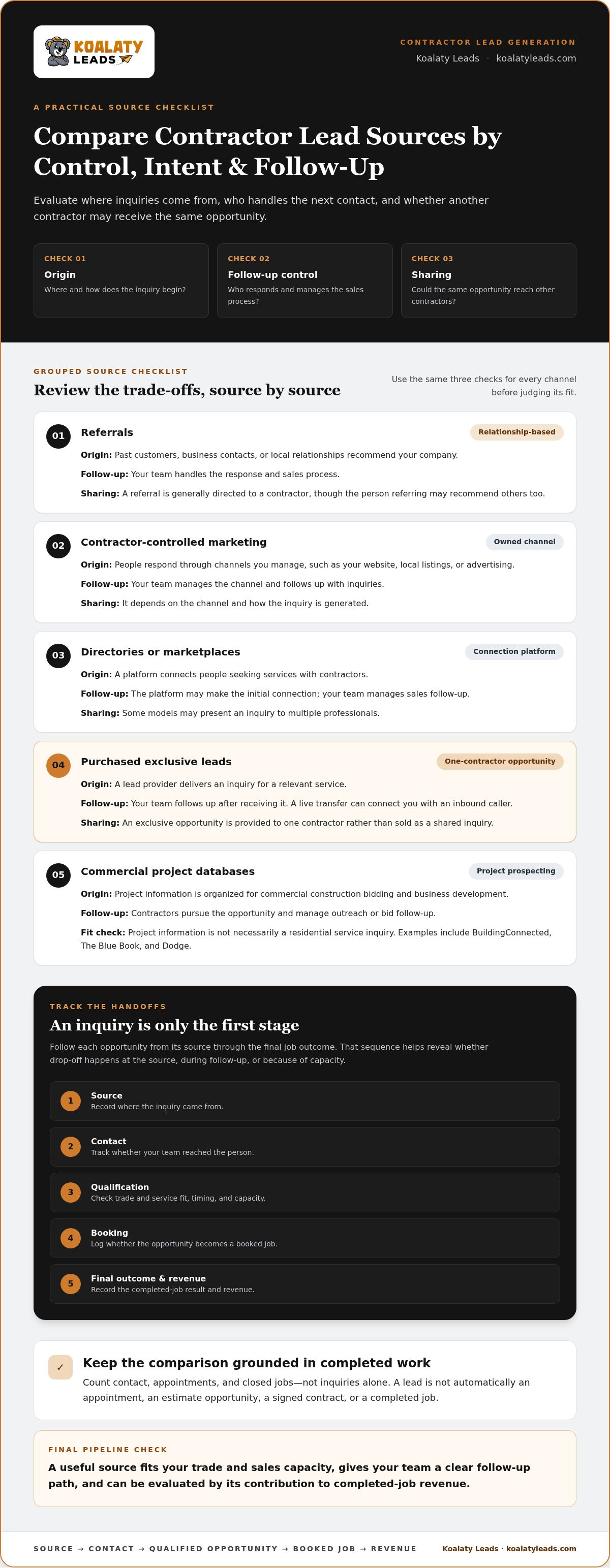
- Compare lead sources by how inquiries originate, who controls follow-up, and whether opportunities are shared.
- Track contact, appointment, and close rates to understand what each lead source costs per acquired job.
- Assign clear ownership for new inquiries and log each outcome so follow-up stays consistent.
- Consider exclusive leads and live calls as potential additions to a balanced pipeline, then measure their results.
Lead Generation for Contractors Starts With the Job Pipeline, Not Lead Volume
Lead generation attracts and captures potential customers for a contractor’s services. Effective lead generation for contractors tracks what happens after an inquiry arrives, from first contact through a qualified opportunity, booked job, and revenue.
A lead is only the start. It is not automatically an appointment, an estimate opportunity, a signed contract, or a completed job. Counting inquiries without tracking those stages can hide poor fit, missed follow-up, and marketing spend that doesn’t return through completed work.
For a useful overview of the concept, see What is lead generation? The practical test for your business is whether each source produces opportunities your team can handle and convert.
To see lead generation strategies discussed for general contractors, watch this video:
What counts as a contractor lead?
An inquiry is a potential customer expressing interest in a service, such as roofing, HVAC, or remodeling. Before treating it as a sales opportunity, check whether the request matches your trade and services, whether your team can reach the person, and whether the project timing fits your capacity.
A contactable inquiry may still be unqualified. The prospect might need work outside your scope, be planning for a later date, or not be ready to schedule. Record the stage accurately so your team doesn’t mistake form submissions or calls for booked work.
Why a pipeline beats a single lead source
Referrals can be valuable, but depending on them alone may leave lead flow outside your control. A mix of suitable sources can create more consistent opportunities, provided the volume aligns with available sales capacity, crews, and scheduling. Contractors can also consider exclusive lead and call options across home improvement trades as one potential source in that mix.
A lead-generation pipeline is the repeatable path that moves an inquiry from its source to a qualified opportunity, a booked job, and recorded revenue. Track each handoff: source, contact, qualification, booking, and final job outcome. That sequence shows where prospects drop off and helps distinguish a source problem from a follow-up or capacity problem.
Keep the pipeline connected to your operating schedule. If crews are booked out, a surge in inquiries may create follow-up delays rather than growth. If sales staff have room but qualified opportunities are scarce, review which sources are producing the right trade, service fit, and timing. The goal is a manageable flow that your team can respond to and convert, not a bigger inquiry count on its own.
Compare Contractor Lead Sources by Control, Intent, and Follow-Up
Lead sources differ in more than how an inquiry arrives. For lead generation for contractors, compare who creates demand, who controls the next contact, and whether other contractors may receive the same opportunity. That distinction helps you choose sources that fit your trade, sales process, and capacity.
| Source | How inquiries originate | Who controls follow-up? | May the opportunity be shared? |
|---|---|---|---|
| Referrals | Past customers, business contacts, or local relationships recommend your company. | Your team handles the response and sales process. | The referral is generally directed to a contractor, but the person referring may recommend others too. |
| Contractor-controlled marketing | People respond through channels you manage, such as your website, local listings, or advertising. | Your team manages the channel and follows up with inquiries. | It depends on the channel and how the inquiry is generated. |
| Directories or marketplaces | A platform connects people seeking services with contractors. | The platform may handle the initial connection; your team manages sales follow-up. | Some models may present an inquiry to multiple professionals. |
| Purchased exclusive leads | A lead provider delivers an inquiry for a relevant service. | Your team follows up after receiving it; live transfers can connect a contractor with an inbound caller. | An exclusive opportunity is provided to one contractor rather than sold as a shared inquiry. |
| Commercial project databases | Project information is organized for commercial construction bidding and business development. | Contractors pursue and manage outreach or bid follow-up. | Access to project information does not necessarily mean a residential service inquiry. |
Owned demand, referrals, and project databases
Referrals come through relationships and can bring useful context, but their timing and volume aren’t fully controlled by your business. Contractor-controlled marketing gives you more influence over where inquiries come from, while still requiring ongoing management and prompt follow-up. For commercial construction prospecting, BuildingConnected, The Blue Book, and Dodge are examples of project databases. They serve a different purpose from residential home improvement inquiry sources.
Keep the source aligned with the work you want to book. A commercial project listing is not the same as a residential request for roofing, HVAC, or remodeling services; the sales process and follow-up may differ.
Directories, shared inquiries, and exclusive opportunities
A directory or marketplace can connect a potential customer with multiple professionals. A shared lead is an inquiry distributed to more than one contractor, so each business must manage its own response and sales process. An exclusive lead is routed to one contractor, while a live transfer creates an immediate phone conversation. Neither model guarantees a sale; fit, timing, and follow-up still matter.
Koalaty Leads provides exclusive opportunities and live transfers for home improvement contractors. If you’re comparing delivery formats, consider how each could fit alongside your current channels and sales process. Review sources by the opportunities they produce and how well your team can work them, not by inquiry volume alone.
Measure Contractor Lead Generation by Cost per Acquired Job
For lead generation for contractors, a useful scorecard follows each source beyond the initial inquiry. Track the money spent, the movement through your sales process, and the jobs that actually get completed. That connects marketing cost to business results without relying on industry benchmarks that may not match your trade or operation.
A practical lead-to-job measurement sequence
Use one reporting period and one lead source at a time. Keep each funnel stage separate, and make sure the spend and lead counts refer to the same cohort. If projects take time to close, continue tracking that group until you can see which inquiries became signed and completed jobs.
- Cost per lead: Divide the channel’s spend by the number of leads received. Include the costs you’re comparing consistently, such as the campaign or lead charge.
- Contact rate: Divide leads you successfully contacted by total leads received. A form submission or unanswered call is not a completed contact.
- Appointment rate: Divide appointments booked by leads contacted, or by qualified leads contacted if that better fits your process. Choose one denominator and use it consistently.
- Close rate: Divide signed jobs by the opportunities you’re measuring, such as estimates delivered or appointments held. State the denominator so comparisons are meaningful.
- Cost per acquired job: Divide the source’s spend by customers acquired. For realized acquisition cost, use completed jobs as the count, and label signed-job and completed-job figures separately.
For a simple worksheet, enter your own figures: channel spend = [S], leads received = [L], contacted leads = [C], appointments = [A], signed jobs = [J], and completed jobs = [F]. Then calculate CPL as [S] ÷ [L], contact rate as [C] ÷ [L], appointment rate as [A] ÷ [C], and completed-job acquisition cost as [S] ÷ [F]. Use your observed counts, not assumed conversion rates.
Why cheap leads can still cost more
Cost per lead tells you what an inquiry costs; cost per acquired job tells you what it takes to win work. A lower CPL can be offset by poor contactability, weak fit, or fewer opportunities progressing to a signed and completed job. Compare sources across the full funnel before deciding which is more economical.
Include sales labor and follow-up time for a fuller comparison. If one channel requires repeated outreach or extra qualification, record the hours and apply your own internal labor cost. Keep this fully loaded view distinct from media-only CPL so you can see both the upfront acquisition charge and the resources needed to turn inquiries into work.
Finally, compare acquisition cost with the average job value and gross margin, not revenue alone. Job value shows the sale amount; gross margin estimates what remains after direct job costs. A source may bring in high-value projects yet leave too little margin after delivery and acquisition expenses. Review the figures by source and job outcome, then adjust based on the economics your own records show.
Build a Contractor Lead Follow-Up Process That Protects Conversion
A consistent follow-up process keeps new inquiries from getting lost between marketing and the sales team. In lead generation for contractors, the source matters, but so does what happens after an inquiry arrives: assign an owner, make contact, qualify the request, set a next step, and record the outcome.
Set a clear process your team can follow across phone calls and form inquiries. The goal isn’t to force every inquiry into an appointment. It’s to respond, identify fit, and capture enough information to learn where opportunities move forward or stall.
Set up clear ownership and qualification
Assign a person or role to monitor incoming inquiries, with a designated backup when the primary owner is unavailable. For each lead, record its source, trade fit, requested service, contact status, and next action. That gives the team a clear handoff instead of leaving responsibility to whoever happens to notice the inquiry.
Use a simple sequence:
- Receive and assign: Log the inquiry and name its owner.
- Attempt contact: Record whether you reached the prospect, left a message, or need another attempt.
- Qualify: Confirm the requested service and whether it fits your scope and current capacity.
- Set the next step: If it’s workable, schedule the appropriate conversation or appointment. If it isn’t, record why.
- Update the outcome: Continue tracking through estimate, sale, and job completion, or mark the lead lost with a reason.
Keep qualification practical. A request for work outside your trade or service area isn’t the same as a qualified opportunity that didn’t close. Separate those outcomes so your team can distinguish a targeting issue from a sales issue.
If you’re reviewing how exclusive inquiries or live calls could fit your process, explore Koalaty Leads’ exclusive lead and call options.
Close the feedback loop between sales and marketing
Agree on stage definitions before comparing channels. For example, decide what counts as “contacted,” “appointment,” “estimate sent,” “sold,” and “lost.” Apply the same labels and reporting period to each source, and don’t treat an appointment as a sale or a signed contract as a completed job.
Lost reasons make the tracking useful. Record specific outcomes such as no contact, service mismatch, timing, declined estimate, or capacity constraints. A pattern of service mismatches may point to a need to refine lead criteria; repeated missed contacts may indicate that ownership or follow-up steps need attention.
Review the results with both sales and marketing. If one source produces inquiries that fit your services but rarely reach an appointment, examine the contact process. If prospects are reached and qualified but don’t proceed, review what happens later in the sales cycle. Make one adjustment at a time, then compare the next reporting period using the same definitions. That turns follow-up records into a decision tool, not just a list of old leads.
Use Koalaty Leads for Exclusive Contractor Leads and Live Calls
Koalaty Leads can be one source in a contractor’s measured pipeline, alongside referrals and contractor-controlled marketing. We provide exclusive opportunities and live transfers for home improvement contractors, including businesses in roofing, HVAC, solar, windows, remodeling, gutters, and siding. The right fit depends on your trade and how your team handles new opportunities.
Keep the same discipline you apply to any channel: track what arrives, how your team responds, and whether the opportunity progresses to a job. A lead source can create a chance to sell, but conversion depends on fit, timing, and follow-up.
Exclusive leads and live transfers in practice
An exclusive lead is an inquiry provided to one contractor rather than sold as a shared opportunity. Your team receives the inquiry and manages the next steps. A live transfer is different: it connects the contractor with an inbound caller for a direct conversation, making a ready-to-respond sales process important.
Both formats require clear ownership. Decide who handles each inquiry, how the team records the result, and what happens if the first contact doesn’t progress. An exclusive lead gives your business a direct opportunity to follow up; a live transfer calls for someone prepared to speak with the prospect when connected. Neither guarantees a booked job.
Match the lead model to your trade and sales capacity
Start with the work you want to book and the team you have available to respond. A contractor focused on roofing leads may have different qualification steps from a business handling HVAC, solar, window replacement, remodeling, gutter, or siding inquiries. Make sure the lead type aligns with your service scope and that your sales process can handle the follow-up.
Then consider how each format fits your workflow. If your team can reliably receive and work inquiries, exclusive leads may fit that process. If a salesperson is prepared to handle a phone conversation, live transfers may be worth discussing. Neither option replaces tracking contact, appointments, outcomes, and completed jobs against your own costs.
For contractors working across trades, contractor lead generation services can be part of a broader source mix. Bring your trade, current lead-handling process, and growth priorities into the conversation. That gives you a practical basis for discussing which lead format may complement your pipeline, without treating lead volume or a particular result as guaranteed.
Make Your Next Lead Decision With Confidence
Build your next growth decision around what your own pipeline can prove. Choose a source that fits your trade and sales capacity, define how your team will handle each inquiry, then review the results through completed jobs and revenue. That gives lead generation for contractors a practical direction: invest with clear expectations, learn from real outcomes, and adjust when the evidence points to a better fit.
Koalaty Leads provides exclusive leads, pay-per-call opportunities, live transfers, and inbound calls for home improvement contractors, and does not sell shared leads. Talk with us about the options for your trade and market, and how they could fit the lead process you’re building.
Keep measuring, keep refining, and build a pipeline your team can rely on with confidence.
Frequently Asked Questions
What is lead generation for contractors?
Lead generation for contractors is the process of attracting interest in a contracting service and capturing inquiries your sales team can work. A practical example is tracking whether a roofing inquiry came from a referral, an online campaign, or a purchased lead source, then recording what happened next. That source-level view helps you compare opportunities by trade and identify where your team should focus its follow-up.
What is the difference between a contractor lead and a booked job?
A contractor lead is an inquiry or potential sales opportunity; a booked job is work the customer has agreed to move forward with and your business has scheduled. For example, someone requesting an estimate is still a prospect, even if your team has spoken with them. Keep separate records for estimate requested, estimate delivered, agreement signed, and work scheduled so your reporting reflects actual sales progress.
How should contractors calculate cost per acquired job?
Divide the costs assigned to a lead source by the number of jobs that source acquired during the same measurement period. For a more complete comparison, consistently include lead or campaign spend and any attributable sales labor, then state whether the result counts signed jobs or completed jobs. Don’t compare one source’s media-only cost with another source’s fully loaded cost. Use your own records rather than assumed conversion rates.
Are contractor leads shared with other businesses?
Some lead sources distribute the same inquiry to multiple contractors, while an exclusive lead is provided to one contractor. Check the delivery model you’re evaluating because it affects how many businesses may be pursuing the same prospect. Koalaty Leads does not sell shared leads. Its exclusive opportunities are intended for one contractor, but exclusivity alone doesn’t ensure a particular response, appointment, or sale.
What is the difference between pay-per-lead and pay-per-call?
Pay-per-lead generally charges for an inquiry delivered to your business, often as contact information and project details. Pay-per-call is centered on an inbound phone opportunity, and a live transfer connects the caller with a contractor during the transfer. The exact billing and qualification terms can differ by provider, so compare what counts as a billable lead or call before judging channel costs.
How quickly should a contractor follow up with a new lead?
Follow up as promptly as your operation can reliably manage, and assign an owner as soon as an inquiry arrives. Delays can make it harder to reach a prospect who is contacting multiple businesses or moving on to other priorities. Set a response standard your team can meet, create a backup for missed handoffs, and record attempted contact so managers can spot gaps and improve coverage.
Can a contractor use more than one lead source at a time?
Yes. A contractor can combine referrals, contractor-managed marketing, directories, and purchased opportunities when each source fits the business and its sales capacity. Give every inquiry a source label and apply consistent stage definitions so results remain comparable. If channels overlap, record the source that generated the original inquiry and note any later touchpoints. This helps you understand each channel’s contribution without relying on one source alone.
Need exclusive leads instead of shared ones? Koalaty Leads delivers qualified homeowners — web leads or live call transfers — to one contractor only.
Get Started