
Kitchen Remodeling Leads: A Buying Guide for Remodelers

For remodelers, a stronger pipeline starts with understanding which inquiries fit the business and how each source performs. Kitchen remodeling leads can come from project pages, referrals, campaigns, or purchased opportunities, but the source alone doesn’t determine whether a prospect becomes a job.
The practical advantage comes from connecting marketing and sales. Assign every inquiry an owner, capture the details your team needs, and track progress beyond first contact. This makes it easier to spot gaps, prioritize prospects, and understand which channels contribute to signed work.
This guide explains how project examples and referrals attract prospects, why response speed and lead exclusivity matter, and how to recognize buying intent. It also shows how to compare source costs with sales outcomes, so you can make decisions based on the work your team actually books. Use these steps to assess your process and decide where a more focused approach could support growth.
Key Takeaways
- Use project pages with clear examples, scope, and budget context to help serious prospects recognize whether your work fits their needs.
- Respond quickly and build a consistent follow-up process so promising inquiries don’t lose momentum.
- Compare exclusive and shared lead models by competition, buying intent, and potential cost per acquired job, not lead price alone.
- Qualify prospects around project scope, budget, timing, motivation, and decision-makers before booking a consultation.
- Track each source through appointments and signed contracts to see which channels produce profitable work.
1. Attracting serious homeowners through project pages and referrals
Project pages help homeowners assess whether your work suits their plans before contacting your team. Build each page around a completed kitchen, with before-and-after photos, project scope, design choices, and a clear description of your role. Include the community or service area where relevant, so visitors can quickly see whether you work where they live.
Give each example enough detail to make it useful. A page about a kitchen refresh should not be presented as a full renovation. Explain what the project involved, how the work progressed, and which decisions shaped its scope. A 360-degree virtual tour can help visitors explore a finished room, while a short video can add context to the photos.
Authentic reviews and testimonials, shared with permission, can add context to project examples. Place a customer’s comments beside the relevant project rather than collecting praise without context. For example, a review describing communication during a kitchen project can help prospects understand the experience behind the finished photos.
Make referrals a routine follow-up after completed projects. Ask satisfied customers whether they’re comfortable recommending your company, and make your contact details easy to share. Past kitchen, bathroom, or basement clients may know someone planning similar work. Route each introduction according to the project type.
Use a consistent intake process to qualify each kitchen remodeling lead. Confirm the homeowner’s role in the decision, project scope, budget range, location, and timeline. Ask whether the prospect is planning a full renovation or a narrower update, such as new cabinets or countertops. These details help your team assess fit before scheduling design time.
Discuss realistic budget ranges early, using examples from your own recent projects. Explain how scope affects the estimate, then ask whether the prospect’s expectations align. This can prevent mismatched consultations and help sales staff focus on projects that fit the company’s work and capacity.
Connect each project page or referral source to a clear next step. Request the details your team needs, assign an owner to every inquiry, and record whether it becomes a qualified appointment. Reviewing that path helps reveal where prospects stop responding and where intake questions need refinement.
For local visibility, keep your business information and service area consistent across your website and Google Business Profile. Publish useful project pages tied to the locations you serve, write accurate descriptions, and request honest customer reviews. Relevant examples give local searchers a direct way to submit an inquiry.
2. How Quickly Should Contractors Respond to Kitchen Leads?
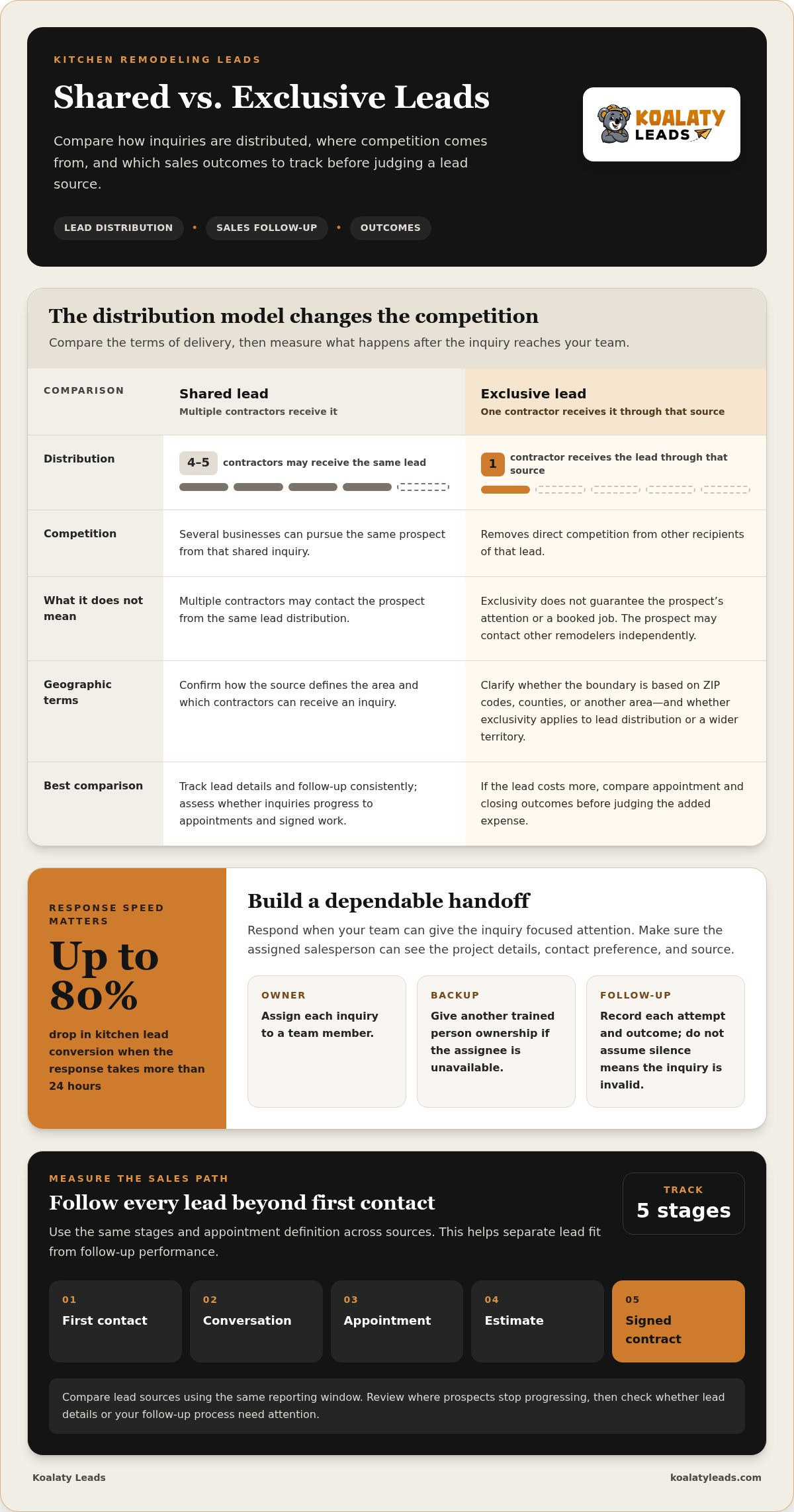
Respond as soon as your team can give a new inquiry focused attention. Kitchen lead conversion can drop by up to 80% when the response takes more than 24 hours. Treat that as a reason to build a dependable response process, not as a promise about any individual prospect. Log when inquiries arrive and when your team first contacts them.
Set a clear handoff for every lead. Before reaching out, the assigned salesperson should see the project details, contact preference, and source. If that person is unavailable, another trained team member can take ownership instead of leaving the inquiry in a general inbox. Review missed contacts regularly to find gaps in coverage and assignment.
Lead distribution changes the competitive setting. A shared lead may be sold to four or five contractors, so several businesses can pursue the same prospect. An exclusive lead goes to one contractor through that source, removing direct competition from other recipients of that lead. The homeowner may still contact other remodelers independently, so exclusivity doesn’t guarantee attention or a booked job.
Compare lead models by tracking each sales stage. Record first contact, conversation, appointment, estimate, and signed contract for every source. If shared inquiries lead to conversations but few appointments, review the lead details and your team’s follow-up. If exclusive inquiries cost more, compare appointment and closing outcomes before judging the added expense.
Regional exclusivity needs a precise definition. A provider may describe territory using ZIP codes, counties, or another geographic boundary. Match that boundary to the areas your crews can serve, and clarify whether exclusivity refers to lead distribution or a wider territory. A nearby contractor may still reach the same homeowner through separate marketing.
Use a response sequence that gives prospects a clear, relevant next step. Reference the kitchen project in your first message, offer a way to continue the conversation, and record the outcome. If the prospect doesn’t answer, schedule another attempt instead of assuming the inquiry is invalid. Keep notes visible to everyone handling the account.
Before purchasing leads, define what qualifies as a kitchen inquiry, how duplicates are treated, and what project details come with delivery. Ask how each lead is assigned and what geographic exclusivity means in practice. Compare sources using the same reporting window and appointment definition. Consistent tracking helps distinguish faster follow-up from stronger lead fit.
3. Exclusive local remodeling leads
An exclusive local remodeling lead gives one contractor the opportunity to contact a prospect through that source. Local targeting makes the inquiry relevant to your service area, but the homeowner can still contact other remodelers independently. Define both terms before comparing lead programs or campaign results.
Ask how the provider defines “exclusive.” Does it mean one contractor receives the inquiry, or does it also refer to a geographic boundary? A ZIP code, county, or broader region can produce different competition patterns. Get the delivery territory and distribution terms in writing, then match them to the areas your crews can serve.
Local relevance matters because an inquiry outside your practical service area may consume sales time without leading to a workable appointment. Compare the lead’s location with your coverage map before assigning it. Track the location, project type, contact outcome, and booked appointment in your customer relationship management system.
Buying leads is one way to reach local prospects. Remodeling contractors can also generate inquiries through referrals, project pages, paid search, and local business listings. Each source behaves differently: referral inquiries may arrive with context, while paid campaigns need clear targeting and consistent follow-up. Record the source for every lead instead of combining them into one total.
Use project photos to connect local prospects with work that matches their renovation needs. A page showing a completed kitchen in a nearby community can explain the scope better than a general gallery. Include the location, project details, and a clear inquiry path. Keep claims accurate, and use customer images only with permission.
Track performance from inquiry through signed contract. For each source, record whether the prospect was reachable, qualified, scheduled, estimated, and won. Compare the cost per acquired job and gross profit, not just the average cost per remodeling lead. This shows whether local exclusivity is producing valuable work or merely reducing competition at first contact.
For campaigns in the United States, document how permission is collected and how each contact entered your system. Follow applicable federal and state requirements, honor opt-out requests, and keep records of consent and communications. These steps give your team a clear operating standard without treating every lead source as interchangeable.
Contractors can buy kitchen renovation inquiries from specialized lead providers or marketplaces, or generate them through their own local campaigns. Compare the source, territory, exclusivity terms, project details, and delivery process before evaluating results. A defined service area and consistent tracking make the options easier to assess side by side.
4. Identifying homeowners with active buying intent
Active intent shows in the details attached to an inquiry, not just its source. A homeowner who requests a consultation, describes a kitchen renovation, and shares a workable timeline signals more than someone who only downloads a general planning guide. Record those details before routing the inquiry to sales.
Use a short intake form to capture project type, location, scope, timing, and preferred contact method. For example, “replace cabinets and counters” gives your estimator a clearer starting point than “interested in remodeling.” Add a field for decision-makers, then confirm key answers during the first conversation.
Google search campaigns can reach people actively looking for a kitchen contractor or renovation estimate. Match each campaign to a focused landing page, then review search terms and inquiries. If an ad about full renovations draws mostly cabinet-only requests, adjust the targeting or page language to match your capacity.
Social campaigns can support discovery, but a click or photo view alone doesn’t prove readiness. Distinguish people who engage with project photos from those who request a consultation. Use separate campaign tracking to compare social inquiries with Google leads by qualified appointments and signed projects.
Ask whether the prospect has chosen a project scope, set a budget range, or selected a start window. The answers help distinguish active planning from early research. A verified phone number and valid project location help your team confirm that the inquiry is reachable and within its service area.
Kitchen and bath projects can involve long decision cycles. The market estimate for their average sales cycle is around 180 days, compared with roughly 60 days across the general industry. Keep a follow-up status for prospects who are still planning, rather than marking every unbooked inquiry as lost.
When handled well, kitchen remodeling inquiries result in appointments 68% of the time. Use that figure as a reference, then measure your own funnel: inquiry, contact, qualified opportunity, appointment, estimate, and signed contract. Compare each stage by source, campaign, and project scope to find where intent is getting lost.
A practical lead score can combine clear project details, decision-maker involvement, timeline, and successful contact. Apply consistent criteria across Google, social, referrals, and purchased inquiries. Compare scores with booked appointments and closed work, then refine them using your records instead of optimizing for inquiry volume alone.
5. How much do kitchen remodeling leads cost by source?
There isn’t one comparable price across referrals, paid search, and purchased inquiries. Measure each source by total acquisition spend, qualified appointments, and signed projects. A low cost per inquiry can still mean an expensive job acquisition if few prospects book or close.
For paid search, kitchen and bath remodeling terms typically cost $8–$18 per click. A click is not a lead: the prospect still needs to visit a relevant page and submit an inquiry. Track campaign spend through to booked appointments and signed contracts to understand the full cost.
Purchased leads are priced per inquiry or call, while campaign spending can include advertising and management costs. The final economics depend on targeting, lead details, competition, and your team’s follow-up. Ask what counts as a billable lead and how duplicates or inquiries outside your service area are handled.
| Source | Cost basis | What to measure |
|---|---|---|
| Paid search | Cost per click, then campaign cost per inquiry | Qualified inquiries, appointments, and signed jobs |
| Referrals | Time and referral-program expenses | Project fit and contracts won |
| Purchased leads | Cost per delivered inquiry or call | Contact, appointment, and close rates |
| Organic project pages | Content and website investment | Local inquiries and completed projects |
Exclusive and shared inquiries can have different per-lead prices because they are distributed differently. A shared inquiry may reach several contractors, while an exclusive inquiry is routed to one buyer through that source. Compare the price difference with your own contact and close rates, not the label alone.
Calculate cost per acquired job by dividing total source spend by the number of signed projects attributed to it. Include advertising, purchased inquiries, and campaign management in the spend figure. Apply the same accounting rules across channels, or the comparison may favor whichever source leaves out more costs.
Kitchen projects can take weeks to months to close, depending on design work and decision-making. Maintain source attribution through the sales cycle, including estimate follow-ups and later signed contracts. Judging a campaign only by its newest inquiries can undercount projects still moving through the pipeline.
Review results by source, project scope, and territory. If search clicks are costly but produce qualified appointments, compare their job-acquisition cost with purchased inquiries and referrals. If a source generates volume without signed work, refine targeting or qualification before increasing its budget.
Koalaty Leads: Roofing Leads
Koalaty Leads offers exclusive kitchen remodeling leads for contractors seeking more relevant local opportunities. If your team is ready to supplement referrals and project pages with purchased inquiries, review the kitchen remodeling leads offering and consider whether its model fits your sales process.
Exclusive inquiries give your team the opportunity to follow up without competing against other contractors receiving the same lead through that source. Live inbound call transfers can connect a prospect with your team by phone, while pay-per-lead offers another way to acquire inquiries. Results still depend on fit, response, qualification, and follow-up.
Consider exclusive kitchen remodeling leads when you have a defined service area and a process for handling new inquiries. Koalaty Leads provides exclusive leads and live inbound call transfers for home improvement contractors. Visit koalatyleads.com to discuss the opportunities that fit your trade and market.
Turn Your Lead Plan Into a Growth System
Make your next move operational. Decide how many new opportunities your sales team can handle, who owns each inquiry, and how you’ll evaluate results. Treat kitchen remodeling leads as a deliberate part of your growth plan, with clear ownership and consistent reporting from first contact through a signed project.
Use those decisions to set a practical test for any new source. Define the project types you want, the areas your team serves, and the sales outcomes you’ll track. A focused plan gives you a sound basis for deciding whether to expand, adjust, or change your lead mix.
Koalaty Leads also provides Roofing Leads, Window Replacement Leads, and Bathroom Remodel Leads for contractors working in those trades. Keep your growth strategy focused on the work your team is equipped to sell and deliver.
Take the next step with a clear plan and build momentum on your terms.
Frequently Asked Questions
What Works in Kitchen Remodeling Lead Generation?
A balanced system works best when every source has a defined role and measurable outcome. Use project content to demonstrate your capabilities, referrals to build on completed work, and paid or purchased inquiries to add opportunities. Compare sources by qualified appointments and signed contracts, not raw contact volume. If a channel brings inquiries your team can’t service, adjust its targeting before increasing spend.
How Quickly Should Contractors Respond to Kitchen Leads?
Respond promptly, assign an owner to every inquiry, and set a backup route when that person is unavailable. An intake notification should include the prospect’s contact preference and project summary, so the first conversation starts with useful context. If you can’t reach the prospect, record the attempt and schedule a follow-up rather than leaving the record untouched. Review unassigned inquiries daily to catch gaps.
What Counts as a “Qualified” Kitchen Lead?
A qualified lead concerns a real kitchen project that fits your services and service area, with a reachable contact who can discuss next steps. Look for a clear project need, an identifiable decision-maker, and a reasonable match between the prospect’s plans and your company’s capabilities. Finished drawings aren’t essential; a specific goal, such as changing the kitchen layout, gives your team a useful basis for assessment.
What Are the Best Ways to Generate Leads for a Kitchen Remodeling Business?
Combine referral requests, useful project pages, local search visibility, and paid channels that match your capacity. Koalaty Leads provides exclusive kitchen remodeling leads and live inbound call transfers for contractors seeking direct phone opportunities. Tag each source in your sales system, then review which brings projects your team can serve. Add volume only when follow-up and estimating capacity can support it.
How Do Exclusive and Shared Kitchen Remodeling Leads Compare?
Exclusive leads go to one contractor through the source, while shared inquiries may be distributed to several contractors. Shared leads can create direct competition for the same prospect; exclusive leads remove that competition among recipients of the source. Koalaty Leads provides exclusive leads, not shared leads. Compare models using your records for contact, appointments, signed jobs, and total acquisition cost.
What Are the Best Online Marketing Channels for Kitchen Remodelers?
Google search and local business profiles can reach people actively looking for remodeling services, while social platforms can showcase project photos and completed work. Use separate landing pages and tracking for each campaign, then connect inquiries to appointments and signed jobs in your CRM. This helps distinguish useful visibility from clicks that don’t generate sales conversations. Choose channels your team can monitor and follow up consistently.
What Information Should a Kitchen Remodeling Lead Include?
A useful inquiry should include contact details, project location, requested work, and the prospect’s preferred response method. A description such as “replace cabinets and expand the island” gives sales staff more context than a general request. The record should identify its source and capture any available timing or budget information. These details help your team route the inquiry and prepare for a relevant first conversation.
How Do Contractors Qualify Kitchen Remodeling Leads and Avoid Scams?
Validate the contact details, location, project description, and source before investing substantial estimating time. Check for duplicate records, inconsistent information, or requests outside your services. Ask the prospect to clarify the scope and confirm their role in the decision. Treat a missed call as an unanswered inquiry, not proof of fraud. Document attempts and assess the details consistently before closing the record.
Need exclusive leads instead of shared ones? Koalaty Leads delivers qualified homeowners — web leads or live call transfers — to one contractor only.
Get Started