
HVAC Leads: The HVAC Contractor's Buying Guide

A low-cost lead can become an expensive booked job when several contractors are calling the same prospect or your team can’t respond quickly. The right HVAC leads fit your sales capacity, give you a fair chance to reach the prospect, and make sense against the revenue and close rate of your jobs.
It’s not enough to compare lead prices or chase volume. You need to know what separates exclusive, shared, aged, and call-based leads, then track how many become contacts, appointments, and paying jobs. Follow-up matters too: even a strong lead can lose value if no one owns the next call.
This guide breaks down the trade-offs between HVAC lead models and shows you how to assess lead spend using your own conversion rates and job economics. You’ll also learn what to consider when choosing a source, from prospect intent and exclusivity to the response time your team can consistently deliver. The goal is a lead flow you can work well today and scale with confidence as your business grows.
Key Takeaways
- Separate an inquiry from a qualified opportunity, booked appointment, won job, and collected revenue to see where your pipeline is losing value.
- Compare exclusive, shared, aged, and call-based HVAC leads by intent and competition, not just by how they’re delivered.
- Measure lead spend against contact, appointment, and close rates to calculate what each acquired job actually costs.
- Match lead volume to your team’s staffing, coverage, and appointment capacity so prospects get timely follow-up.
- Koalaty Leads provides exclusive HVAC opportunities and live call transfers, not shared leads or a marketplace.
HVAC Leads: What Contractors Are Actually Buying
An HVAC lead is a prospective customer inquiry relevant to a contractor’s services. Buying HVAC leads means buying access to an inquiry, not a booked job or guaranteed revenue. The opportunity still has to move through your sales process.
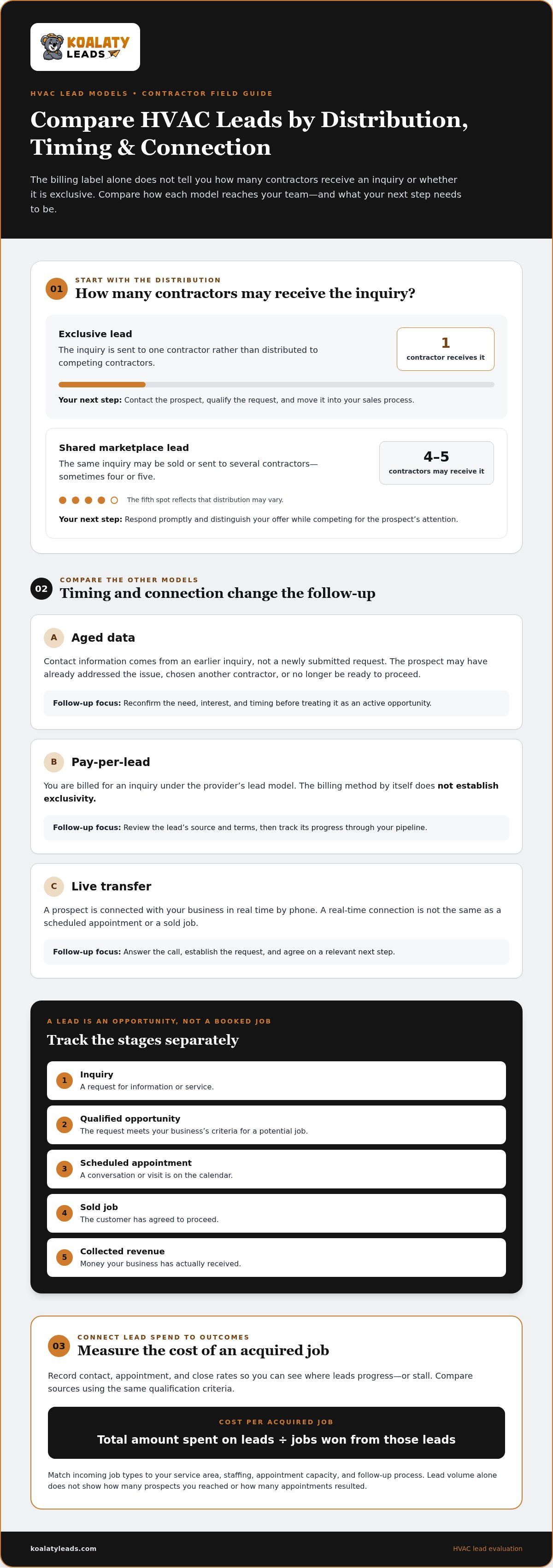
Keep the stages distinct. An inquiry is a request for information or service; a qualified opportunity meets your business’s criteria for a potential job. A scheduled appointment means a conversation or visit is on the calendar. A sold job is one the customer has agreed to proceed with, while collected revenue is money your business has actually received. These are separate outcomes, so recording them separately shows where leads progress or stall.
Service, repair, replacement, and installation inquiries can also signal different needs. A repair request may call for fast dispatch and a service-team opening. A replacement inquiry may need a sales consultation, while an installation request could fit a team focused on new equipment projects. Treating every inquiry as the same opportunity can skew performance tracking and send prospects to the wrong next step.
Separate lead intent from lead volume
A stated need and readiness to take the next step affect an inquiry’s sales value. Someone requesting a specific service and available to discuss scheduling is at a different point than someone exploring options without a defined project. A large lead count alone won’t tell you which situation you’re getting, how many people you reached, or how many appointments resulted.
Define a qualified lead with criteria your team can record consistently. For example, capture whether the inquiry fits your service area, matches a job type you handle, includes usable contact details, and has a clear next step. Apply the same criteria across sources; otherwise, one campaign may look stronger simply because staff classify inquiries differently.
Match HVAC opportunities to the business
A service-focused team may prioritize inquiries it can route to available technicians and fit into its dispatch process. A replacement-focused sales team may instead need prospects suited to a consultation and follow-up sequence. Neither model is automatically better. Lead fit depends on the work you want, your crew’s service capacity, and the way your team sells and schedules that work.
Before increasing volume, compare incoming job types with open appointments, staffing, and the team responsible for follow-up. If your sales process handles replacement consultations but not urgent service requests, a high count of repair inquiries may create workload without supporting the goal. Set expectations for what your team can work promptly, then assess outcomes by job type.
Cost per acquired job is the total amount spent on leads divided by the number of jobs won from those leads. It connects lead investment to a business outcome, rather than treating every inquiry as a sale.
Compare HVAC Lead Sources, Sharing Models, and Call Formats
Lead sources differ in when an inquiry reaches you, whether other contractors receive it, and what your team must do next. Compare HVAC leads by distribution and connection format, not just by the label on the billing model.
| Model | How it works | Your next step |
|---|---|---|
| Exclusive lead | An inquiry is sent to one contractor rather than distributed to competing contractors. | Contact the prospect, qualify the request, and move it into your sales process. |
| Shared marketplace lead | The same inquiry may be sold or sent to multiple contractors, sometimes four or five. | Respond promptly and distinguish your offer while competing for the prospect’s attention. |
| Aged data | Contact information comes from an inquiry made earlier, rather than a newly submitted request. | Reconfirm the need, interest, and timing before treating it as an active opportunity. |
| Pay-per-lead | You’re billed for an inquiry under the provider’s lead model; billing alone doesn’t establish exclusivity. | Review the lead’s source and terms, then track its progress through your pipeline. |
| Live transfer | A prospect is connected with your business in real time by phone. | Answer the call, establish the request, and agree on a relevant next step. |
Exclusive, shared, and aged HVAC leads
An exclusive inquiry gives one contractor the opportunity to follow up without the same inquiry being distributed to competing contractors. Shared leads create direct response competition: when several teams receive one prospect’s request, they may all call around the same time. That can put pressure on staff and make it harder to separate source performance from differences in response and sales handling.
Aged data changes the timing, not just the label. The prospect may have already addressed the issue, chosen another contractor, or no longer be ready to proceed. Treat it as a fresh qualification task, and record separately whether contact was made and whether the need is still active. That helps keep older records from inflating the apparent performance of current inquiries.
Inbound calls and live transfers
A form inquiry arrives as information for your team to review and follow up on. An inbound call starts with a phone conversation; a live transfer connects a prospect and contractor in real time. Neither format guarantees a scheduled appointment or sold job. The value depends on whether the call reaches someone prepared to handle it and capture the next step.
Set call coverage around actual staffing. If technicians are dispatched and sales staff are unavailable, a real-time connection may go unanswered or lack a clear owner. The HVAC industry outlook from the U.S. Bureau of Labor Statistics provides context on workforce demand, a factor contractors should consider alongside the capacity they can assign to incoming opportunities.
Pay-per-lead and pay-per-call describe billing or connection formats, not job outcomes. If you’re weighing exclusive opportunities against live calls, talk with Koalaty Leads about options for your HVAC business.
Measure HVAC Lead Economics Beyond Cost per Lead
A lead price tells you what you paid to enter the sales process. It doesn’t show how many prospects you reached, booked, closed, or collected revenue from. Track each stage so you can compare sources by the jobs they produce, not by inquiry count alone.
| Measure | Calculation | What it tells you |
|---|---|---|
| Lead cost | Total lead spend ÷ leads received | Average spend for each inquiry from that source. |
| Contact rate | Leads reached ÷ leads received | How often your team makes contact. |
| Appointment rate | Appointments scheduled ÷ leads received | How often inquiries advance to a scheduled next step. |
| Close rate | Jobs won ÷ leads received | How often a lead turns into a sold job. |
| Cost per acquired job | Use the definition from the previous section | Lead spend associated with each job won. |
Calculate the cost of a won HVAC job
Apply the cost-per-acquired-job definition from the previous section to one reporting period and one source at a time. Use jobs won, not appointments or estimates, as the outcome. This keeps the comparison grounded in sales results and makes it easier to see whether a source is producing work your business actually closes.
Cost per lead measures the price of an inquiry; it doesn’t tell you the full acquisition cost. Keep lead spend separate from sales labor, follow-up time, call handling, and other acquisition expenses. If you want a broader view, list those costs alongside lead spend instead of folding them into the lead figure.
To assess payback, compare revenue collected from jobs with their direct costs and gross margin. Average job value can help frame potential revenue, but it isn’t profit: labor, equipment, and other job costs affect what remains. A high-value job may still deliver weak payback if its margin is thin or acquisition effort is substantial.
If you’re weighing lead options for your team, talk with Koalaty Leads about exclusive HVAC leads or live transfers for your trade and market.
Read performance data without misleading yourself
Record source, service need, contact outcome, appointment, sale, and collected revenue using consistent definitions. Compare groups of leads from the same source over a period long enough for your usual sales process to play out. A single inquiry is too small a basis for a reliable decision.
Review results by job type as well as source. Repair and replacement opportunities may follow different sales paths, so combining them can hide where leads are converting. Use current, credible benchmarks only when their source and scope are clear, and don’t treat them as Koalaty Leads pricing or performance data.
Build an HVAC Lead Process Your Team Can Handle
A reliable process gives every inquiry an owner, a next step, and a recorded outcome. Before increasing lead volume, match the flow to the people available to answer calls, follow up, book appointments, and complete the work.
Use a consistent intake sequence so opportunities don’t disappear between marketing, sales, and dispatch:
- Receive: Record when the inquiry arrived, its source, and its format, such as a form or phone call.
- Assign: Route it to a named team member based on service type and current responsibility.
- Contact: Log contact attempts and whether the prospect responded.
- Qualify: Capture the stated need, timing, service fit, and relevant details using consistent fields.
- Schedule: Record whether an appointment was offered, booked, rescheduled, or declined.
- Track the outcome: Update the record as the opportunity progresses to a sold job, a closed-lost outcome, or another defined disposition.
Set response and qualification rules
Decide who owns new inquiries during each coverage period and what happens if that person is unavailable. Set a repeatable contact and follow-up process, and make sure the team records service need, timing, contact status, and appointment outcome in the same system.
Choose disposition codes that show what happened, such as “not reached,” “outside service fit,” “appointment set,” or “no current need.” Review missed contacts and unworked opportunities separately from source performance. A campaign can appear weak when the real breakdown is an unassigned inquiry or a follow-up step that never happened.
Scale lead flow against real capacity
Before adding volume, estimate how many inquiries your team can handle while maintaining its follow-up process. Consider who can answer calls, how much sales time is available, which appointment slots are open, and whether technicians can take on the resulting work. Practical capacity is the limit, not the number of leads a campaign could send.
If appointment availability or follow-up resources tighten, adjust intake rather than letting a backlog build. A weekly review can surface the constraint: compare spend, contacts, appointments, sold jobs, and payback by source, service type, and lead format. Look for where opportunities stall, then address the specific gap, whether it’s assignment, contact, qualification, scheduling, or job capacity.
Keep reporting definitions consistent across the team. Separate calls from form inquiries and service requests from replacement opportunities so unlike sales paths don’t get blended into one result. Review each group over a period that gives your normal sales process time to progress before making operational changes.
Explore Exclusive HVAC Leads and Live Transfers from Koalaty Leads
Koalaty Leads provides exclusive HVAC opportunities, inbound calls, and live call transfers for contractors. We don’t sell shared leads or operate as a marketplace. The formats give contractors a choice between receiving an inquiry to work through their process and handling a prospect connected by phone.
Assess the fit against your own operating priorities. Consider the types of HVAC work you want to pursue, how your team routes new opportunities, and which outcomes you use to evaluate lead performance. A useful comparison starts with the workflow your business can sustain, then measures results against that standard.
Choose a lead format that fits the sales workflow
A delivered lead can suit a team that reviews inquiries, assigns them by service type, and follows up through an established process. A live call transfer connects a prospect and contractor in real time, which can fit a workflow built around answering and handling calls as they arrive.
Think through who will own each format and what should happen next. A service-focused business may route an inquiry toward dispatch, while a replacement sales team may direct it into a consultation process. The choice depends on staffing, service focus, and whether your team can respond in the way that format requires.
Evaluate outcomes consistently rather than assuming either format guarantees a sale. Track how opportunities move through your own sales process and assess whether the resulting jobs fit your business goals. That gives you a grounded basis for deciding which approach to continue, adjust, or test alongside another format.
Discuss an HVAC lead plan with Koalaty Leads
Build your evaluation around practical details: the HVAC services you want to grow, the sales process your team uses, and the challenges that make current opportunities harder to convert. These priorities help define what a suitable lead format needs to support.
Koalaty Leads serves contractors nationally across the United States with exclusive opportunities, inbound calls, and live call transfers. Keep the plan tied to your team’s actual capacity and the work you’re prepared to take on. Clear expectations and consistent tracking make it easier to judge whether the approach is contributing to sustainable growth.
Put Your Next Lead Decision to Work
Make your next move deliberate. Before changing your HVAC leads mix, decide what your team wants to learn: whether a particular format fits your intake process, whether a service category deserves more focus, or whether your current follow-up can support additional opportunities. Set a review point and use the same definitions for each outcome, so your next decision reflects what happened rather than what you hoped would happen.
That gives your team a practical way to build: start with a clear goal, watch the results, and adjust based on your capacity and job economics. Growth doesn’t require guesswork. It requires a lead plan your people can execute and a consistent view of what the investment returns.
Take the next step with confidence. A focused plan can help your team pursue growth with purpose.
Frequently Asked Questions
Are HVAC leads worth buying for a small HVAC company?
They can be worthwhile if your team can respond consistently and the jobs won support your acquisition costs. For a small company, start by deciding which job types you can take on without disrupting existing work, then assess whether the lead flow fits that capacity. Track results by source and service type. A manageable volume of well-worked HVAC leads is more useful than inquiries your team can’t follow up on.
How much should an HVAC contractor budget for leads?
Set a budget based on the acquisition cost your business can support, not a generic industry figure. Work backward from your target job volume, average job economics, and available sales and technician capacity. Keep lead spend visible as its own expense, then compare it with jobs won and revenue collected. Since lead prices and results vary by source and market, use your own tracked performance to adjust spend.
What is the difference between an HVAC lead and a booked job?
An HVAC lead is an inquiry, while a booked job is work the customer has scheduled with your company. The steps between them matter: your team may reach the prospect, confirm the service need, and arrange an appointment, but the prospect might not approve the work. Track scheduled work separately from completed work and payment so a full calendar doesn’t get mistaken for collected revenue.
How can HVAC contractors compare lead providers fairly?
Use the same evaluation rules for each provider. Compare like with like: service category, lead or call format, whether the opportunity is exclusive or shared, and what event triggers billing. Then use consistent outcome definitions and allow enough time for the sales cycle to progress. Keep separate records for each source, and review any written terms on delivery, lead handling, and disputed inquiries before comparing results.
Should an HVAC contractor choose exclusive leads or shared leads?
Choose based on how your team handles competition and what your acquisition results support. An exclusive lead is directed to one contractor, while a shared inquiry can reach several contractors and require faster, more competitive follow-up. Shared leads may suit a team prepared to work that format; exclusivity may fit a contractor seeking a direct opportunity to contact the prospect. Compare acquired-job costs, not assumptions about either model.
What should an HVAC contractor track after receiving a lead?
Record the source, service requested, receipt time, assigned team member, contact attempts, and whether the prospect responded. Add the appointment result, sale status, revenue collected, and a clear reason if the opportunity was lost or left unworked. These details help distinguish a sourcing issue from a missed handoff, unavailable appointment, or sales-process gap. Review records using the same labels across campaigns so comparisons stay meaningful.
Need exclusive leads instead of shared ones? Koalaty Leads delivers qualified homeowners — web leads or live call transfers — to one contractor only.
Get Started