
How to Get Roofing Leads: Proven Strategies for Growth

A steady roofing pipeline comes from a repeatable system, not a lucky storm. To learn how to get roofing leads, combine local visibility, focused outreach, and paid campaigns, then manage every inquiry through a consistent sales process. Roofing leads are opportunities to speak with property owners or decision-makers who may need residential or commercial roofing work.
More inquiries alone won’t fix an uneven pipeline. Match lead sources to the jobs your crews can take on, and give your team a clear way to distinguish a genuine project from a poor fit. Track each inquiry by source, service type, buyer, and next sales step. This makes it easier to see whether your marketing is producing opportunities worth pursuing.
This guide covers practical ways to attract residential and commercial prospects, use outreach and advertising, and assess paid search. It also explains how to turn interest into qualified conversations and booked work. Choose strategies that fit your capacity, measure what happens after each inquiry, and build a pipeline your team can manage consistently.
Key Takeaways
- Strengthen your local search presence with an up-to-date business profile, useful project content, and a consistent review process.
- Use phone, email, direct mail, and online outreach to reconnect with prospects and build a repeatable follow-up routine.
- Assess paid search by tracking lead source, contact rate, appointments, and closed jobs, not just clicks.
- Separate residential and commercial prospecting so your message and follow-up fit each buyer’s needs.
- Use targeted mail and door hangers to create local visibility around completed projects and support other lead channels.
1. Local SEO and Google Business Profile optimization
Local search helps roofing businesses reach potential customers already looking for contractors. Build your profile and website around the work you want, such as residential repairs, full replacements, storm damage assessments, or commercial roofing. Clear service details help searchers and Google understand what your team handles.
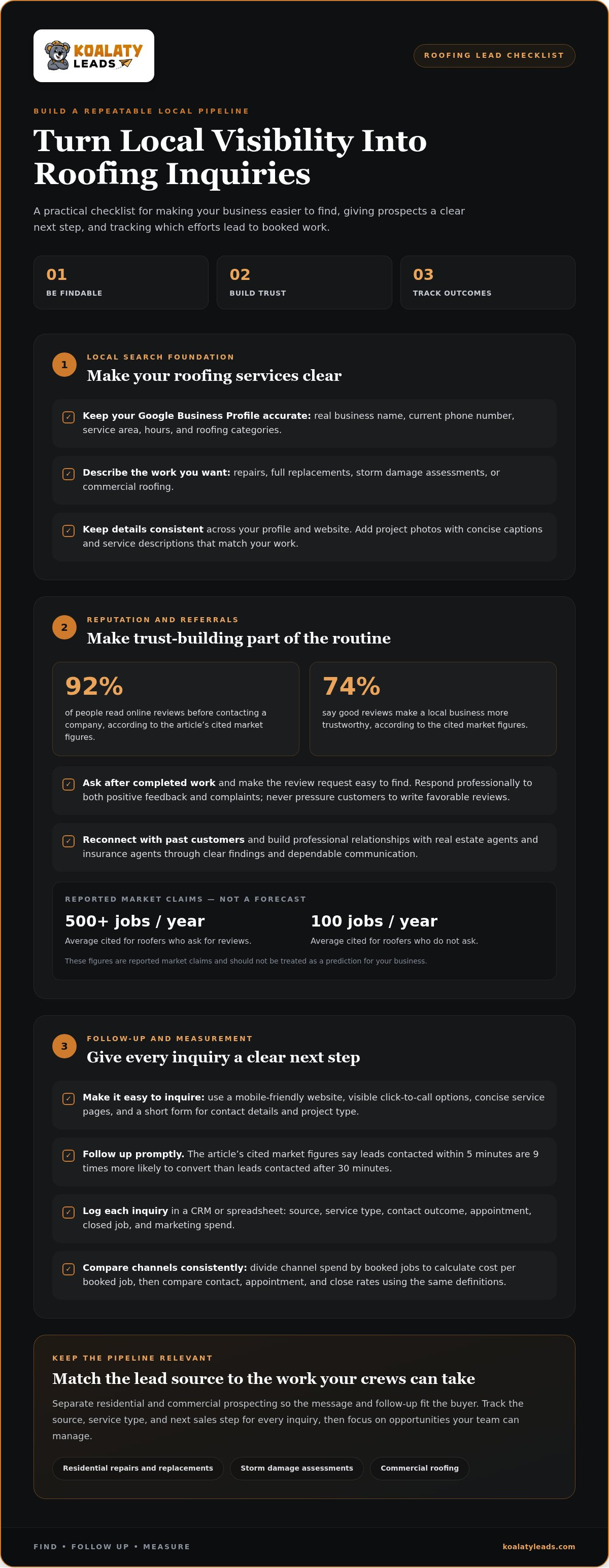
Start with an accurate Google Business Profile. Use your real business name, current phone number, service area, hours, and roofing categories. Add service descriptions that match your work, then upload project photos with concise captions. Keep the information consistent across your website and profile so customers see the same details wherever they find you.
Reviews strengthen that local presence. Ask satisfied customers to leave an honest review, then respond professionally to both positive feedback and complaints. The market figures cited for this topic report that 92% of people read online reviews before contacting a company, and 74% say good reviews make a local business more trustworthy. Make review requests part of project closeout, not an occasional campaign.
Roofers who ask for reviews average more than 500 jobs per year, while those who do not ask average 100 jobs per year. Treat those figures as reported market claims, not a forecast for your business. A steady process matters: ask after a completed job, make the request easy to find, and never pressure customers to write favorable feedback.
Exclusive roofing leads can be valuable because each opportunity goes to one contractor, rather than several contractors pursuing the same prospect. Measure their results by tracking contact, appointment, and close rates, then calculate the cost per booked job.
After a storm or hail event, update your profile and website with relevant service details, publish timely posts, and respond promptly to inquiries. Keep messaging factual and focused on inspections, repair estimates, and the areas your crew serves. This helps storm-affected prospects find relevant services without promising an outcome.
For referrals, contact satisfied past customers and ask whether they know property owners who need roofing work. Build professional relationships with real estate agents and insurance agents by offering clear inspection findings and dependable communication. The market reports that 71% of roofers rely on past-customer word of mouth, and recommends reconnecting with customers from the previous 3 to 5 years.
Make it easy to request a quote with a mobile-friendly website, visible click-to-call buttons, concise service pages, and a short form for contact details and project type. Place recent work and customer reviews near the form. Remove fields that aren’t needed to take the next step.
Track every inquiry in a CRM or spreadsheet. Record its source, contact outcome, appointment, closed job, and marketing spend. Divide channel spend by booked jobs to calculate cost per booked job, then compare channels using the same definitions.
2. Contacting prospects by phone, direct mail, email, and online advertising
Tailor outreach to the prospect’s intent and the roofing service you want to sell. A homeowner requesting a replacement estimate needs a different follow-up from a property manager receiving a commercial roofing mailer. Match each message to its source, then track replies and appointments by channel.
Phone calls work best when they connect to a clear inquiry or relationship. Call promptly after a quote request, introduce your roofing business, and ask what project the prospect wants addressed. Leads contacted within 5 minutes are 9 times more likely to convert than leads contacted after 30 minutes, according to the market figures for this topic. Log the attempt, outcome, and next action so another salesperson can continue the conversation.
Email supports both new inquiries and repeat business. Send a concise follow-up after an estimate, with the next step, contact details, and a relevant example of your roofing services. The market figures report that 88% of people check email every day. They also report that 25.5% of roofers who follow up by email after a job land repeat work. Use an organized list and personalize messages instead of sending the same pitch to every contact.
Direct mail can target a defined neighborhood, property type, or list of commercial prospects. A postcard might introduce your company, describe residential roof assessments, and explain how to request an estimate. Track each campaign with a dedicated phone extension or landing page so you can connect responses to the mailing.
Paid advertising channels include Google search ads, Facebook ads, and other social media campaigns. Google Ads roofing leads average $50-$150 per lead. Facebook Ads and lead-generation company costs depend on targeting, competition, lead intent, and whether an opportunity is exclusive or shared; those costs vary by campaign and provider.
Social media ads let contractors tailor creative to local audiences and specific services. On Facebook, test a project photo against a short video, then compare qualified inquiries rather than reactions. Facebook users spent 33 minutes per day on the platform in the cited social-platform figures. Keep the offer specific, such as a commercial roof assessment or residential replacement estimate.
Send each ad to a focused landing page rather than a general homepage. Use a headline that matches the advertised service, a short inquiry form, and a call option. Add tracking details to campaign links and ask prospects how they found your business. This makes it easier to compare cost per inquiry, booked appointment, and completed job.
Before investing more, review results by source and lead type. If you want to add purchased opportunities, Koalaty Leads provides exclusive roofing leads and live inbound call transfers.
3. Google Ads and paid search
Google Ads can reach people actively searching for roofing help. Organize campaigns around distinct services, such as roof replacement, leak repair, and commercial inspections. This connects search intent with a relevant message and makes it easier to see which services attract suitable inquiries.
Choose search phrases that signal a project, not general interest. “Roof repair estimate” shows different intent from “roofing materials” or “roofing career.” Add irrelevant searches as negative keywords, then review the search-term report regularly. To get roofing leads through paid search, separate buyer intent from research unlikely to become a sales conversation.
Organize each campaign around a specific service and audience. For example, create separate ad groups for residential replacement and commercial roof assessments. Name the service in your ad and give prospects a clear next step. Keep the promise specific and consistent with the landing page, so a commercial roofing search doesn’t lead to a residential repair page.
Use the campaign settings to keep spending aligned with your actual sales capacity. Set a daily budget based on what your team can handle, and limit targeting to areas where crews can take work. If you’re not pursuing a particular project type, exclude its search terms rather than paying for inquiries your sales team can’t use.
Paid search performance depends on more than clicks. Review each inquiry for service fit, location, and project intent, then connect the search term to the sales outcome in your CRM. If a phrase brings calls but few qualified opportunities, revise the keyword, ad, or page. If it attracts suitable prospects, maintain that focused campaign instead of expanding all targeting.
Roofing searches can shift after severe weather. Keep storm-related terms and messaging separate from routine replacement or repair campaigns. This helps you assess whether a spike in damage-related inquiries is producing suitable jobs or simply more unqualified calls. Reflect the work your business can take on, without implying every searcher has a confirmed claim or repair need.
When deciding how to get roofing leads through paid search, measure the campaign by its contribution to booked work, not traffic alone. Review search terms, qualified inquiries, appointments, and sales together. Make one deliberate adjustment at a time, such as narrowing a broad keyword or revising a mismatched ad. Then you can see what changed and whether it helped your pipeline.
98% of consumers start their search online when they need home improvement services such as roofing. Ranking in Google’s local 3-pack is critical for local SEO. Roofing contractors can optimize a Google Business Profile by updating photos, managing reviews, and adding service-specific keywords. Companies with a Google rating of 4.5+ stars dominate local visibility and homeowner trust.
A roofing marketing agency may help with local SEO, Google Ads, lead generation, and website optimization. Contractors can seek leads without paying through a Google Business Profile, local Facebook groups, referrals, and previous customers.
4. Targeting residential and commercial roofing prospects
Residential and commercial prospects enter the sales process for different reasons. A homeowner may contact you about one property, while a commercial buyer may coordinate roofing decisions across several buildings. Shape your lead generation around the buyer’s role, property portfolio, and requested work instead of treating every inquiry alike.
For residential campaigns, distinguish urgent repairs from planned replacements. An active leak calls for a different sales conversation than a future project. Ask what prompted the request and what work the prospect wants considered. That context helps route the conversation to a salesperson prepared for the project.
Commercial prospecting requires more account context. A facilities manager might gather information, while an owner or asset manager approves the work. Identify who started the conversation, who evaluates proposals, and who makes the final decision. If several people are involved, agree on one contact to coordinate next steps before preparing a proposal.
Qualify prospects by confirming their identity, property connection, location, requested work, and decision-making role. To avoid scams or low-quality inquiries, watch for inconsistent details, vague project descriptions, pressure to share sensitive business information, or a contact who cannot explain their authority. Pause and verify the inquiry through a separate, reliable contact channel.
Prepare audience-specific messages before launching outreach. A residential message can address a property owner’s repair or replacement request. A commercial message should reflect the building type, portfolio needs, and procurement process. Match the call to action to the audience, whether that means discussing one property or several sites.
Choose target accounts based on the work your company is equipped to pursue. A roofing company focused on commercial properties can prioritize organizations with buildings that match its experience and capacity. A residential contractor can focus on project types that fit current crew availability. This reduces time spent pursuing unsuitable opportunities.
Prepare sales materials for each prospect type. A residential conversation may need a concise explanation of the project scope and next steps. A commercial prospect may need relevant company qualifications, examples for the building type, and a clear proposal process. Keep materials accurate and tailored so buyers can see how your team understands their project.
Review the pipeline by buyer and project category, not just total inquiry volume. Compare how residential repairs, residential replacements, and commercial opportunities progress through your sales process. If a segment stalls, identify whether the problem is project fit, access to the decision-maker, or proposal readiness. Then adjust targeting and outreach to address that gap.
5. Direct mail and door hangers
Direct mail lets roofing businesses target specific streets, property types, or commercial accounts. Choose one audience and one offer for each mailing. For example, send a residential replacement postcard to a defined neighborhood and track its calls separately from commercial outreach.
Make every piece easy to understand at a glance. Lead with the roofing service, give a clear next step, and include your business name and phone number. Use photos of completed projects rather than generic roof images. Specific examples help recipients connect the message with your services.
Door hangers can support neighborhood lead generation around an active project. Place one on nearby homes while crews are working in the area, and name the service without implying that neighboring properties have damage. A concise message and direct contact method give interested residents a practical way to reach your team.
Yard signs can extend local exposure around a job. Place one shortly before work begins, then leave it up briefly after the final inspection. Ask the customer’s permission first, and ensure the sign displays a readable company name and phone number.
Use a distinct phone number, QR code, or landing page for each mail campaign to identify which postcard or door hanger generated an inquiry. In your CRM, record the campaign, property location, requested work, appointment outcome, and booked job. Compare results by campaign, not just by total calls.
Keep the offer relevant to the timing and location. After a completed roofing job, a contractor can knock on 10 nearby doors to introduce the company and share its contact details. A brief, respectful introduction is more useful than a hard sell, especially when residents have no immediate project.
Match mailing lists to the work your crews can take on. Separate residential addresses from commercial properties, and tailor the message to each audience. A property manager may respond to a concise note about roof assessments, while a nearby homeowner may be more interested in replacement or repair services.
To stand out, use a consistent design across postcards, door hangers, and signs. Include one offer, one call to action, and a trackable response method. Review inquiries and booked work after each mailing, then adjust the audience or message before repeating the campaign.
Koalaty Leads: Roofing Leads
Koalaty Leads provides exclusive roofing leads on a pay-per-lead basis, along with live inbound call transfers for contractors seeking another source of prospects. Exclusive web leads go to one contractor, while a live inbound call transfer connects your team directly with a prospect by phone.
Consider this option when your roofing business needs to supplement in-house lead generation or focus sales effort on incoming inquiries. Match the lead approach to your team’s process: use submitted inquiries when your staff can follow up, or live transfers when your team is ready to take calls. Review the roofing leads available to contractors and discuss your trade and market with Koalaty Leads.
Build a Roofing Pipeline You Can Manage
A durable way to get roofing leads is to build a measurable pipeline and strengthen it with opportunities that fit your team’s capacity. Set a clear process for handling each inquiry, from first response through appointment and follow-up. This gives you a practical basis for deciding where to focus next.
Koalaty Leads provides Roofing Leads, Window Replacement Leads, and Bathroom Remodel Leads. Ask about exclusive web leads or live inbound call transfers for roofing, and discuss how they could fit your current sales process.
Choose a next step that matches your goals, then follow through consistently. A focused pipeline gives your team room to build momentum.
Keep refining your system and your team ready to respond as you work toward more dependable growth.
Frequently Asked Questions
What are roofing leads?
Roofing leads are prospective sales opportunities connected to a roofing need, such as a repair inquiry, replacement request, or commercial project bid. They may arrive through a phone call, online form, referral, or another contact point. A lead is not automatically a booked appointment or a sale. Qualify the project, identify the decision-maker, and determine an appropriate next step.
What are the best ways for roofing contractors to generate leads?
The right approach depends on your crew capacity, ideal project type, and ability to follow up. Build a mix of sources rather than relying on a single channel, then assess which ones produce projects suited to your business. For example, a company pursuing larger commercial work can prioritize opportunities matching its experience, while a residential team can focus on the projects it handles efficiently. Adjust as capacity changes.
How can roofers get leads through Google Business Profile and local SEO?
Use your Google Business Profile to help prospective customers recognize your roofing company and find relevant service information. Link it to website pages that clearly describe your roofing work instead of sending every visitor to a generic homepage. Review profile performance and inquiries to see which services people are seeking. Then make relevant website content easier to find and understand, without forcing keywords into the copy.
Need exclusive leads instead of shared ones? Koalaty Leads delivers qualified homeowners — web leads or live call transfers — to one contractor only.
Get Started