
How to Get HVAC Leads: Strategies for High-Quality Growth

A bigger prospect list can produce fewer HVAC jobs. To learn how to get HVAC leads that turn into booked work, combine local search visibility, referrals, targeted outreach, and carefully selected lead sources. Track which channels generate qualified conversations and profitable jobs. Purchased lists and targeted prospecting are different: one provides contacts to pursue, while the other starts with a defined audience and a tailored approach.
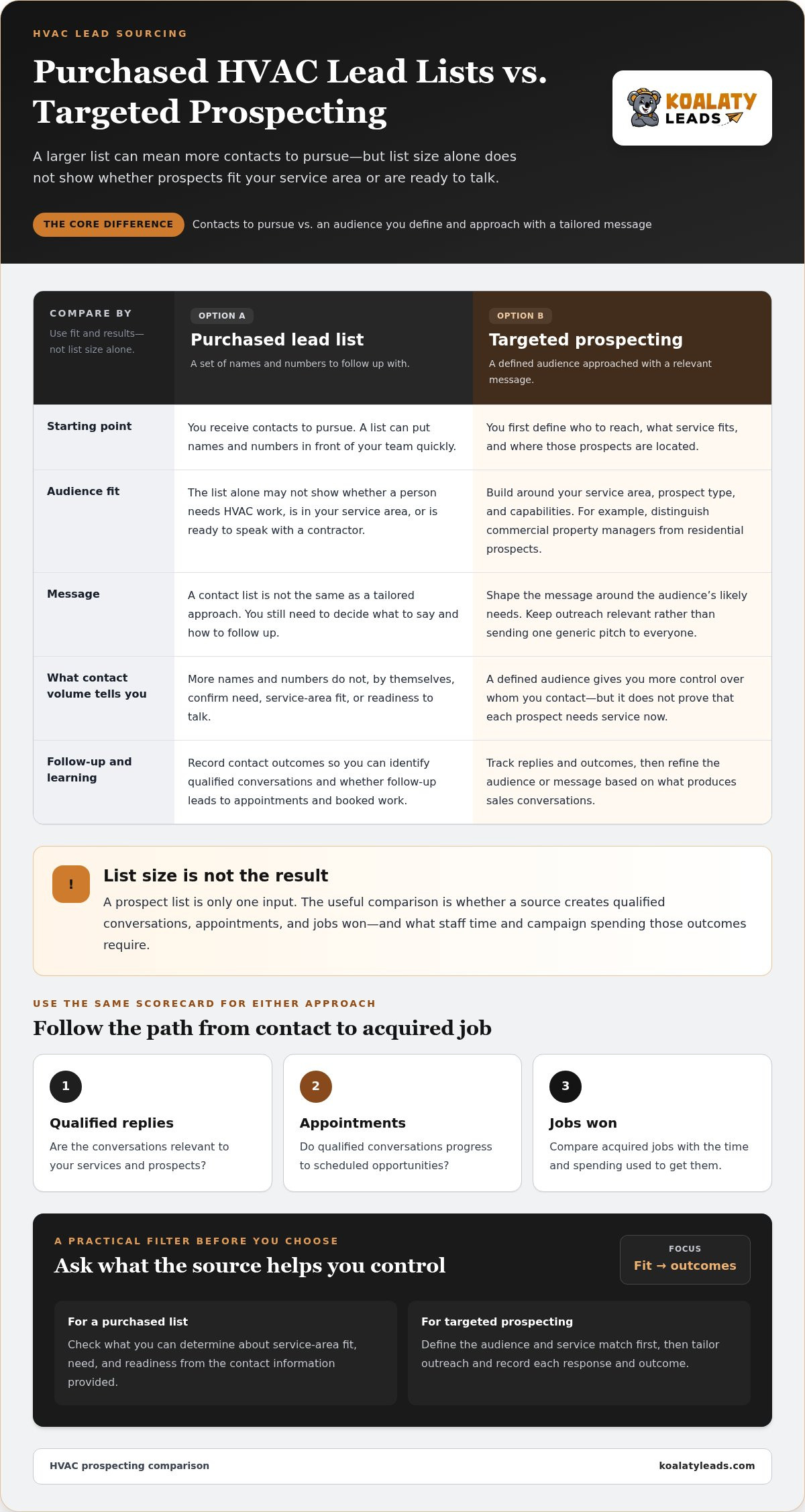
A list of names and numbers can put prospects in front of your team quickly. But volume alone does not show whether those people need HVAC work, are within your service area, or are ready to speak with a contractor. A focused pipeline gives you more control over whom you contact and how you follow up.
This guide covers practical ways to find HVAC prospects through local visibility, outbound campaigns, and referrals, plus the trade-offs between purchased lists and targeted prospecting. It also explains how to assess each channel by contact quality, appointment potential, close rate, and cost per acquired job, so you can prioritize sources that fit your team’s capacity and growth goals.
Key Takeaways
- Build outbound campaigns around a defined prospect profile and a relevant message instead of sending the same pitch to a broad list.
- Use local social content, customer reviews, and referral offers to strengthen trust and encourage more HVAC inquiries.
- Compare purchased lists with targeted prospecting by fit, contactability, appointment potential, and cost per acquired job, not by list size alone.
- Make it easy for prospects to find and contact your business with relevant service content, clear booking prompts, and an accurate Google Business Profile.
- Track which channels create qualified conversations and booked work so you can focus time and budget on the sources that perform for your business.
1. Creating targeted outbound email, LinkedIn, and call campaigns
Targeted outbound works best when each HVAC campaign starts with a clear prospect and service fit. Separate commercial property managers from residential customers, then tailor the message to their likely need. According to Biscred, 5% of B2B buyers are actively in-market at any given time, so relevant follow-up matters more than sending one generic pitch.
For U.S. outreach, follow the rules that apply to each contact channel and record contact preferences. Identify your business clearly, use accurate subject lines, and stop messages when someone opts out. Before launching, review applicable federal and state requirements for calls, texts, and commercial email.
For another perspective on HVAC prospecting, watch Matteo Chiodo’s video:
Build a focused list before writing. Identify facilities in your service area, note property types, and prioritize prospects whose needs match your capabilities. A property manager overseeing 150 office buildings has a different scope from one managing three properties. Use those details to personalize outreach without assuming either prospect needs service now.
Write each email around one useful next step, such as discussing maintenance planning or service coverage. Name the relevant service in the subject line, explain why you’re reaching out, and make the requested action clear. Targeted email marketing can earn $40 for every $1 spent, but that reported return isn’t a forecast for your campaign.
On LinkedIn, search by role for facilities staff, property managers, or business owners. Connect with a brief note relevant to their work, then follow up with something useful, such as a seasonal maintenance-planning checklist. Avoid sending the same pitch to every connection. A role-specific message gives recipients a reason to respond.
Call prospects who match your criteria. Prepare a concise opener, confirm whether the person handles HVAC decisions, and record the outcome. A simple call log helps distinguish interested prospects from wrong contacts and people who do not want further contact.
Social media and direct mail can reinforce one targeted message. Share a practical HVAC tip on LinkedIn, then mail a postcard with a matching service offer to a defined group of commercial prospects. Keep the message consistent across channels and track each campaign separately.
Review campaign results by qualified replies, appointments, and jobs won. Compare those outcomes with staff time and campaign spending, then refine the audience or message. This helps HVAC contractors identify outreach that creates sales conversations, not just activity.
2. How to get more customers for HVAC?
Use social content, customer feedback, and referrals to create more local opportunities. Give each tactic a clear purpose: build familiarity, strengthen trust, or encourage a past customer to return.
Facebook posts can feature recent installations, practical repair tips, and seasonal service reminders. For example, share a completed installation with permission and explain what work your team performed. A useful post gives local prospects a concrete reason to remember your HVAC business.
Reviews can influence a prospect’s decision to contact a contractor. A consumer survey found that 94 percent of consumers said positive reviews make them more likely to use a business, and prospects read an average of 10 reviews before trusting one. Nine out of 10 people check reviews before choosing a business. Northwestern University reported that purchase likelihood for a product with five reviews was 270% greater than for one with no reviews.
After completing a job, invite the customer to leave an honest review on Google or Facebook. A follow-up text with a direct review link makes it easy to respond. Track requests and responses, then use recurring feedback themes to improve how your team communicates with customers.
A referral program gives past customers a straightforward way to recommend your company. Choose a reward that suits your business, such as six months of Comfort Club maintenance service, a free indoor air quality service, or cash. You could also offer entry into a drawing for a referral reward check. Explain the process and reward clearly.
Make the path from website interest to inquiry straightforward. A mobile-friendly service landing page can include customer reviews, a concise description, and a visible booking call to action. Keep the form focused on useful details, such as the service requested and the best way to respond, so your team can route the inquiry appropriately.
Match seasonal posts and landing pages to the services you are promoting, and name only the areas you serve. For example, a seasonal maintenance post should link to a maintenance page, not a general page that leaves prospects unsure where to go.
To qualify inquiries, record the requested service, location, timing, and outcome. Track contacts through appointments and booked jobs, then compare campaign spending with jobs acquired. Segmenting results by service and lead source helps HVAC contractors identify which customer-acquisition efforts support profitable work.
If you’re considering another source of inquiries, discuss lead options for your market.
3. Comparing purchased lead lists with targeted prospecting
No single HVAC lead platform is right for every contractor. Google Ads and Local Services Ads can capture local search demand; marketplaces route inquiries through their systems; purchased lists provide contacts for outbound sales. Compare options by prospect intent, exclusivity, contactability, and the follow-up effort required from your team.
There is no universal price for HVAC leads from Google Ads, Local Services Ads, or lead-generation platforms. Google Ads costs vary with keywords, location, and competition, while other platforms use their own pricing models. Compare actual spending with qualified inquiries, appointments, and acquired jobs instead of relying on a headline cost per click.
| Source | What you receive | Trade-off to assess |
|---|---|---|
| Purchased contact list | Names and contact details for outreach | Your team must establish interest and fit |
| Targeted prospecting | Contacts selected for a defined HVAC fit | Research and outreach require staff time |
| Google Ads | Visibility for searches using selected keywords | Spend varies with competition and campaign setup |
| Lead marketplace | Inquiries routed through a platform | Shared leads may be sold four to five times |
A purchased list provides contact information, not proof that a prospect currently needs HVAC work. Data may be outdated, incomplete, or poorly matched to your service area. Before buying, review the list’s source, fields, recency, and prospect type. Check whether it supports the residential or commercial work your team wants.
Targeted prospecting starts by defining the ideal account and its decision-maker. A research example is building a curated list of 500 qualified prospects rather than blasting 10,000 irrelevant contacts. Those figures illustrate precision, not a required list size. For HVAC companies, qualification could include property type, service fit, and whether the contact influences vendor decisions.
Compare platforms by their lead model as well as their advertised reach. Find out whether inquiries are exclusive, shared, or aged, and how each source defines a lead. A fresh inquiry sent to multiple contractors creates a different sales situation from a researched business contact your team approaches directly.
Track every source through the same stages: inquiry or first contact, appointment, estimate, and closed job. Record spending and staff time alongside contact and close rates. Dividing source costs by acquired jobs gives you a practical cost-per-job comparison; revenue from those jobs helps assess payback.
Choose based on fit, not volume alone. A team with time and skill for outreach may prefer targeted prospecting; a contractor seeking inbound inquiries may test a search campaign or lead platform. Compare results over a defined review period, then shift investment toward sources that produce qualified conversations and profitable work.
4. What are the most effective ways for HVAC contractors to generate leads?
Effective HVAC lead generation links local visibility to a clear next step. Build around three channels: useful service content, paid search, and responsive inquiry handling. Give each channel a trackable landing page, such as one focused on furnace repair or heat-pump installation. Then compare qualified inquiries and booked work by source.
Start with service pages built around the work your team performs and the places you serve. Use relevant keywords naturally, such as “AC repair in [city]” or “commercial HVAC maintenance in [area].” Each page should address a prospect’s immediate need, explain your service, and provide a clear way to request it.
Choose a relevant domain name and a mobile-friendly website that displays clearly on phones. Link from your general HVAC page to specific service pages, and include credible external resources when they add useful context. Add customer reviews and a clear booking call to action, so visitors can move from research to inquiry.
Short TikTok videos can introduce your expertise to local prospects without extensive production. Demonstrate a practical maintenance tip, explain a common service issue, or show a completed installation with the customer’s permission. Direct viewers to the matching service page instead of leaving them to decide what to do next.
Paid search can capture active demand when campaigns use relevant service keywords and target only areas your team serves. Separate ad groups for “AC repair” and “commercial HVAC maintenance,” for example, so each search leads to a closely matched page. Review search terms and location settings regularly, and pause traffic outside your service area.
Response handling matters after a form submission or phone inquiry. AI tools can answer calls, book jobs, handle rescheduling and urgent requests, and engage website visitors. Set clear workflows for common requests, such as routing a maintenance inquiry to scheduling and a complex commercial request to the appropriate staff member.
Track more than clicks. Record the lead source, requested service, service area, contact outcome, appointment, and closed job in your CRM. If a paid search campaign produces inquiries but few appointments, for example, review keyword intent, landing-page fit, and follow-up before increasing its budget.
Use a consistent review cycle to decide where to invest. Compare content, TikTok, paid search, and call handling by qualified leads and cost per acquired job. Keep campaigns tied to services and locations your HVAC business can support, and improve the pages or processes where prospects stop progressing.
5. How can HVAC companies get leads through Google Business Profile and local SEO?
A complete Google Business Profile helps local searchers understand what your HVAC company does and where you work. Tommy Mello says consumers in the United States find 70 percent of all services online through Google searches. Treat your profile as a key point of contact, not a set-and-forget listing.
Start by checking your business name, phone number, hours, and service areas. Keep those details consistent with your website, especially if your company serves nearby cities. If your team covers Mesa and Tempe, for example, make sure both locations are described accurately wherever you list your service area.
Choose profile categories and service descriptions that reflect your HVAC work. A company that handles air conditioning repair, furnace service, and system installation should describe those services clearly. Accurate details help prospective customers decide whether your business fits their search before they call.
Use profile updates to share useful business information, such as seasonal service reminders, new offerings, or changes to operating hours. Keep each update specific. A post about preparing for summer demand should point to the relevant service page rather than sending every visitor to a generic homepage.
Local SEO supports your profile with focused website content. Build separate pages for distinct services and the locations your team serves. A page targeting “furnace repair in Mesa” should explain the service, name the area naturally, and provide a clear way to request an appointment.
Make location pages genuinely useful. Include available services, nearby cities, and a direct call or booking action. Avoid creating near-identical pages that only swap city names. For example, add specific details about service coverage in Tempe instead of duplicating the Mesa page word for word.
Connect those pages with clear internal links. Link a general HVAC services page to relevant repair, maintenance, and installation pages so visitors can quickly find the next step. Use descriptive link text, such as “air conditioning repair,” rather than vague labels that provide no context.
Measure profile and local search performance by tracking calls, booking requests, and completed jobs by source. Compare those outcomes with your service areas and the pages visitors used. If a location page attracts inquiries from outside your operating area, revise its coverage language and booking path.
Accurate profile details, useful local pages, and clear booking actions give searchers a direct route to your team. Review them regularly, especially when your hours, services, or coverage areas change.
Koalaty Leads: Roofing Leads
Koalaty Leads provides Roofing Leads for contractors building or expanding a roofing sales pipeline. If HVAC is your priority, focus your lead strategy on HVAC prospects: roofing inquiries serve a separate trade and sales process.
Roofing Leads may suit your business if you also serve roofing customers and have the capacity to follow up on that work. Koalaty Leads also offers Window Replacement Leads, Bathroom Remodel Leads, and Kitchen Remodeling Leads for contractors serving those remodeling markets.
For help identifying whether roofing leads fit your business goals, contact Koalaty Leads.
Build a lead system you can keep improving
Your next growth decision is which lead source to make a consistent part of your sales process. As you decide how to get HVAC leads, define what makes an inquiry valuable to your business and use that standard to guide spending and follow-up. Measure progress by booked work, not impressions or assumptions.
No single channel suits every contractor. Your service area, preferred work, and sales process all shape how to get HVAC leads effectively. Refine your approach as you learn which prospects fit and which steps help them move forward.
For contractors considering another source of HVAC inquiries, Koalaty Leads offers HVAC leads and live transfers. Discuss options for your trade and market with the team, then decide whether they fit your pipeline.
Keep building with focus. A stronger pipeline starts with deliberate choices and a process your team can sustain.
Frequently Asked Questions
Where can I get HVAC leads?
HVAC leads can come from local search, paid advertising, referrals, direct outreach, and lead providers. Match the source to the work you want: search campaigns can capture people seeking a specific service, while referrals may come through existing customer relationships. Before adding a source, decide how your team will qualify inquiries and record outcomes. That makes it easier to compare channel quality and return.
How can I advertise my HVAC business?
Promote your HVAC business through local search campaigns, social media, and service-focused website pages. Build each campaign around a clear offer, such as maintenance or system replacement, and direct prospects to a page explaining that service. Track calls and forms separately by campaign to see which messages bring qualified inquiries, rather than judging results by views or clicks alone.
How do I get HVAC sales?
Turn inquiries into HVAC sales with a consistent process: respond, understand the requested work, confirm the prospect’s decision-making role, and agree on a clear next step. A caller seeking a replacement estimate, for example, needs a different conversation from a property manager asking about ongoing service. Record the outcome in your CRM, including why a prospect did not proceed. Those details can improve future qualification and follow-up.
How to get more customers for HVAC?
To attract more HVAC customers, make your business easy to find and contact. Keep service descriptions consistent across your website and business profiles, and give each service page a clear inquiry path. Someone researching maintenance, for example, should reach a page focused on maintenance, not a generic list of every service. Review inquiries regularly to spot gaps in the services or information prospects request.
How can HVAC contractors get referrals and repeat-business leads?
HVAC contractors can encourage referrals by asking satisfied customers to recommend the business and making introductions simple. For repeat business, organize customer records by service history and send relevant follow-ups, such as a maintenance reminder after a previous appointment. Keep messages useful and specific to the customer’s past work. Track referrals and returning customers separately in your CRM to see how these relationships contribute to booked jobs.
What are the rules for buying HVAC leads and contacting prospects by phone, text, or email in the U.S.?
Before buying a list, review its source, fields, recency, prospect type, and fit with your service area and work. For outreach, identify your business clearly, use accurate email subject lines, record contact preferences, honor opt-outs, and review applicable federal and state requirements for calls, texts, and commercial email.
Need exclusive leads instead of shared ones? Koalaty Leads delivers qualified homeowners — web leads or live call transfers — to one contractor only.
Get Started