
How to Buy Solar Leads: A Guide for High-ROI Growth

The right solar lead isn’t the one with the lowest sticker price. It’s the one your team can contact, qualify, and convert into a profitable installation. When you buy solar leads, weigh the delivery format and follow-up demands against your sales capacity, then judge the source by the jobs it helps you acquire.
Lead volume and cost per lead are useful starting points, but they don’t show whether your spend is working. Track contactability, appointments, closed jobs, and acquisition cost to see whether leads are supporting growth or consuming your sales team’s time.
This guide explains how to compare solar lead formats, measure campaign economics, and set buying criteria around your pipeline. It also covers how to match exclusive leads or live transfers to your team’s sales process, so you can make decisions using your capacity and job economics rather than guesswork.
Key Takeaways
- Before you buy solar leads, define what makes an opportunity a fit for your projects and sales process.
- Compare exclusive, shared, aged, live-transfer, and preset-appointment formats by how they’re delivered and how much follow-up they require.
- Track contact, appointment, and close rates alongside cost per lead to understand your cost per acquired job.
- Set response ownership, qualification rules, sales capacity, and CRM tracking before launching a campaign.
- Koalaty Leads provides exclusive solar leads, inbound calls, and live call transfers for contractors.
Buy Solar Leads With a Clear Definition of a Qualified Opportunity
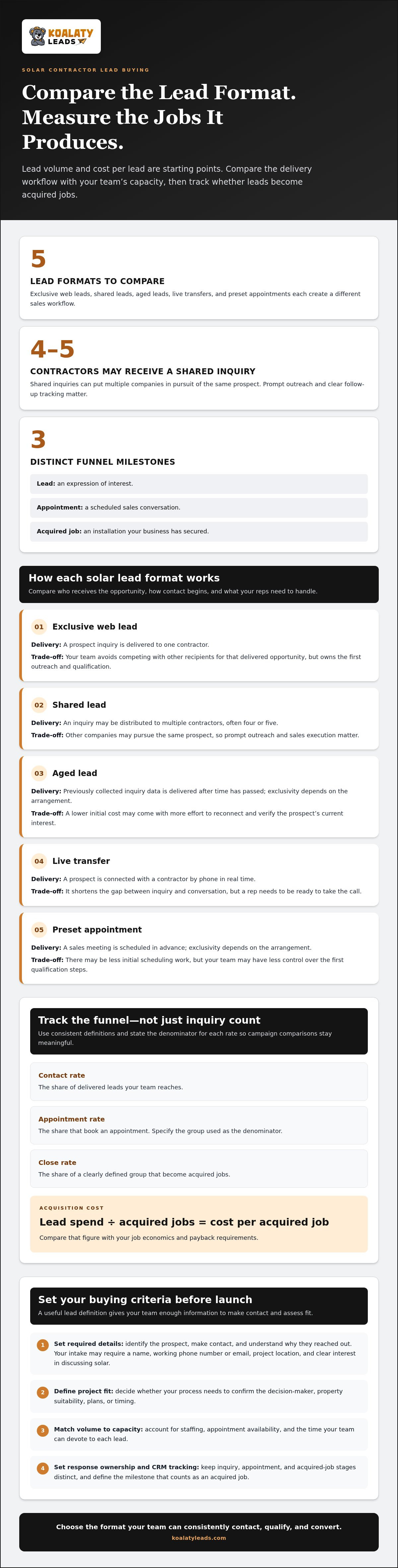
Before you buy solar leads, define the opportunity your sales team can work: a reachable prospect with a relevant project, enough intent for a useful conversation, and a fit with your service criteria. A lead is not automatically an appointment, and an appointment is not a completed installation.
A lead is an expression of interest, an appointment is a scheduled sales conversation, and an acquired job is an installation your business has secured. Keep those stages distinct in your CRM and in your campaign terms. This prevents a high inquiry count from being mistaken for a full sales pipeline.
Solar is a broad category, so your team needs to define what information it uses to assess fit. For general background, solar energy is radiant light and heat from the Sun. Your lead criteria, however, should reflect your own sales process and project requirements. Koalaty Leads provides solar leads for contractors to evaluate against those criteria.
What should count as a solar lead?
At minimum, your team needs enough information to identify the prospect, make contact, and understand why they reached out. Depending on your intake process, that may include a name, a working phone number or email, the project location, and a clear indication of interest in discussing solar. Set your required fields before a campaign begins, so your team can distinguish an actionable inquiry from one that lacks the details needed for follow-up.
Then qualify for project fit and intent using questions your sales process can act on. Depending on your criteria, that could mean confirming the prospect is the decision-maker, establishing whether the property suits the work you perform, and understanding their plans and timing. An inquiry shows interest; verified intent indicates willingness to discuss a relevant project; an appointment is a scheduled conversation. Define the sales milestone that counts as an acquired job, such as a signed agreement, and apply it consistently.
Match the criteria to how your team sells. If the first call is designed to establish basic fit, don’t require details that reps can only determine during a consultation. If your process depends on specific information before an appointment is worthwhile, make that a qualification rule and track whether the information is captured.
Why lead volume alone can mislead solar contractors
More inquiries can create a fuller queue without creating more sales capacity. If new leads outnumber the prospects your team can contact and qualify promptly, follow-up can slip and reps may spend time on opportunities that don’t fit your work. Set a workable flow based on staffing, appointment availability, and the time your team can devote to each lead.
Measure the funnel using consistent definitions. Contact rate is the share of delivered leads reached; appointment rate is the share that book an appointment; close rate is the share of a clearly defined group that become acquired jobs. Specify the denominator for each metric, such as all delivered leads or all appointments attended. Without a consistent denominator, campaign comparisons can mislead.
Connect those stages to acquisition cost. Divide lead spend by acquired jobs to calculate cost per acquired job, then compare that figure with your job economics and payback requirements. A qualification standard is useful when it helps your team identify opportunities it can contact, advance, and close.
Compare Solar Lead Types Before You Buy
The right format depends on how your sales team works. Before you buy solar leads, compare who receives the opportunity, how the first contact happens, and how much follow-up your reps must own. Koalaty Leads provides exclusive solar leads, inbound calls, and live call transfers.
These formats aren’t interchangeable. A form submission puts the first outreach step on your team; a live transfer connects a prospect and rep in real time. The U.S. Department of Energy provides information on solar energy deployment and market trends, but your buying decision should also account for the workflow your team can consistently support.
| Format | Delivery and exclusivity | Response workflow | Operational trade-off |
|---|---|---|---|
| Exclusive web lead | A prospect submits an inquiry that is delivered to one contractor. | Your team makes the first outreach and qualifies the prospect. | You avoid competing with other recipients for the same delivered opportunity, but your team owns follow-up. |
| Shared lead | An inquiry may be distributed to multiple contractors, often four or five. | Reps need a process for prompt outreach and clear tracking. | Other companies may pursue the same prospect, so response speed and sales execution matter. |
| Aged lead | Previously collected inquiry data is delivered after time has passed; exclusivity depends on the arrangement. | Reps need to re-establish interest and confirm the prospect’s current plans. | A lower initial cost may come with more effort to reconnect and verify relevance. |
| Live transfer | A prospect is connected with a contractor by phone in real time. | A rep needs to be ready to take the call and guide the first conversation. | It shortens the gap between inquiry and conversation, but requires call-handling capacity. |
| Preset appointment | A sales meeting is scheduled in advance; exclusivity depends on the arrangement. | Your team prepares for and attends the scheduled conversation. | Less initial scheduling work may mean less control over the first qualification steps. |
Exclusive versus shared solar leads
A shared inquiry can be sent to several contractors, creating competition for the prospect’s attention. An exclusive opportunity is delivered to one contractor, removing that specific lead-sharing competition. It does not remove the uncertainty of whether the prospect will answer, qualify, or buy. Koalaty Leads sells exclusive opportunities, not shared leads.
Compare costs only after matching the terms: qualification criteria, delivery method, exclusivity, and what counts as a valid lead. A lower quoted cost may reflect a different workflow or level of qualification. Compare each format against your own contact, appointment, and close data, rather than judging by the quoted lead price alone.
Web leads, aged leads, appointments, and live transfers
Web leads and aged records require your team to initiate or renew contact. A live transfer is an active phone conversation, not a form submission or a scheduled meeting. A preset appointment is a calendar commitment, not a completed sales conversation or a sale; its qualification depends on how it was set.
Choose a format that fits your operations. If reps can respond to inquiries and follow a defined outreach process, web leads may suit that workflow. If your team can handle calls as they arrive, live transfers may fit better. To discuss exclusive opportunities or call-based formats for your market, review our solar lead options.
Measure Solar Lead Economics Beyond Cost per Lead
Cost per lead shows what you paid to generate an inquiry, not whether that inquiry became a profitable installation. Cost per lead alone can’t establish campaign profitability because it leaves out contact, appointment, close, and job-margin outcomes. To compare sources fairly, use your CRM and define each metric, denominator, campaign cost, and attribution window before reviewing results.
Use the same formulas across campaigns. Calculate the figures from your own records instead of assuming that a lead source will perform at a particular rate.
| Metric | Calculation | What it helps you assess |
|---|---|---|
| Cost per lead | Campaign lead spend ÷ leads delivered | The acquisition cost for each delivered inquiry. |
| Contact rate | Unique delivered leads reached ÷ leads delivered | Whether your team can connect with the prospects. |
| Appointment rate | Appointments booked ÷ unique leads reached | How often a conversation advances to a scheduled meeting. You can also track appointments per delivered lead, but label that denominator clearly. |
| Close rate | Acquired jobs ÷ attended appointments | How effectively attended sales opportunities become jobs. Keep this denominator consistent when comparing sources. |
| Cost per acquired job | Tracked campaign costs ÷ acquired jobs attributed to the campaign | The cost of generating a job, rather than just an inquiry or appointment. |
Calculate cost per acquired solar job
Start by defining which costs you intend to compare. For a lead-only view, include lead spend. For a fuller acquisition view, you might also include campaign management or sales labor if you can attribute those costs consistently. State the boundary in your reporting, and don’t compare a lead-only figure from one source with a fully loaded figure from another.
Set an attribution window that reflects your actual sales cycle, and use the same job definition for every source. For example, decide whether “acquired” means a signed agreement or another specific milestone, then count it consistently. If you’re assessing exclusive solar leads, keep their spend and attributed outcomes identifiable in your CRM.
Use funnel metrics to diagnose weak returns
Read the funnel from first contact through the acquired job. A low contact rate may point to delivery details or follow-up execution; a low appointment rate among reached leads may signal a mismatch in project fit or qualification; a weak close rate after attended appointments can indicate a sales-process issue. Treat these as diagnostic clues, then review call outcomes and lead records before deciding what to change.
Use your own average job value and gross margin to judge whether acquisition cost and payback fit the business. Job value is revenue, while gross margin reflects what remains after the costs included in your margin calculation. The Solar Energy Industries Association tracks solar market growth and policy, but industry context doesn’t replace your campaign data.
Review results alongside the assumptions behind them. If qualification rules, staffing, or the sales process changed during the reporting period, separate those conditions in your analysis rather than treating the full period as one uniform test. This helps you distinguish a lead-source issue from a change in how the team handled opportunities.
Use This Solar Lead Buying Checklist Before Launch
A disciplined launch starts before the first opportunity arrives. If you plan to buy solar leads, set your project criteria, sales capacity, response ownership, and tracking rules first. Then review performance against the terms you agreed to.
- Define target project fit. Specify the project types your team handles, the locations you can serve, and the characteristics that make an opportunity relevant to your installation process. Write down clear disqualification reasons, such as a project outside your scope or a prospect who isn’t the decision-maker.
- Set qualification rules. Decide what your team needs to learn before treating an inquiry as qualified. Separate information captured at intake from details a rep can establish during follow-up, and document what counts as a valid contact, appointment, and acquired job.
- Choose the delivery format and record the terms. Note whether the opportunity is a web lead, inbound call, or live transfer. Record the quoted commercial terms, how exclusivity is defined, and what the provider counts as a delivered lead. Keep the terms tied to the format you’re evaluating; don’t assume one provider’s definitions apply to another.
- Match the test scope to sales capacity. Estimate how many new opportunities your team can work while maintaining its usual follow-up and appointment standards. Set a test scope your reps can manage, rather than treating a higher volume as an automatic advantage.
- Assign response ownership. Name who handles initial contact, follow-up attempts, appointment setting, and CRM updates. Establish a handoff for missed calls or unworked inquiries, so responsibility doesn’t disappear between marketing and sales.
- Configure CRM attribution before launch. Create a distinct source or campaign label and capture delivery date, contact attempts, qualification outcome, appointment status, and job outcome. Decide how long you’ll attribute resulting jobs to the campaign, then apply that same window consistently.
- Review outcomes and document changes. Compare delivered opportunities with contact, appointment, and acquired-job records over a consistent reporting period. Record changes to qualification, staffing, follow-up, or sales scripts before assessing the next period, so you can distinguish lead-source performance from process changes.
Use the results to locate the constraint, not just to judge the lead source. If contact is weak, examine delivery and response execution; if appointments don’t progress to jobs, review qualification and sales follow-through. A clear record of criteria, capacity, quoted terms, and campaign changes gives your team a fair basis for its next decision.
If you’re comparing formats, talk with Koalaty Leads about exclusive solar leads and live transfers that fit your sales process.
Buy Exclusive Solar Leads and Live Transfers From Koalaty Leads
Once you’ve defined a qualified opportunity and mapped the numbers you’ll use to measure performance, match delivery to your sales workflow. Koalaty Leads provides solar leads, including exclusive leads, inbound calls, and live call transfers.
Exclusive delivery means an opportunity is delivered to one contractor rather than shared with competing contractors. Your team can manage follow-up without racing other recipients for the same inquiry. Exclusivity doesn’t guarantee contact, an appointment, or a sale. Results still depend on project fit, prospect intent, your response process, and sales execution.
Match exclusive opportunities or live transfers to your sales process
An exclusive lead can suit a team prepared to receive inquiries, make initial contact, and manage follow-up through its CRM. It fits a process where reps qualify prospects and schedule the next conversation without competing for the same delivered lead.
Live transfers fit a different workflow: a rep needs to be ready to engage an inbound caller directly in real time. Decide who will take calls, how they’ll be routed internally, and what happens if the assigned rep is unavailable. Choose a format that fits your current capacity, not an assumption about future staffing.
Both options call for consistent tracking. Record each opportunity from delivery or call through appointment and job outcome, then assess results using the same definitions and reporting window. The format changes how the first conversation starts, but your team still owns qualification and the sales process.
Start a solar lead conversation with the right information
Bring a practical outline of your business and sales process. Describe your solar trade focus, the project types you want to pursue, how your team handles new inquiries, and the follow-up capacity you can support. Be specific about the criteria your sales team uses to decide whether an opportunity fits.
Identify your performance measures before the conversation, too. Decide which CRM fields will capture source and outcome, who will maintain those records, and how you’ll assess contact, appointment, close, and acquired-job results. This gives you a clear basis for discussing fit and reviewing performance later.
Koalaty Leads provides exclusive solar opportunities and live call transfers for contractors. Bring your target project fit, follow-up plan, and measurement approach to discuss which format aligns with the way your team sells. No lead format guarantees a completed installation, so ground your decision in your process and campaign results.
Make Your Next Solar Lead Decision With Confidence
Turn your growth goals into a focused decision about the opportunities your business is prepared to pursue. As you decide whether to buy solar leads, tie the discussion to your operating priorities and the outcomes that matter to your team, not to promises of results no lead source can make.
A useful partner conversation should clarify how exclusive opportunities or live calls relate to your sales process, what commercial terms apply, and how you’ll evaluate the campaign. Koalaty Leads provides solar leads, inbound calls, and live call transfers, with exclusive opportunities delivered to one contractor rather than shared with competing contractors.
Bring your goals, preferred sales workflow, and performance measures. Then choose a next step your team can support and assess using consistent records.
Frequently Asked Questions
How much do solar leads cost?
Solar lead pricing varies by format, qualification, exclusivity, and delivery terms, so there isn’t one price that applies to every campaign. Before you buy solar leads, compare the quoted amount with your own contact, appointment, close, and acquired-job data. Check what the quote covers and whether the lead definition matches your expectations. A lower cost per lead doesn’t automatically mean a better return if fewer opportunities become jobs.
Are exclusive solar leads better than shared leads?
Exclusive leads go to one contractor, while shared leads may be distributed to multiple companies. Exclusivity can reduce direct competition over the same inquiry, but it can’t ensure that a prospect responds or proceeds with a project. Consider how each format fits your team’s follow-up capacity and qualification process. Then compare campaign outcomes using your CRM records, including how many leads become appointments and acquired jobs.
What is the difference between a solar lead and a live transfer?
A solar lead may arrive as an inquiry that your team needs to contact; a live transfer connects your team with an inbound caller in real time. That changes the first action for your sales staff. Form inquiries need an assigned follow-up process, while a transferred call needs a rep ready to speak with the caller. Neither format guarantees a completed installation, so record outcomes consistently.
How many solar leads should a contractor buy?
There’s no universal number that fits every installer. Base your test scope on who can respond, qualify prospects, and manage follow-up without neglecting current opportunities. Consider your active pipeline and appointment availability, too. If your team can handle only a limited number of new conversations, a larger flow may create a backlog rather than useful sales activity. Start with a manageable scope, measure results, and adjust based on capacity and outcomes.
How can I tell whether buying solar leads is profitable?
Follow campaign spend through to acquired jobs, then calculate cost per acquired job using a consistent job definition and attribution period. Compare that cost with job value and gross margin from your own business records, not revenue alone. A campaign can produce signed work yet still fall short of your margin target. If CRM records don’t connect the original lead source to the outcome, improve attribution before deciding whether the campaign paid off.
Are live-transfer solar leads the same as booked appointments?
No. A live transfer connects a caller with your team during the interaction, while a booked appointment is scheduled for a later time. The first requires a rep available to engage on the call; the second requires a process for preparing for and attending the scheduled meeting. For a fair comparison, record the delivery event first, then track whether it led to an appointment and an acquired job.
What should I track when testing a solar lead provider?
Track enough detail to explain what happened after each opportunity arrived. In your CRM, record its format, delivery date, qualification details, contact attempts, appointment outcome, close status, and acquired-job value. Add a consistent reason when a prospect doesn’t advance, such as poor project fit or no response. Reviewing those loss reasons alongside conversion stages can show whether to refine targeting, follow-up, or sales execution.
Need exclusive leads instead of shared ones? Koalaty Leads delivers qualified homeowners — web leads or live call transfers — to one contractor only.
Get Started