
Home Improvement Leads: A Buying Guide for Remodelers

The lowest-priced home improvement leads can become your most expensive acquisition channel if they bring weak intent, duplicate outreach, or projects your team can’t take on. A lead’s real value depends on trade fit, exclusivity, response speed, and the economics of the jobs you win, not cost per lead alone.
Lead quality and buyer intent vary, and shared opportunities can put several contractors in competition for the same prospect. This guide explains how to compare lead sources and buying models, estimate acquisition costs using your own sales data, and assess whether opportunities fit your trade, follow-up process, and available capacity. Use that framework to choose leads based on the work they can realistically produce.
Key Takeaways
- Separate a homeowner inquiry from a booked job so you measure lead sources by outcomes, not activity.
- Compare home improvement leads by competition, delivery timing, qualification details, and the follow-up your team must provide.
- Calculate cost per acquired job by dividing total lead spend by the jobs won, then compare the result with your job economics.
- Match each opportunity to your trade, service scope, crew capacity, and ability to respond promptly.
- Run a measured test and track delivery, contact attempts, appointments, wins, and acquisition cost before deciding whether to continue.
What Home Improvement Leads Mean for Your Contracting Business
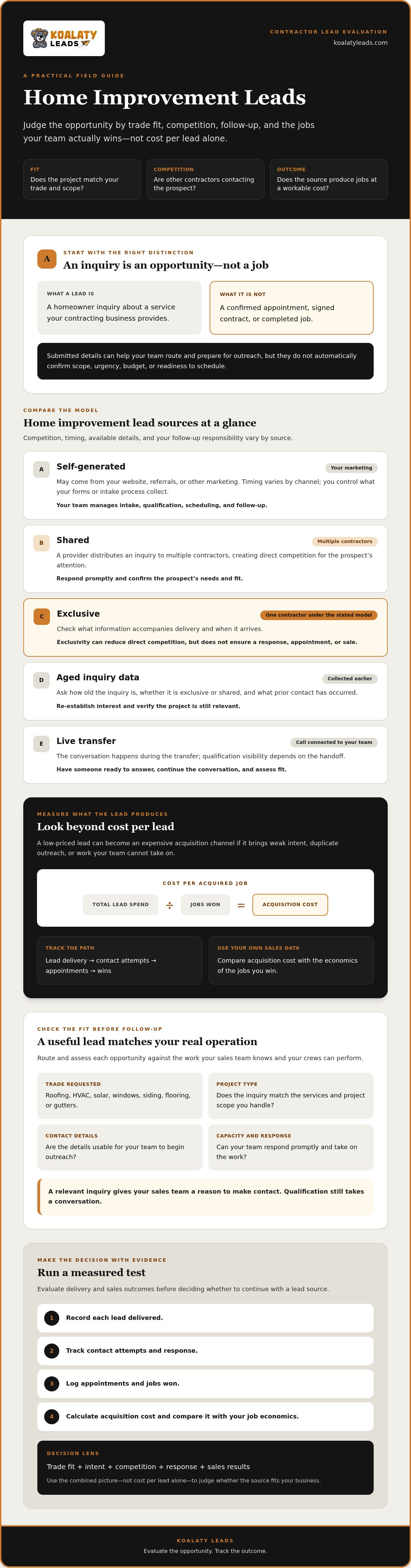
Home improvement leads are homeowner inquiries about services your contracting business provides. An inquiry is an opportunity to start a sales conversation, not a booked appointment, signed contract, or completed job.
Lead generation is the process of identifying potential customers and connecting them with a business. For contractors, what happens after an inquiry arrives matters just as much: your team needs to make contact, confirm the project fits, schedule an estimate, follow up, and win the work. Lead acquisition supplies the opportunity. Lead management and sales execution determine what you do with it.
What information makes a lead useful to a contractor?
Start with the basics: the trade requested, project type, usable contact details, and what the homeowner says they’re interested in. A roofing inquiry, for example, is more relevant to a roofing contractor than a general home-services request. Clear project information helps your team route the inquiry and prepare for outreach.
Submitted details don’t automatically confirm scope, urgency, budget, or readiness to schedule. Treat them as a starting point for qualification, not proof that the person is ready to buy. A useful lead gives your sales team a relevant reason to make contact; it doesn’t replace the questions needed to verify fit.
Which home improvement trades can use these leads?
Lead fit depends on the services your crews perform and the projects your sales team knows how to estimate. Roofing contractors may prioritize inquiries about roof work; HVAC businesses need requests that match their service or replacement focus. Solar, window, siding, flooring, and gutter contractors each need inquiries aligned with their work.
The same principle applies to remodeling. A kitchen or bathroom project inquiry is most useful when it matches your company’s scope, sales expertise, and ability to take on the job. Koalaty Leads supports multiple trades; review its home improvement lead services to see the categories offered.
Lead value depends on several factors working together: trade and project fit, homeowner intent, whether the opportunity is exclusive or shared, how quickly your team responds, and how effectively it turns the conversation into a job. Exclusivity can reduce direct competition for an inquiry, but it doesn’t guarantee contact, an appointment, or a sale. Judge the opportunity by its fit and your team’s results, not by the label alone.
Compare Home Improvement Lead Sources and Buying Models
Home improvement leads can come from your own marketing, a shared marketplace, an exclusive provider, older inquiry data, or a live call transfer. These models differ in who else may contact the prospect, how quickly you receive the opportunity, and how much qualification information you can review before following up.
| Opportunity type | Source and competition | Contact timing and qualification visibility | Your follow-up responsibility |
|---|---|---|---|
| Self-generated | Your website, referrals, or other marketing; competition depends on how the prospect found you. | Timing varies by channel. You control what information your forms or intake process collect. | Manage intake, qualification, scheduling, and follow-up. |
| Shared | A provider distributes an inquiry to multiple contractors, creating direct competition. | Delivery timing and available project details vary by provider and lead. | Respond promptly and confirm the prospect’s needs and fit. |
| Exclusive | A provider sends the opportunity to one contractor under its stated model. | Check what information accompanies delivery and when it arrives. | Contact the prospect and qualify the opportunity. Exclusivity does not ensure a response or sale. |
| Aged | Previously collected inquiry data; ask whether it is exclusive or shared. | The inquiry was collected earlier. Confirm its age, details, and prior contact history. | Re-establish interest and verify that the project is still relevant. |
| Live transfer | A call is connected to your team; ask how the provider handles other recipients. | Contact happens during the transfer, with qualification visibility depending on the handoff. | Have someone ready to answer, continue the conversation, and assess fit. |
Exclusive versus shared home improvement leads
“Exclusive” should mean the provider delivers an inquiry to one contractor under its stated model. Shared opportunities may go to multiple contractors, so you may be competing for the prospect’s attention. Before buying, confirm in writing who receives the lead and what exclusivity covers. Fewer direct competitors may help, but it can’t guarantee contact, an appointment, or a job.
Pay-per-lead, inbound calls, and live transfers
Pay-per-lead opportunities commonly arrive as written inquiries that your team must contact. Inbound calls and live transfers depend more on call-handling capacity: a live transfer connects a call to your team, but it doesn’t promise a qualified project or booked work. A marketplace, directory, and exclusive lead provider also operate differently. A bid-to-appear marketplace may determine visibility through bidding, while a directory helps prospects find listed businesses. Neither model should be confused with a provider selling an exclusive inquiry.
Trade fit matters, too. Compare the details behind roofing leads and HVAC leads with the work your crews and sales team can take on. Review Koalaty Leads’ home improvement lead services to learn about its exclusive lead and call options.
Judge Lead Costs by Cost per Acquired Job, Not CPL Alone
No single cost-per-lead figure tells you whether a source is worthwhile across every trade and business. Measure what you spend against the jobs you win, then check whether those jobs support your margins and sales costs.
Cost per acquired job = lead spend ÷ jobs won. If a source produces no wins during the period measured, you can’t calculate a meaningful acquired-job cost yet. A low cost per lead may still result in a high acquisition cost if few inquiries become jobs.
Calculate the funnel using your own sales data
Track each stage separately: contact rate, appointment rate, estimate rate, and close rate. Record average job value and gross margin as well, since a won job’s revenue is not the same as the amount available to cover acquisition and operating costs.
Use one consistent measurement period and isolate each lead source. Don’t combine different trades, campaigns, or follow-up processes if you want a useful comparison. The table is a blank tracking template, not a performance benchmark.
| Measurement | Your result |
|---|---|
| Lead spend for the period | [Enter amount] |
| Leads contacted | [Enter count] |
| Appointments booked | [Enter count] |
| Estimates completed | [Enter count] |
| Jobs won | [Enter count] |
| Cost per acquired job | [Lead spend ÷ jobs won] |
Enter your own lead spend and number of won jobs in the formula; don’t treat a sample calculation as an industry result. Compare the outcome with your average job value and gross margin to assess whether the source fits your economics.
Account for lead terms beyond the advertised price
Before comparing home improvement leads by headline price, get the billing rules in writing. Confirm what counts as a delivered lead, how duplicate inquiries are handled, and what the provider’s credit policy says about invalid contact details or requests outside your service scope.
Also verify any contract length, minimum purchase, geographic targeting, and volume terms directly with the provider. These conditions affect your actual spend and ability to test a source. Don’t assume a policy applies unless it’s confirmed in the terms you receive.
Choose Home Improvement Leads That Fit Your Trade and Capacity
The right home improvement leads match the work your crews perform, the projects your sales team can estimate, and the inquiries your staff can handle. A promising request can still be a poor fit if it falls outside your service scope, arrives when no one can respond, or adds work your team cannot take on.
Check project type and scope before committing. Roofing and HVAC inquiries represent distinct contractor categories, so confirm each request matches the services your business actually provides. Apply the same test to your crews, estimating expertise, and current workload.
Match lead delivery to your sales operation
Direct calls and live transfers suit teams with staff available to answer and continue the conversation. Written inquiries can allow more flexibility for scheduled follow-up, but they still need a clear owner and a timely response process. Neither format works well if calls go unanswered or form submissions sit unassigned.
Before choosing a delivery model, review when inquiries arrive, what project details are included, how the provider defines qualification, and what geographic targeting is available. Then check your own coverage hours, call-handling capacity, estimating schedule, and follow-up ownership. Confirm those terms with the provider rather than assuming a lead will fit your operation.
Track response time alongside contact, appointment, and close outcomes. This helps you see whether results reflect the opportunity itself, your team’s ability to respond, or a mismatch in project fit. Use what you learn to clarify who handles new inquiries and when.
Keep trade-specific research focused
Match each lead category to the work your business is equipped to sell and deliver. Remodelers can assess bathroom project inquiries against their service scope and estimating process, while window contractors can check whether inquiries align with their installation work. Keep each evaluation focused on operational fit, not just the number of opportunities available.
Explore home improvement lead options for your trade.
Vet a Home Improvement Lead Provider and Start With a Measured Test
Buy with a process, not a hunch. Define the jobs you want, confirm how the provider delivers and bills for opportunities, assign follow-up, track each result, and review the numbers before expanding. That turns a purchase of home improvement leads into a controlled test against your own sales targets.
Questions to ask before buying
Get clear answers about the lead model and its terms before you commit. Ask whether inquiries are exclusive, shared, or aged, or whether the offer is for inbound calls or live transfers. Confirm what project and contact information is supplied, when an opportunity counts as delivered, and how the provider defines the requested project or qualification criteria.
Request the applicable terms in writing. Review billing, geographic targeting, contract conditions, and how invalid contact details or out-of-scope inquiries are handled. Don’t assume that a credit applies, or that a particular targeting or delivery condition is included, unless the provider confirms it.
Measure a pilot before expanding
Set a test period and spending limit based on your approved budget and the time your sales team needs to work each opportunity through the funnel. Assign one person to record the source, delivery time, contact attempts, response, qualification, appointment, estimate, sale, and resulting acquisition cost. Keep the tracking consistent so you can identify where the process succeeds or stalls.
Review results against your internal targets and available crew capacity. A source may produce appointments but still be a poor fit if those projects fall outside your scope or your team can’t take them on. Compare cost per acquired job with your own job economics, and don’t scale solely because inquiries arrived or the advertised lead price looked attractive.
A practical sequence keeps the test accountable:
- Define: Specify the trade, project type, service scope, and target geography.
- Confirm: Get lead delivery, exclusivity, qualification, billing, targeting, and credit terms in writing.
- Assign: Name the person responsible for prompt outreach and complete tracking.
- Review: Compare contact, appointment, and sales outcomes with acquisition cost and team capacity.
Use the evidence to decide whether to refine the process, continue testing, or increase investment. If you’re considering exclusive leads or live transfers, talk with Koalaty Leads about options for your trade and market.
Build a Lead System You Can Measure
Choose home improvement leads by trade fit, delivery model, and your team’s capacity, then judge performance by the jobs won rather than the advertised cost per lead. Track each source through contact, appointments, estimates, and sales so you can calculate acquisition cost using your own results.
Before buying, confirm how leads are delivered, what information is included, and how billing and credit terms work. Start with a measured test, assign clear follow-up ownership, and expand only when the results fit your acquisition targets and your crews can handle the work.
Koalaty Leads provides exclusive leads that are not shared with competing contractors. Available formats include pay-per-lead opportunities, inbound calls, and live call transfers, giving contractors options to consider alongside their response process and trade needs.
With a clear process and consistent tracking, you can make more confident lead decisions and build a pipeline that supports sustainable growth.
Frequently Asked Questions
What are home improvement leads?
Home improvement leads are inquiries from homeowners seeking a service a contractor provides, such as roofing, HVAC, or remodeling. A lead gives your team a potential sales conversation, not a confirmed appointment or job. You still need to contact the person, verify the project fits your trade and service scope, and determine whether there’s a real opportunity to estimate and win the work.
Are exclusive home improvement leads better than shared leads?
Exclusive leads can reduce direct competition because the provider delivers the inquiry to one contractor under its stated model. Shared leads may be distributed to multiple contractors, so the prospect could receive several outreach attempts. Neither format guarantees contact, an appointment, or a sale. Compare lead terms, project fit, your response process, and cost per acquired job to decide which model works for your business.
How much do home improvement leads cost?
There’s no single cost that applies across trades and lead sources. Pricing can depend on the project category, how the opportunity is delivered, its qualification details, and whether it’s exclusive or shared. Ask providers for current pricing and written billing terms, then compare the amount with your own contact, appointment, and close results. A lower cost per lead doesn’t necessarily mean a lower cost to win a job.
How do I calculate the cost of acquiring a job from purchased leads?
Divide the lead spend for a defined period by the number of jobs won from those leads. Record the total spend and closed jobs from one source, then calculate: lead spend ÷ jobs won = cost per acquired job. Track contacts, appointments, and estimates separately to see where opportunities drop off. Compare the result with your average job value and gross margin.
What is the difference between pay-per-lead and live-transfer leads?
With pay-per-lead, billing is tied to a delivered inquiry according to the provider’s terms, and your team handles outreach after delivery. A live transfer connects a call to your team, so staff need to be available to take it and continue the conversation. A connected call is not automatically a qualified project or a booked job. Confirm delivery and billing definitions before choosing a format.
Can home improvement leads be shared with other contractors?
Yes. Some providers distribute the same inquiry to multiple contractors, while others offer opportunities as exclusive. Ask who receives each lead and get the provider’s definition of exclusivity in writing. Koalaty Leads states that its leads are exclusive and aren’t shared with competing contractors. Exclusivity can limit direct competition for the inquiry, but your team still needs to qualify it and follow up.
How quickly should contractors follow up on a new lead?
Follow up as promptly as your operation can reliably manage, and assign a clear owner to each new inquiry. A team that can answer calls may handle inbound calls or live transfers directly; form submissions need a defined response process so they aren’t overlooked. Track delivery time, first response, contact attempts, appointments, and sales by source. Use your results to refine staffing and follow-up expectations.
Need exclusive leads instead of shared ones? Koalaty Leads delivers qualified homeowners — web leads or live call transfers — to one contractor only.
Get Started