
Home Improvement Lead Generation: A Growth Guide

More leads do not automatically mean more jobs. Home improvement lead generation is easier to assess when you track each step from inquiry to contact, appointment, sale, and revenue, then compare results by source.
Lead performance varies. Some inquiries turn into conversations and booked estimates; others stall before your team reaches the prospect. Differences may reflect lead intent, response and follow-up processes, market conditions, or how consistently your team records outcomes.
This guide explains which process measures and business outcomes to track, how to connect them to the cost of acquiring a job, and how to identify where leads drop out. It also covers why performance varies by source, trade, and market, and how to use those patterns to make more disciplined decisions about your lead budget. The goal is to see what is working, what needs attention, and how to judge results beyond lead volume.
Key Takeaways
- Compare lead sources by the cost of turning inquiries into acquired jobs, not by lead price alone.
- Understand how marketplaces, paid search, and local visibility differ in how they connect contractors with prospects.
- Separate the roles of SEO and Google Ads when building a steady flow of local remodeling inquiries.
- Track each stage from first contact to closed job to find where your sales process loses opportunities.
- Build calling, texting, and email follow-up around the rules that apply to your lead source and outreach.
How much do home improvement leads cost per lead?
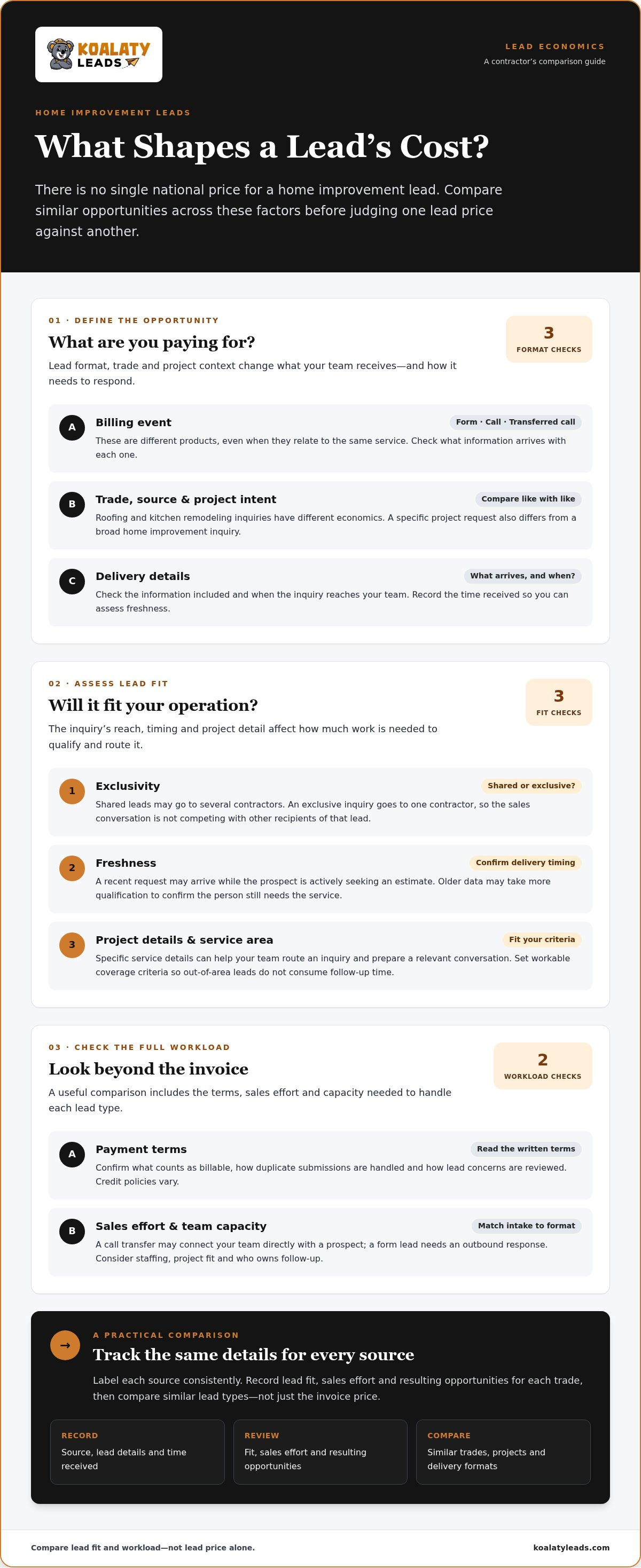
There is no single national price for a home improvement lead. Roofing and kitchen remodeling inquiries have different economics. Trade, market, source, project intent, and delivery method all affect the quote. Compare similar opportunities before judging one lead price against another.
Start by identifying the billing event. A provider may charge for a submitted form, a phone call, or a transferred call. These are different products, even when they relate to the same service. Check what information comes with delivery and whether the inquiry fits your trade and project criteria.
Exclusivity also affects the comparison. Shared leads may be sold to several contractors, putting multiple teams in contact with the same prospect. An exclusive inquiry goes to one contractor, so the sales conversation is not competing with other recipients of that lead. Compare exclusivity alongside price.
Lead freshness can affect the work your team needs to do. A recent request may arrive while the prospect is actively seeking an estimate. Older data may require more qualification to determine whether the person still needs the service. Ask how delivery timing is defined and record when your team receives each inquiry.
Project details matter, too. A request naming a specific service gives your salesperson a clearer opening than a broad inquiry. For example, a roofing replacement request differs from a general home improvement inquiry. Check whether the information helps your team route the lead and prepare a relevant first conversation.
Market conditions shape lead availability and competition. A densely served area may have a different lead environment from a market with fewer contractors. Service boundaries matter, too. Leads outside your crews’ practical coverage can consume follow-up time without fitting your operation, so set workable service criteria.
Read the payment terms before committing your budget. Find out how the provider defines a billable inquiry, how duplicate submissions are handled, and how lead concerns are reviewed. Credit policies vary, so understand the written process before purchasing. Clear written terms are more useful than a verbal description alone.
Compare the expected sales workload, not just the invoice. A call transfer may connect your team directly with a prospect, while a form lead requires an outbound response. Each format needs a different intake plan. Consider staffing, project fit, and follow-up ownership when assessing the economics.
Set a clear evaluation period and record sources consistently. Review lead fit, sales effort, and resulting opportunities for each trade. A low inquiry price may require substantial qualification, while a higher-priced format may include useful project context. Compare the value and workload attached to each lead type.
Lead prices and availability can vary by market. Densely served areas may have a different competitive environment from markets with fewer contractors.
How do Angi, HomeAdvisor, Thumbtack, and Google Local Services Ads compare for contractor leads?
Platform names alone don’t explain how inquiries reach your sales team. Compare the specific lead format, delivery, billing trigger, and account controls available to your business. Then decide whether each channel fits your services, staffing, and follow-up process.
| Channel type | Inspect before use | Operational consideration |
|---|---|---|
| Home-services marketplace | Inquiry details and routing | Confirm how your team receives requests. |
| Professional-services marketplace | Service categories and request flow | Check that requests match your work. |
| Local search advertising | Search placement and contact method | Plan for the inquiries your campaign generates. |
Start by reviewing how customers make contact. A marketplace request may begin inside its platform, while a search ad begins with a search query. That difference affects what information your salesperson sees and what context is available during follow-up.
Next, inspect the inquiry record. Note the requested trade, project description, contact method, and time received. A roofing prospect seeking a replacement estimate needs different handling from someone seeking unrelated work. Clear details help your team assign the inquiry correctly.
Review the platform’s controls, too. Look at service categories, location targeting, notification settings, and billing definitions. Do not assume two programs use identical terms. Record the applicable settings before launch so later performance reviews reflect how each account was configured.
Operational fit matters as much as channel type. If your estimators spend most days on job sites, decide who monitors new inquiries. If one salesperson handles kitchen projects, route matching requests to that person. A channel can create administrative work as well as sales opportunities.
Use a separate source label for every platform in your customer records. At intake, record the inquiry details and assigned salesperson. This helps distinguish platform performance from differences in staffing or project mix. Review the records with your sales team, note recurring obstacles, and identify useful account changes.
Use a controlled comparison instead of relying on brand reputation. Define the trades and services you want to evaluate, and keep intake questions and sales ownership consistent across sources. Record which requests fit your operation, which needed clarification, and which led to a meaningful conversation.
Revisit your setup when your service mix or team capacity changes. A campaign built for kitchen projects may not suit a roofing team’s workflow. Judge each channel by its fit and execution, then refine your process using the records your team collects.
A campaign built for one setting should be assessed against the conditions where the work happens. Understanding how local conditions shape work processes is part of understanding the system that produces current outcomes. Consider those conditions when reviewing how inquiries are received, reviewed, and handled, and use that understanding to assess whether the setup remains suitable for the work and the team.
How do SEO and Google Ads generate local remodeling leads?
SEO helps your remodeling pages appear in unpaid search results. Google Ads can place paid listings for selected searches. Both can attract prospects, but they require different management. Build your plan around the services you sell, the projects you can schedule, and the inquiries your team can handle.
For SEO, create a separate page for each core service. A kitchen remodeling page should focus on kitchen projects, not every service your company performs. Explain the project types you accept, where you work, and how prospects can request an estimate. Make each page useful to someone searching for that specific service.
Use local details that help prospects assess fit. Name the service areas your crews actually cover and describe relevant project experience accurately. Keep your business information consistent across your website and Google Business Profile. Update pages when your offerings or service boundaries change, so outdated details do not misdirect inquiries.
Google Ads lets you build campaigns around specific search terms. Separate kitchen remodeling from bathroom remodeling and direct each campaign to its matching page. Use negative keywords to screen out searches unrelated to your work, such as employment or do-it-yourself instructions. Review search terms and adjust targeting when irrelevant clicks appear.
Match the ad message to the landing page. If an ad promotes bathroom remodeling, make that service clear on the page right away. Give visitors a direct way to call or submit an inquiry. Remove unrelated navigation and competing messages that could distract prospects from contacting your team.
Track more than website visits. Use distinct source labels for organic search and paid campaigns. Record which service page generated each inquiry, then follow its progress through sales. This helps distinguish an increase in traffic from a rise in relevant project requests. Keep tracking consistent across devices and intake channels.
Use your records to pinpoint friction. If organic visitors reach a page but do not inquire, check whether the service, coverage, and contact options are clear. If paid clicks come from unrelated searches, refine keywords and ad copy. If inquiries arrive when staff cannot respond, improve intake coverage before expanding campaigns.
Review SEO and Ads against your business priorities. Organic visibility can support ongoing discovery, while paid campaigns give you control over selected searches. Neither replaces a clear sales process. Connect marketing records with estimate outcomes, then adjust pages or campaigns based on which services attract suitable prospects.
What steps improve conversion rates from home improvement leads
Improve conversion by identifying where prospects leave your sales process. Track each stage, from inquiry through contact, appointment, estimate, and won job. Separate process measures from outcomes: contact attempts measure activity, while booked estimates and acquired jobs show results. Without both, a weak close rate can hide missed calls, poor qualification, or inconsistent follow-up.
Start by defining each stage clearly. Decide what counts as a valid inquiry, a reached prospect, and a completed appointment. Apply the same definitions across roofing, HVAC, and remodeling inquiries. Record the lead source, requested project, location, contact attempts, and outcome. A shared tracking process helps sales managers compare results without confusing uncontacted inquiries with lost estimates.
Review the path through your team’s actual workflow. Check who receives new inquiries, how they are assigned, and what happens after an unanswered call. For example, a lead routed to a busy estimator may wait while another salesperson has capacity. Adjust assignments or follow-up ownership, then observe whether contact and appointment outcomes change.
Use a Plan-Do-Study-Act cycle to test one focused change. Plan a specific adjustment, such as routing kitchen inquiries to a trained remodel specialist. Do it with a defined group of inquiries. Study contact and appointment outcomes against the earlier process. Act by adopting, revising, or dropping the change. State the expected result before the test.
Look at variation instead of relying only on an overall conversion rate. Compare lead source, trade, location, salesperson, and project type. A strong result in one market may not carry over to another. Local conditions, including crew capacity and travel distance, affect which inquiries your team can serve. Identify what works, for whom, and under which conditions.
Include the people closest to the work. Sales representatives can explain why prospects decline or appointments fail. Estimators can identify scheduling bottlenecks, while operations staff can flag capacity limits. Review these observations alongside recorded outcomes. This can reveal process problems a dashboard alone may miss and involve key participants in improvement early.
Watch for unintended consequences when changing follow-up. More contact attempts may increase workload or take time away from estimate preparation. Track both the intended outcome and the operational effect. If a trial reduces appointment delays but creates missed callbacks elsewhere, revise the process rather than scaling it unchanged.
Learn from unsuccessful tests. Record what you changed, the result, and the conditions around it. Then repeat useful changes with other teams or in other markets, measuring performance as you expand. Reliable improvement depends on a process that works consistently at scale, not one strong result or an untested assumption.
Assess what works, for whom, and under what conditions, rather than asking only what works. Learning from unsuccessful tests is an important part of improvement.
What are the rules for calling, texting, and emailing home improvement leads in the US
Use the lead’s recorded preferences and source details before outreach. For every call, text, or email, keep the inquiry record, consent language, timestamp, and channel together. A roofing form requesting a callback does not automatically document permission for every type of marketing message. Keep service follow-up separate from promotional campaigns.
Before dialing, identify your business and the reason for the call. Keep the conversation tied to the requested project, such as a roof estimate or bathroom remodeling inquiry. Maintain an internal do-not-contact list and record requests to stop future contact. Apply those preferences across your sales team, phone systems, and customer relationship management platform.
Use a documented call process. Train sales representatives to confirm the prospect’s identity, explain the inquiry, and end the conversation when asked. Record attempted calls and their outcomes. If your team uses automated dialing or prerecorded messages, review that technology separately for compliance rather than treating it as an ordinary manual callback.
Text messages need their own controls. Preserve the source form and its wording, then connect the permission record to the phone number. Identify your business in the opening message, keep the message relevant, and honor stop requests promptly. Do not add a prospect to recurring promotions just because they asked about a one-time estimate.
Email outreach also needs a clear sender identity and a working way to opt out. Use an accurate sender name and subject line. Keep the message focused on the requested project, such as scheduling a window replacement estimate. Maintain suppression records so an opt-out does not re-enter a later campaign through another list or salesperson.
Lead source matters. An inquiry from your own website may have different preference records from one routed through a marketplace or advertising platform. Store the original form, consent wording, submission time, source, and permitted contact channels. If a record lacks enough detail for your process, pause that channel and route the inquiry for review.
Assign clear ownership for these controls. Have a manager review scripts, forms, opt-out handling, and vendor records. When your business changes its call system or lead source, update training and workflow before launch. Keep a consistent audit trail, including who contacted the prospect and which preference record supported the outreach.
Federal and state requirements can depend on the technology, message, and recipient. Build procedures around the rules that apply to your campaigns, rather than assuming one form covers every channel. A documented process helps your team respond to legitimate inquiries while reducing unwanted follow-up and keeping clear records.
Koalaty Leads: Roofing Leads
Koalaty Leads provides exclusive home improvement leads and live transfers for contractors who want a direct path to prospective customers. If your team has a clear follow-up process and wants to evaluate roofing inquiries by contact, appointment, and job outcomes, explore roofing leads for contractors.
The same approach may fit other remodeling teams seeking window replacement leads, bathroom remodel leads, or kitchen remodeling leads. Compare the opportunity with your current sales capacity and track results using the measures covered above. That gives you a practical basis for deciding whether these leads fit your acquisition strategy.
Visit Koalaty Leads to discuss exclusive leads or live transfers for your trade and market.
Set a clear direction for your next growth move
Choose your next step based on the work your team wants to win, its follow-up capacity, and the results you can measure. A tighter focus gives your sales team a practical target and makes future marketing decisions easier to assess.
Make home improvement lead generation part of a deliberate operating plan, not a collection of disconnected campaigns. Decide which trade and market to prioritize, define what a sales-ready inquiry means, and clarify ownership from first contact through the final outcome. This creates a stronger foundation for sustainable growth.
For contractors focused on remodeling opportunities, Koalaty Leads offers exclusive Roofing Leads, Window Replacement Leads, and Bathroom Remodel Leads. Match the offering to the work you are prepared to pursue, then build your follow-up process around that focus.
Take the next step with a clear target, a prepared team, and a process you can improve as results come in.
Frequently Asked Questions
What is lead generation for home improvement contractors?
It is the process of creating or acquiring opportunities to sell contracting work. A roofing company, for example, may receive an inquiry from a prospect seeking an estimate, then qualify the project and decide whether it fits crew capacity. Strong home improvement lead generation connects a defined service with interested prospects and gives your team a trackable path from inquiry to sales conversation.
What are the best ways to generate home improvement leads?
The right mix depends on your trade, sales capacity, and appetite for managing marketing activity. A contractor might build organic search visibility for core services, use Google Ads to reach active searchers, or purchase leads and calls. Compare channels by the type of inquiry they produce and how well your team can handle it. Keep source tracking separate so results remain attributable.
What is the average cost per booked job from home improvement marketing?
There is no useful average across all trades and markets. Calculate your own figure by dividing the marketing spend tied to a source by the jobs booked from that source. Include campaign costs and lead charges, then count only booked jobs in the matching period. Track cancellations separately, since a scheduled estimate and a completed sale are different outcomes.
How can contractors generate exclusive home improvement leads?
Choose a lead source that delivers exclusive web leads or live inbound call transfers, then define the trade and project criteria your team can serve. Koalaty Leads provides exclusive opportunities, not shared leads. Keep each lead’s source and project details attached to its sales record. This helps your team distinguish a direct prospect conversation from an inquiry circulated among multiple contractors.
Need exclusive leads instead of shared ones? Koalaty Leads delivers qualified homeowners — web leads or live call transfers — to one contractor only.
Get Started