
Home Improvement Contractor Leads: Growth Strategy Guide

Lead volume is a weak growth metric if requests don’t turn into conversations, appointments, and booked jobs. A strong strategy for contractor leads home improvement companies can convert starts with three checks: who else receives the request, how quickly your team can respond, and what each completed job costs to acquire.
It’s reasonable to expect a lower-priced lead to stretch your budget. But shared requests can put several contractors in a race to reach the same prospect, while a higher lead price alone doesn’t tell you whether the opportunity will pay off. The number that matters is the cost of winning the job.
This guide shows you how to compare shared, exclusive, and live-transfer opportunities using consistent criteria. You’ll see how to track contact, appointment, and close rates, connect lead spend to job-level acquisition cost, and assess whether a model fits your trade, sales capacity, and follow-up process. The goal is a practical system for judging lead performance, not a bigger count on a report.
Key Takeaways
- Assess contractor leads home improvement by whether they can become profitable completed jobs, not by lead count alone.
- Compare shared requests, exclusive leads, and live transfers by who receives the inquiry and how it reaches your team.
- Track the path from delivered lead to contact, appointment, close, and cost per acquired job to see what your spend returns.
- Before increasing lead flow, check trade fit, reporting, call-answering capacity, and who owns follow-up.
- Learn how Koalaty Leads’ exclusive leads, inbound calls, and live transfers can fit your sales process.
Contractor leads home improvement businesses can evaluate for job-level ROI
A lead is a potential customer inquiry, not a booked job. Its business value depends on what you pay to access the opportunity, whether your team can reach and qualify the prospect, and whether the resulting work can support the cost of acquiring it.
Contractor lead value comes from the combination of relevant access, effective response, and job economics, not from delivery volume alone. That distinction gives contractors a consistent way to evaluate contractor leads home improvement programs, whether inquiries arrive through an online form or a phone call. For a broader buying framework, see Home Improvement Leads: A Buying Guide for Remodelers.
What makes a home improvement lead useful to a contractor?
Start with fit. The inquiry should concern a trade and project your company handles, come from someone expressing relevant interest, and include contact information your team can use. A request that falls outside your services or capacity may count as a delivered lead, but it is unlikely to become a viable sales opportunity.
Keep the stages distinct: an inquiry is not automatically a qualified opportunity; a qualified opportunity is not an appointment; an appointment is not an estimate or a sold job. Record these stages separately so you can see where opportunities advance or stall.
Why lead volume alone can mislead
A high delivery count can look encouraging while hiding a weak connection rate or few scheduled appointments. Review what happened after each inquiry, including whether your team made contact, confirmed trade and project fit, and agreed on a next step. Without that context, raw volume says little about the pipeline.
Cost per acquired job gives you a more useful view: divide lead spend over a defined period by the number of jobs won from those leads. Compare that figure with the economics of the work, including job value and the costs required to sell and complete it. The calculation connects marketing spend to outcomes, rather than treating every delivered inquiry as equal.
For a practical review, track:
- Whether the inquiry matches your trade and the work you take on.
- Whether contact details allow your team to respond and continue the conversation.
- How many inquiries become qualified opportunities, appointments, estimates, and sold jobs.
- How much lead spend is associated with each completed sale.
Use the same definitions across lead sources and review a consistent time period. A lead source may generate a different mix of projects, while your follow-up process, staffing, and sales execution also affect results. Separate those factors before deciding that a source is performing well or poorly. For cross-trade home improvement lead options, Koalaty Leads outlines its home improvement lead services.
How shared leads, exclusive leads, and live transfers reach contractors
Shared leads, exclusive leads, and live transfers differ in who gets access to an inquiry and how it reaches your sales team. Compare the delivery model, competition, and response demands before deciding which fits your business.
Shared versus exclusive home improvement leads
Aggregator marketplaces collect project requests and may distribute one shared lead to four or five contractors. That can create a race to make contact, while an exclusive lead goes to one contractor, reducing direct competition for that inquiry. Exclusivity changes access, not the outcome: the prospect may still be unreachable, the project may not fit, or the sale may not close.
| Lead model | How it reaches you | Key operational consideration |
|---|---|---|
| Shared marketplace request | A request may be sold to four or five contractors. | Several businesses can pursue the same inquiry, so response and follow-up matter. |
| Exclusive pay-per-lead opportunity | An inquiry is delivered to one contractor. | You have sole access to that lead, but still need to qualify and sell the work. |
| Live transfer | An inbound caller is connected directly with a contractor. | Your team needs to be ready to answer and qualify the caller in real time. |
Pay-per-lead describes how you’re charged for a delivered opportunity; the exact delivery and billing terms depend on the provider’s model. For shared requests, ask how distribution works and whether the inquiry is current or aged. Those details affect the time you have to respond and the context your team has when reaching out.
Pay-per-lead versus live-transfer opportunities
A form-based lead gives your team contact information to follow up on. A live transfer is different: a live transfer connects an inbound caller directly with your team, creating an immediate conversation rather than a follow-up task. That can suit a sales operation prepared to answer calls, but it still takes a clear process to establish trade fit, understand the request, and agree on next steps.
Choose based on your actual capacity, not an idealized workflow. If your estimators are often on jobs and calls go unanswered, form-based delivery may give your team more control over when to follow up. If someone can handle incoming calls, transfers create a direct opening to speak with the prospect. For broader context on the remodeling market, the Harvard Joint Center for Housing Studies report on residential remodeling examines spending trends and factors that influence project activity, though it does not determine how any specific lead source will perform.
For contractor leads home improvement businesses evaluate, the model should match the team’s response process as well as its trade and sales capacity. If you’re weighing exclusive leads against live calls, talk with Koalaty Leads about options for your trade.
Measure home improvement lead performance beyond cost per lead
Cost per lead tells you what you paid for an inquiry. It doesn’t show whether your team reached the prospect, booked an appointment, won the work, or earned enough from completed jobs to justify the spend. Track each stage, then compare lead investment with your own job and margin data.
Build a lead-to-job measurement chain
Use consistent definitions and record outcomes by source and delivery model. That lets you identify where results change without treating every inquiry as equally valuable.
- Delivered leads: Count inquiries received during the review period, separated by source and delivery model.
- Attempted contacts: Record how many inquiries your team tried to reach, along with whether follow-up happened as planned.
- Successful conversations: Calculate contact rate as successful conversations divided by delivered leads. This reveals how often an inquiry becomes a two-way discussion.
- Appointments: Measure appointment rate as appointments set divided by qualified conversations. Track appointments held separately so cancellations don’t disappear from the picture.
- Sold jobs: Define close rate consistently, such as sold jobs divided by appointments held or estimates delivered. Pick one denominator and use it for every source you compare.
- Completed jobs: Follow sold work through completion, then review the revenue and margin using your own records.
Interpret cost per lead alongside return
Calculate cost per acquired job by dividing total lead spend by the jobs won from those leads. For a completed-job view, use completed jobs as the denominator instead. State which measure you’re using, and keep the timeframe aligned so costs and outcomes belong to the same lead cohort.
A lower cost per lead can still produce a higher acquisition cost if fewer inquiries become customers. Conversely, a pricier inquiry may be more economical if it results in enough profitable work. Don’t assume either outcome: measure it in your own operation.
Hypothetical example: Suppose Source A costs less per inquiry than Source B, but Source A produces fewer completed jobs from the same total lead spend. Dividing each source’s spend by its completed jobs shows which has the lower cost per completed job. The example illustrates the calculation only; it isn’t a performance benchmark or a claim about any provider.
Then assess payback. Compare the gross profit from attributable completed jobs with the cost of acquiring them, using your own margin records and accounting for the time between lead spend and completed work. A job’s contract value alone doesn’t show how much is available to cover acquisition costs and other expenses.
For contractor leads home improvement programs, report contact rate, appointment rate, close rate, cost per acquired job, and payback together. If one stage weakens, check lead fit, call-answering capacity, and follow-up before increasing spend. Your team’s actual results are the useful benchmark.
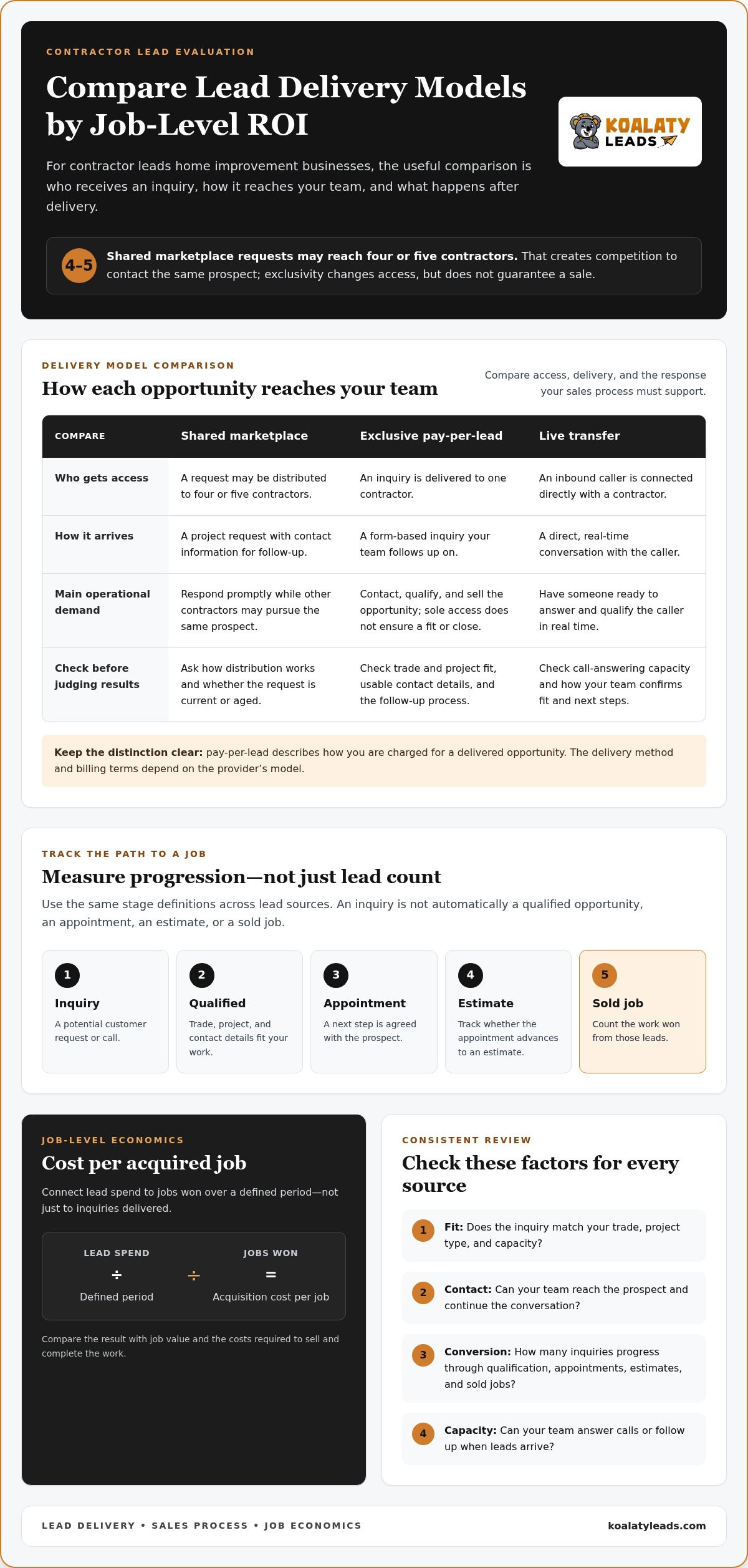
A contractor’s checklist for evaluating home improvement lead programs
Evaluate a lead program against your trade, delivery process, sales capacity, and reporting before increasing spend or volume. For contractor leads home improvement businesses can manage effectively, a clear handoff and consistent tracking matter as much as the inquiry itself.
Match delivery to trade and sales capacity
Check that inquiries align with the services you perform and the kinds of projects your team can take on. Then match delivery to your workflow: form leads need an assigned follow-up owner, while inbound calls and live transfers require someone ready to answer and qualify the caller. More flow won’t fix a missed handoff.
Use this checklist when reviewing a program:
- Trade and project fit: Does the inquiry match your services, job types, and ability to schedule and sell the work?
- Exclusivity: Is the request shared with other contractors or delivered to one business? Exclusivity limits direct competition for that request, but doesn’t guarantee contact or a sale.
- Delivery method: Will your team receive a form inquiry, an inbound call, or a live transfer? Identify who owns the next step for each type.
- Reporting: Can you distinguish delivered inquiries, attempted contacts, conversations, appointments, estimates, wins, and losses by source?
Track quality without assuming every lead will close
Agree on internal outcome labels before comparing sources. Record contact attempts and successful conversations separately, then note appointments set and held, estimates delivered, and whether each opportunity was won or lost. Review these records regularly to spot bottlenecks, such as unassigned follow-up or inquiries that don’t match your services.
Compare contact and appointment outcomes using the same definitions and time period across programs. That keeps differences in reporting from looking like differences in performance. Interpret the results alongside your sales process and job economics; a lead source alone doesn’t determine the outcome.
Use the checklist as part of both buying home improvement leads and evaluating contractor lead generation. If you’re reviewing cross-trade options, Koalaty Leads describes its home improvement lead services for contractors. Set ownership before increasing lead flow, and consider discussing lead options for your trade as you assess what fits your operation.
How Koalaty Leads supports home improvement contractors with exclusive leads
After setting your evaluation criteria, align your lead plan with the work your business is equipped to sell and the way your team handles new opportunities. Koalaty Leads provides exclusive leads, inbound calls, and live transfers to contractors. Koalaty Leads states that its leads aren’t shared with competitors.
Exclusive opportunities across home improvement trades
Koalaty Leads supports contractors in categories including roofing, HVAC, solar, windows, and remodeling. The right fit starts with your service mix: define which jobs you want, who reviews each inquiry, and what information your sales team needs to decide on a next step. This keeps a broad lead program connected to the work your company actually performs.
Use Home Improvement Leads: A Buying Guide for Remodelers as a broader reference point when assessing lead options. For a cross-trade view of available home improvement lead services, consider how each opportunity type fits your sales workflow, not just your marketing plan.
Discuss a lead model that fits your operation
Exclusive leads and live transfers place different demands on your team’s daily routine. Decide who reviews new inquiries, who can speak with callers, and how sales staff pass an opportunity to the person responsible for the next step. A clear owner for each handoff reduces confusion and makes performance records more useful.
Before choosing a model, map a typical workday. Note when staff can review form inquiries, when someone can handle incoming calls, and how sales activity will be recorded if the primary contact is unavailable. Then compare that workflow with the delivery approach you’re considering. This is an operational decision, not a promise that a particular lead will become revenue.
Koalaty Leads’ lead options are designed for home improvement and home service contractors, with the model selected around your trade and ability to manage incoming opportunities. Bring your service focus and sales process into the discussion so the options can be considered in the context of how your business works. A practical fit starts with clear expectations about who responds and how outcomes are tracked.
Put your next lead decision to work
Make your next step operational: decide what kind of work your team wants to pursue and what it can realistically handle. Then use that capacity to shape your plan for contractor leads home improvement businesses invest in, rather than letting incoming volume set the pace for your sales team.
A focused lead plan should fit the way your business sells. Set clear ownership for new opportunities, keep your team aligned on the work you’re targeting, and use what you learn from each sales cycle to refine your approach. Consistency gives you a stronger foundation for growth than chasing every available inquiry.
As you plan what comes next, prioritize a lead model that supports the way your team works and the jobs it wants to win. Koalaty Leads can discuss options for your trade and market.
Build deliberately, stay focused, and give your next growth decision a clear purpose.
Frequently Asked Questions
How much do home improvement contractor leads cost?
Lead costs vary by trade, delivery model, and provider terms, so compare the same kind of opportunity rather than headline prices alone. Before budgeting, clarify whether charges apply per inquiry or call, how duplicates or out-of-scope requests are handled, and what the billing period covers. Keep those terms with your results. This helps you compare offers accurately without treating a general estimate as a promised rate for your business.
Are exclusive home improvement leads better than shared leads?
Neither model is automatically better for every contractor; the stronger fit depends on your sales operation. Consider whether your team can handle competing for a shared request or would benefit from being the only contractor receiving that opportunity. Also consider the staff time each model requires. A fair comparison should use similar trades, project types, and review periods, rather than judging one model from a small or mismatched batch.
What is the difference between a live transfer and a contractor lead?
A contractor lead may be delivered as an inquiry for later follow-up, while a live transfer connects an inbound caller with your team. For a practical comparison, log call transfers separately and note whether the person who answered could handle the requested work or needed to route the call. Also record call outcomes that don’t fit the standard sales path, such as a wrong trade or a request that needs a later callback.
How do contractors calculate cost per acquired job from leads?
Divide the spend attributed to a lead source by the jobs won from that source during a defined period. To make the result useful, decide how your team will assign a sale when a prospect interacts with more than one source, and apply that rule consistently. Keep open opportunities separate from wins, then revisit the period after those opportunities have had time to resolve. This makes comparisons less vulnerable to incomplete sales cycles.
Can home improvement contractors buy leads for more than one trade?
Yes, contractors can evaluate opportunities across the trades their businesses serve. Keep each trade in a separate reporting category and assign an owner who understands that service’s qualification process. For example, a remodeling inquiry may need a different intake path from an HVAC request. This separation makes it easier to spot staffing gaps and avoid mixing unlike opportunities in a single performance review.
How quickly should contractors follow up on a new lead?
Set a response standard your team can meet consistently, based on staffing and how inquiries arrive. For calls, make clear who takes over if the first person is unavailable; for form inquiries, define when they are reviewed and who owns the next attempt. Track delays and missed handoffs, not just successful contact. That helps you decide whether a process change is needed without assuming one response-time target suits every operation.
What should contractors track when comparing lead providers?
Beyond core sales stages, record the trade requested, project type, delivery channel, date received, assigned salesperson, and reason an opportunity was closed or disqualified. Use consistent labels across your systems so one salesperson’s “not a fit” isn’t another’s “lost.” Review unusual records with the team before drawing conclusions. For contractor leads home improvement businesses assess across sources, clear attribution and consistent data entry make the comparison more dependable.
Do exclusive contractor leads guarantee a booked job?
No. Exclusivity describes access to an inquiry, not a guaranteed appointment or sale. Treat any claim about distribution separately from a claim about business results, and plan for normal sales outcomes such as an unanswered inquiry, a project outside your scope, or a prospect who chooses not to proceed. Your own records can show whether the opportunity type fits your business, but no lead label should be treated as a booked job.
Need exclusive leads instead of shared ones? Koalaty Leads delivers qualified homeowners — web leads or live call transfers — to one contractor only.
Get Started