
High-Quality HVAC Sales Leads: A Buying Guide
There isn’t one fixed price for HVAC sales leads. The cost depends on how prospects are sourced, whether an opportunity is exclusive, and how closely it fits your services and market. Compare what each option delivers, not just its listed price.
A lower-cost inquiry may not fit if the contact details are inaccurate or the prospect needs work your team doesn’t handle. A higher-priced lead may also disappoint if it rarely becomes a booked appointment. Evaluate lead quality alongside your sales process and the revenue your business needs.
This guide gives you a practical framework for evaluating providers and lead models. You’ll learn how to assess exclusivity, data accuracy, freshness, and targeting, then use those factors to judge whether a source fits your operation. You’ll also see how to think about the handoff from inquiry to sales conversation, so your team can choose a lead approach that supports its real capacity and growth plans.
Key Takeaways
- Compare lead costs by how an opportunity is delivered and whether it’s exclusive or shared, not by the headline price alone.
- Assess how accurate and current prospect details are, since poor data can undermine follow-up and sales results.
- Look at how providers target by service area and prospect characteristics to judge whether leads fit your HVAC work.
- Consider the trade-offs between buying leads and other provider models, including how each handles delivery and lead quality.
- Use the guide’s comparison criteria to decide whether HVAC leads or live call transfers better fit your sales process.
1. How much do HVAC lead generation companies charge?
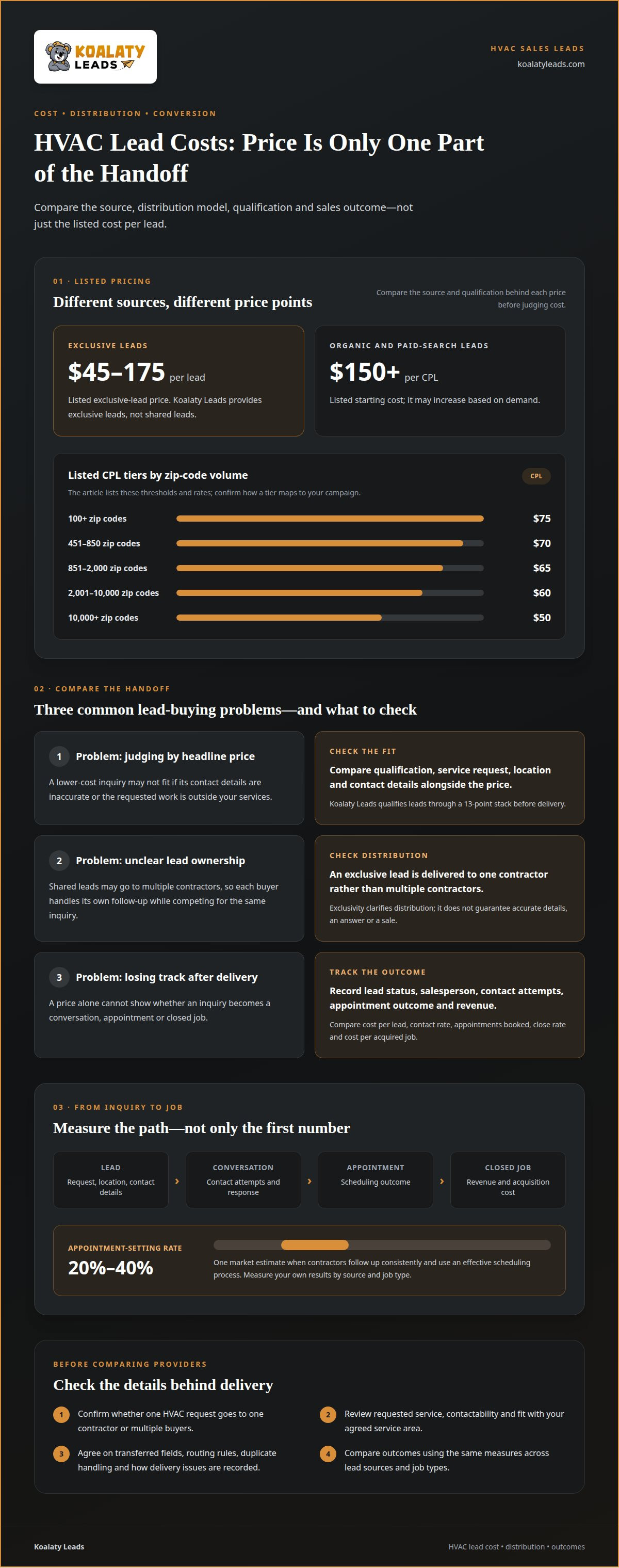
HVAC lead costs depend on the source and pricing model. Koalaty Leads lists exclusive leads at $45-175 per lead, while organic and paid-search leads start at $150 /CPL and may increase based on demand. These are different lead categories, so compare the source and qualification behind each price before evaluating the cost.
Koalaty Leads also lists cost-per-lead tiers by zip-code volume: 100 + zip codes → $75 /CPL; 451-850 zip codes → $70 /CPL; 851-2000 zip codes → $65 /CPL; 2001-10 000 zip codes → $60 /CPL; and 10 000 + zip codes → $50 /CPL. These thresholds and rates are stated as listed; ask how the applicable tier maps to your campaign.
Price alone doesn’t show whether a lead can become a job. Koalaty Leads qualifies leads through a 13-point stack before delivery. Pair that process with the lead’s service request, location, and contact details when assessing whether the opportunity fits your HVAC operation.
Delivery affects how quickly your team can act. Koalaty Leads provides exclusive web leads, live inbound call transfers, API integration, and data-management tools. Before launch, agree on transferred fields, routing rules, duplicate handling, and how delivery issues are recorded. For example, route a replacement inquiry differently from a repair request.
Track each lead’s status, assigned salesperson, contact attempts, appointment outcome, and revenue. Koalaty Leads provides data-management tools, and its delivery options include API integration. Agree on the records your team needs so you can identify where prospects stop progressing.
Set measurable goals before purchasing. Track cost per lead, contact rate, appointments booked, close rate, and cost per acquired job. One market estimate puts the appointment-setting rate at 20% to 40% when contractors follow up consistently and use an effective scheduling process. Measure your own results by source and job type.
Providers can target by requested service, decision-making role, and agreed service area. A valid HVAC inquiry should come from a homeowner or decision-maker requesting service within that area. Separating repair and replacement requests can help route prospects to the right sales process.
Compare pricing with the full handoff: qualification, delivery, targeting, and reporting. For your own campaign, connect lead spend to booked appointments and closed revenue, then assess whether the cost per acquired job fits your business goals. That gives you a more useful basis for budgeting than the headline lead price alone.
2. Exclusive versus shared HVAC leads
An exclusive HVAC lead is delivered to one contractor, while shared leads may go to multiple contractors. Koalaty Leads provides exclusive leads, not shared leads. Exclusivity limits competition for that inquiry, but does not by itself show that the details are accurate or that the prospect is ready to book.
When multiple contractors receive the same inquiry, each must manage its own follow-up. A prospect seeking air-conditioning repair may hear from several companies after submitting a request. Your team’s availability, call handling, and ability to explain its service still shape the sales experience.
With exclusive distribution, one contractor receives the lead rather than competing with other recipients of that same inquiry. This can make ownership and follow-up clearer: one salesperson can manage the conversation, record its progress, and work toward an appointment. Exclusivity is a distribution rule, not a promise that the prospect will answer or buy.
Compare the models using outcomes your business can track. Record how many inquiries become conversations, appointments, and closed jobs, then assess cost per acquired job. If shared inquiries require repeated calls but produce few appointments, the apparent savings may not translate into a stronger result. If exclusive inquiries rarely convert, exclusivity alone hasn’t solved the underlying issue.
Ask how the provider defines a valid inquiry and what makes a lead exclusive. Confirm whether one HVAC request goes to one contractor or multiple buyers, and whether the same prospect can be submitted again through another campaign. Clear distribution terms prevent confusion when your team reviews records and billing.
Your sales process should fit the model. Shared inquiries may require quick, disciplined follow-up because other contractors can also respond. Exclusive inquiries still need prompt handling, but your team can focus its conversation without competing against other recipients of that lead. Route each request to a salesperson who handles the stated service.
Evaluate lead distribution separately from lead quality. A request can be exclusive yet outdated, outside your service area, or unrelated to the work you accept. Conversely, a shared inquiry can include accurate details while still creating competition. Review the prospect’s stated need, contactability, and fit alongside the distribution terms.
Choose based on the sales capacity your team can consistently support. Use appointment and close records to compare lead sources rather than relying on labels. Keep the same performance measures across sources so the comparison reflects outcomes, not assumptions about what exclusivity guarantees.
To discuss how exclusive HVAC leads fit your sales workflow, talk with Koalaty Leads about your trade and market.
3. Data accuracy, verification, and refresh frequency
A lead record is useful when its details support a real sales conversation. Capture the prospect’s name, preferred contact method, requested HVAC service, location, and submission time. If a record asks about air-conditioning repair but lacks a usable phone number, flag it rather than treating it as a normal opportunity.
Define verification before a campaign begins. Specify what counts as a valid inquiry, such as a homeowner or decision-maker requesting HVAC service within your agreed service area. Also define how the provider handles duplicate submissions, incorrect contact details, and requests for work outside your business’s scope. Clear criteria make quality reviews consistent.
Freshness starts with the timestamps. Record when the prospect submitted the request, when your team received it, and when the first contact attempt occurred. These details help distinguish a new inquiry from older data and show whether delays happened during delivery or follow-up.
Set a refresh process that matches the lead source and sales workflow. For incoming campaigns, agree how new records reach your team and how status updates return to your CRM. For stored data, establish when contact details and service interests are revalidated. Don’t treat an old record as a new inquiry.
Check the information that affects routing. A lead should identify the requested service and location, while your intake process can clarify whether the prospect wants repair, replacement, or another HVAC service. Route a replacement inquiry to the team handling estimates, not the repair queue.
Track data problems by source, not as one blended complaint. Tag invalid numbers, duplicate records, wrong-area inquiries, and mismatched service requests separately in your CRM. That gives HVAC businesses a practical view of which campaigns need correction and whether the issue involves targeting, data capture, or lead delivery.
Use those findings to improve the process. If inquiries lack service details, revise the form or qualification questions. If requests have accurate details but few become appointments, review response handling and scheduling. Improve the data path and sales process rather than simply increasing advertising investment.
Measure whether better records lead to stronger outcomes. Compare contact rates, booked appointments, and closed revenue by source and lead status. Keep qualification rules stable during each review period; otherwise, changes to what counts as a valid HVAC lead can make performance difficult to interpret.
Before scaling, document the provider’s definition of a valid lead, timestamp fields, refresh schedule, duplicate process, and reporting format. A shared standard gives your sales team a consistent basis for accepting records and gives the provider specific feedback. That is how data quality becomes an operating process, not a vague promise.
4. Targeting HVAC prospects by demographics and geography
Start local HVAC targeting by defining the services you sell and the areas your crews can serve. Separate repair, replacement, and maintenance requests so each inquiry reaches the right team. Koalaty Leads provides exclusive web leads and live inbound call transfers for contractors.
Geographic settings should reflect dispatch capacity, not just a broad map. Define the areas your team can serve and exclude locations that make scheduling impractical. A request outside your service boundary shouldn’t enter the same queue as an in-area repair inquiry.
Demographic targeting needs a practical connection to qualification. A provider can distinguish a decision-maker seeking HVAC services from someone making a general inquiry, then capture the requested service and location. Avoid treating age or household income as proof of intent; a specific heating or air-conditioning request is more useful for routing.
Define the target audience in plain terms before campaigns launch. Specify the service category, eligible geography, and prospect details needed for a useful handoff. A replacement inquiry in your service area may belong with an estimator, while a repair request should reach the team handling service calls.
Platform settings shape who sees an advertisement and where an inquiry originates. Ask providers how they source leads and what reporting is available for each lead. Review the source and relevant campaign details before deciding whether a lead program fits your business.
Location alone doesn’t establish lead quality. Pair geography with service intent and usable contact information. If your HVAC company accepts maintenance appointments but not replacement projects, reflect that distinction in targeting and intake questions before a prospect enters the sales pipeline.
Use campaign and CRM records to review location fit. Track each inquiry’s location, requested work, source, and outcome. If a lead falls outside the areas you serve, adjust targeting; if its location fits but the service does not, refine campaign wording or qualification questions.
Keep targeting aligned with crew capacity and the jobs your business wants. Assess a newly served area separately rather than widening every campaign. Compare booked appointments and closed work by location and service type, then use the results to guide changes.
Evaluate local opportunities by defining service needs, matching each request to the work you provide, and routing it accordingly. Specific targeting helps keep unsuitable locations and services from crowding your team’s schedule.
HVAC contractors can use Local Service Ads to reach people searching for relevant services within their service area, separating repair, replacement, and maintenance inquiries so each reaches the right team. Set geographic boundaries around dispatch capacity, then review inquiry locations, requested work, sources, and outcomes to refine targeting and qualification.
5. Where can HVAC companies buy qualified sales leads?
HVAC companies can buy leads from direct lead providers, aggregator marketplaces, and marketing agencies that manage campaigns. Each model handles generation, distribution, and qualification differently. The right source depends on whether you need exclusive inquiries, live calls, or broader campaign support.
A direct provider can generate inquiries for a specific trade and route them to contractors under an agreed distribution model. Ask how the provider defines a qualified HVAC inquiry, what details accompany each record, and whether it is exclusive or shared. For example, a request for a repair within your service area is more actionable than a record with no service type or location.
Aggregator marketplaces collect consumer requests and may distribute an inquiry to multiple contractors. This can create access to opportunities across a platform, but your sales team may compete with other businesses contacting the same prospect. Confirm whether distribution is shared, how many buyers may receive each lead, and how quickly the inquiry is delivered.
Koalaty Leads offers exclusive web leads and live inbound call transfers for HVAC contractors. Ask us about the lead format and qualification details available for your services and market.
Call-based options create a different handoff. A live inbound call transfer connects a prospect with your team during the inquiry, while an exclusive web lead requires your staff to initiate contact. Consider your call-handling capacity, service hours, and appointment process when choosing a format.
Compare sources using consistent criteria: lead distribution, requested service, geographic fit, delivery speed, billing basis, and reporting. Then track contact attempts, appointments, closed jobs, and revenue by source. A low initial cost cannot show whether a channel performs well if your records don’t connect each lead with its eventual outcome.
Before starting, define your target services and service area, then agree on what makes an inquiry useful to your team. Set a process for routing repair, replacement, and maintenance requests. Establish how to review duplicates and inaccurate details, and decide which results you’ll use to evaluate performance.
For a contractor comparing buying options, exclusive leads reduce competition for the same inquiry, while shared distribution can place multiple contractors in pursuit of it. Neither label alone establishes accuracy or conversion potential. Qualification rules, freshness, prospect intent, and your follow-up process all affect whether a lead becomes an appointment.
Review HVAC lead options alongside your target services, market, and sales workflow to identify a suitable fit.
Koalaty Leads: HVAC Leads
Koalaty Leads provides exclusive HVAC leads and live call transfers for contractors seeking qualified opportunities in their trade and market. Turn to this option when shared inquiries create too much competition or your team wants prospects connected through a phone conversation.
Choose the format that fits your sales process. Exclusive leads give your team the opportunity to follow up directly, while live transfers connect an active caller with your business. Your service focus, market, and follow-up workflow help shape the right fit.
Talk with Koalaty Leads about exclusive HVAC leads or live transfers for your market.
Build a Lead Program That Fits Your Next Stage
Match your lead source to the way your team sells. Decide whether exclusive web leads, live inbound call transfers, or a combination fits your services, coverage, and follow-up capacity. A focused plan helps your team manage HVAC sales leads without relying on volume alone.
Koalaty Leads offers HVAC Leads for contractors seeking opportunities in this trade. Contractors expanding into other home improvement work can also explore Roofing Leads, Window Replacement Leads, and Bathroom Remodel Leads. Keep each trade’s goals distinct so your sales team can track the work that fits its pipeline.
Start with a conversation about the HVAC lead format and market that fit your business. A practical next step can help you move from evaluating options to planning a consistent sales process.
Focus on the opportunities your team can serve well, then build your process around them.
Frequently Asked Questions
How much do HVAC lead generation companies charge?
Charges depend on whether you buy individual leads, receive phone transfers, or pay for campaigns that generate inquiries. Compare the billing unit and what counts as a billable lead before judging the offer. Advertising spend is different from the price charged for a purchased lead. Also consider how the provider handles duplicates and records that don’t meet the agreed qualification criteria.
Are exclusive HVAC leads better than shared leads?
Exclusive leads can reduce competition for an inquiry because it is assigned to one contractor. Shared leads may be distributed to several businesses, creating more competition for the same prospect. Exclusivity alone doesn’t establish accuracy or intent, so assess the inquiry details and the sales outcomes it produces. Koalaty Leads provides exclusive opportunities, not shared leads.
How much do HVAC leads cost per lead?
There isn’t one universal per-lead cost across HVAC sales leads. The amount depends on the source, service requested, targeting, and whether the lead is exclusive or shared. Compare providers using the same billing definition, then calculate cost per acquired job by dividing lead spend by jobs closed. That measure connects lead purchasing to sales results more directly than a lead’s price alone.
How can contractors verify HVAC lead quality and avoid scams?
Use an acceptance checklist and record each inquiry’s source, submission time, requested service, location, and contact outcome. Review those details against the provider’s qualification and billing terms. Watch for unclear distribution terms, missing timestamps, or charges that don’t match agreed criteria. Track disputed records and their resolution in your CRM to identify patterns.
How can HVAC contractors generate leads through Google and local SEO?
HVAC contractors can use search engine optimization to attract organic traffic and potential leads through their websites. Local Service Ads can target people searching for HVAC services in the contractor’s service area; Tommy Mello says consumers find 70 percent of all services online through Google searches.
How quickly should HVAC companies follow up with new leads?
Follow up promptly and consistently. Track when the prospect submitted the request, when your team received it, and when the first contact attempt occurred.
Need exclusive leads instead of shared ones? Koalaty Leads delivers qualified homeowners — web leads or live call transfers — to one contractor only.
Get Started