
Guaranteed Roofing Leads: How to Scale Without Risk
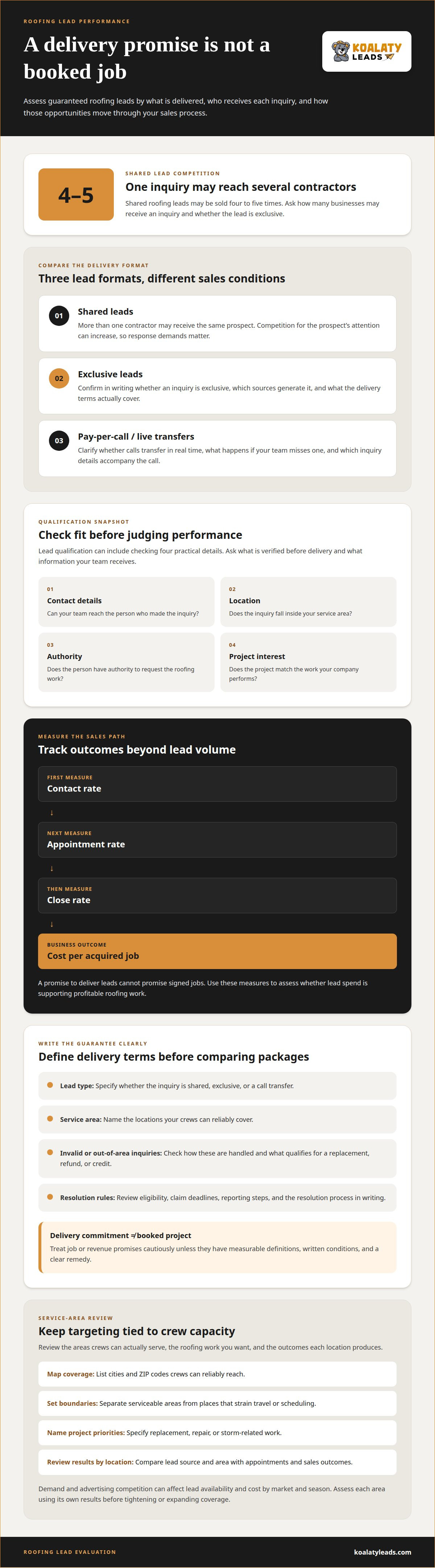
Guaranteed roofing leads should come with a clear definition of what’s guaranteed: the lead type, your target service area, and how invalid or out-of-area inquiries are handled. A promise of leads can’t promise signed jobs, so judge performance by contact rate, appointments, close rate, and cost per acquired job.
It’s reasonable to expect a lead package to make growth more predictable. But volume alone won’t tell you whether it’s working. Shared leads, exclusive leads, and live transfers create different sales conditions, and the right fit depends on your team’s response capacity, coverage, and ability to convert each opportunity.
This guide shows you how to assess roofing lead performance beyond the headline number, define service areas that match your crews, and compare packages without mistaking a delivery promise for a sales outcome. You’ll also learn how lead type affects follow-up and conversion, and which metrics help you decide whether to scale, adjust, or stop a campaign. The goal is a clearer path to buying leads that support profitable roofing work, not simply keeping the phone busy.
Key Takeaways
- Separate a lead-delivery promise from a promise of booked work, and focus on terms you can clearly measure.
- Assess whether inquiries fit your service area and the roofing work your team is set up to sell.
- Compare shared, exclusive, and pay-per-call leads by competition, response demands, and how each fits your sales process.
- Track contact, appointment, and close rates alongside cost per acquired job to judge whether lead spend is paying back.
- Use your market and lead preferences to guide a conversation with Koalaty Leads about roofing opportunities.
What Guaranteed Roofing Leads Actually Guarantee
A roofing lead guarantee should define a measurable delivery condition, not promise a signed job. When assessing guaranteed roofing leads, distinguish written delivery terms from claims about revenue, conversion, or growth.
Provider and Lead Source Comparisons
Referrals come through existing relationships, while SEO builds visibility through your website and search results. Google Ads can generate inquiries from paid clicks, and direct mail puts an offer in front of selected addresses. Each channel has different timing, costs, and follow-up demands, so compare the source and sales process alongside a provider’s written guarantee.
Some online marketplaces distribute customer inquiries to contractors competing for the same project. Ask how many businesses may receive a roofing lead and whether it is exclusive. Shared leads may be sold four to five times, increasing competition for the prospect’s attention. Your website and SEO can support owned lead generation, but results depend on search visibility, relevant service pages, and visitor actions.
Lead Verification and Contact Details
Lead qualification can include checking contact details, location, authority to request roofing work, and project interest. Ask what checks happen before delivery and what information comes with each lead. A name and phone number alone, for example, don’t show whether someone owns or manages the property or wants the type of work your company performs.
For calls, clarify whether a transfer happens in real time and what happens if your team misses it. Ask what details accompany the inquiry, such as its source, timestamp, project information, and qualification status. This helps your team prioritize follow-up and understand the prospect’s request.
If a provider offers a replacement, refund, or credit, review the written eligibility rules. Identify qualifying reasons, claim deadlines, reporting steps, and the resolution process. Don’t assume an invalid number or out-of-area inquiry automatically qualifies for a credit.
Roofing lead-generation resources for certified contractors may discuss credentials, but certification is separate from lead qualification. Review any credential claims independently, then assess each inquiry by contactability, project fit, and service-area match. Keep your company’s own credentials accurate in marketing materials.
Before signing, clarify whether leads are exclusive, which sources generate them, how calls are routed, and what the delivery terms cover. Read the agreement for spending, cancellation, and dispute terms. Treat job or revenue promises cautiously unless they have measurable definitions, written conditions, and a clear remedy. A delivery commitment is not proof of a booked project or profitable return.
Targeting Roofing Leads to Your Service Area
Match each roofing lead to the places your crews can serve and the projects your company wants. Demand and advertising competition can affect lead availability and cost by market and season.
Start with a map of the areas your crews can actually serve, rather than a broad state boundary. Mark the cities, counties, or ZIP codes you can cover, then identify places that create excessive travel or scheduling pressure. For example, a contractor may include nearby suburbs but exclude distant communities that make estimates difficult to coordinate.
Next, define your target by project type and customer intent. A company focused on roof replacement may want different inquiries from one prioritizing storm-damage repairs. State those priorities in your campaign brief, then compare each lead’s location and project details against them.
Google Local Services Ads charge for leads from people interested in the business, while Google Search and Maps advertising can reach homeowners searching for roofing companies. Ask whether an inquiry came from a search ad, a form, or a call. The source helps you assess whether targeting matches your service area and the prospect’s intent.
Review location data alongside sales outcomes. Record each lead’s city or ZIP code, whether your team reached the prospect, whether an appointment followed, and whether the opportunity became a job. If leads from an area repeatedly fall outside your practical coverage, tighten the boundary. If a nearby city produces qualified appointments, consider testing it before expanding further.
State, city, and storm season can affect both lead availability and market competition. Local search demand and campaign targeting shape the volume and mix of inquiries, so assess each market using its own results rather than assuming one area behaves like another.
Before scaling, use this service-area review:
- List the cities and ZIP codes crews can reliably reach.
- Separate serviceable areas from locations that strain travel or scheduling.
- Specify whether you want replacement, repair, or storm-related projects.
- Review lead source and location with appointment and sales outcomes.
Keep your target area narrow enough to serve well but broad enough to support your sales goals. A focused roofing lead-generation plan makes it easier to spot mismatches and adjust boundaries based on actual results, not clicks alone.
If you’re refining coverage or comparing roofing opportunities, explore roofing leads for contractors in the context of your target market.
Compare Shared, Exclusive, and Pay-Per-Call Roofing Leads
Lead source and delivery format are separate decisions. Compare who receives each inquiry, how quickly your team can respond, and whether the format suits your roofing business.
Shared leads may be sold to four to five contractors, giving each company a chance to contact the same prospect. That can create immediate competition, especially after a storm damage inquiry. A shared lead may suit a team ready to call promptly and follow up persistently, but track whether competition affects contact, inspection, and estimate outcomes.
An exclusive lead is delivered to one contractor rather than multiple competing companies. Exclusivity reduces direct competition for that inquiry, but doesn’t guarantee a conversation, appointment, or replacement project. Review the written terms, including how duplicates and out-of-area inquiries are handled.
Pay-per-call describes a call-based delivery or billing model, not necessarily exclusivity. A live transfer connects an interested prospect with your team while the person is calling, but your team still needs to respond and follow up. Confirm whether calls are exclusive, how qualification works, and which call conditions count as billable.
| Model | Competition | Best fit to assess |
|---|---|---|
| Shared lead | Other contractors may receive the same inquiry | Fast follow-up and a team ready to compete |
| Exclusive lead | One contractor receives the inquiry | More control over first contact and sales follow-up |
| Pay-per-call | Depends on routing and exclusivity terms | Teams equipped to answer or return calls quickly |
| Company-owned lead | Depends on your channel and follow-up | Roofing companies building demand through owned marketing |
Company-owned leads come through channels your business operates, such as its website, SEO, or Google Ads. Your roofing company controls the marketing message and can build a direct relationship with prospects, while also managing the work of attracting traffic, capturing inquiries, and following up. A storm-damage page, for example, can collect requests for inspections and estimates.
These models can work together. Contractors may use referrals and owned channels for longer-term demand, then add purchased leads when they need another source of opportunities. Compare each source using consistent stages: inquiry received, contact made, inspection scheduled, estimate delivered, and job won. That helps show whether the issue is lead competition, response process, or project fit.
Choose a delivery format your sales team can handle consistently. A contractor with limited call coverage may struggle to respond to live transfers, while a team that can answer promptly may value the immediate connection. Review the written delivery terms and track outcomes before scaling.
Roofing Lead Costs and Job Economics
Lead cost matters only alongside conversion and job value. Compare roofing lead offers by what you pay for, how inquiries arrive, and how many become profitable work.
Google Local Services Ads charge for leads interested in the business, while Google Ads charge for clicks. A click is not a roofing lead, so evaluate each campaign using its actual inquiry and sales outcomes. Lead costs vary with market competition, targeting, project intent, and whether inquiries are shared, exclusive, or call-based.
There’s no single cost range that fits every roofing market or package. Ask for the pricing basis and identify any separate management or platform charges. Compare offers using the same project type and service area, then check how each provider defines a billable inquiry.
| Package structure | Cost question | Performance measure |
|---|---|---|
| Pay per lead | What event triggers a charge? | Cost per qualified contact and acquired job |
| Pay per call | Which calls count as billable? | Answered calls, appointments, and sales |
| Google Ads campaign | What portion of spend produces inquiries? | Cost per lead and closed project |
| Marketing package | Which services and fees are included? | Results by channel and project type |
Build a funnel from recorded outcomes. Divide leads contacted by total leads to calculate contact rate; divide appointments by contacted leads to calculate appointment rate. Then compare closed jobs with appointments to understand close rate. Use consistent definitions, and separate roof replacement inquiries from repair or storm-damage requests.
Cost per acquired job connects marketing spend to sales results. Divide campaign costs by jobs won, including relevant lead charges and advertising spend. Compare that figure with the gross profit from those jobs, not just contract value. Payback also depends on margin, collection timing, and the cost of completing the work.
A lower charge per inquiry may still mean a higher acquisition cost if contact, appointment, or close rates are weaker. A higher lead charge can make sense if qualified homeowners become profitable projects. Use your own sales records rather than treating a general estimate as a forecast.
Have your team record each inquiry’s source, project type, location, contact outcome, appointment, estimate, and sale. Review the stages together before increasing spend. If calls go unanswered or estimates stall, address that bottleneck before buying more inquiries.
Compare lead offers against your actual sales process using consistent cost and outcome measures. This gives you a clearer basis for adjusting a campaign before committing more of your marketing budget.
Roofing Leads from Koalaty Leads
Koalaty Leads provides exclusive web leads and live inbound call transfers for roofing contractors. Turn to us when you want another source of opportunities and need a lead format that fits your service area, sales coverage, and project focus.
Our roofing leads for contractors are exclusive opportunities, not shared leads distributed among competing contractors. That distinction can reduce direct competition for an inquiry, but it does not guarantee contact, an inspection, a signed estimate, or a completed job. Your team still determines how each opportunity is handled and followed through.
Live inbound call transfers suit businesses prepared to speak with prospects as calls arrive. Exclusive web leads give teams an inquiry to follow up through their own process. The right format depends on how your sales operation handles incoming calls, assigns opportunities, and tracks outcomes.
Before discussing a campaign, identify the roofing work you want to pursue. You might prioritize roof replacement, repairs, or storm-related inquiries, then define the areas your crews can serve. A clear target keeps the conversation focused on relevant opportunities rather than lead volume alone.
Bring your current measurement approach to the discussion. Tracking contact attempts, conversations, appointments, estimates, and closed jobs helps you judge whether a lead source supports your business. Use the same definitions to evaluate new opportunities and compare results with your current channels.
Be direct about operational fit. Consider who answers calls, who follows up on web leads, and how sales staff record project details. A team with dedicated call coverage may prefer live inbound call transfers, while a team that works from a queue may prefer exclusive web leads. Neither format replaces a consistent sales process.
Koalaty Leads can discuss exclusive roofing leads and live inbound call transfers in the context of your trade and target market. The conversation can focus on your projects, service-area boundaries, lead format, and how you plan to assess performance. Lead delivery and sales outcomes are different: no lead source can promise that every inquiry becomes a job.
Share the roofing projects you want, the areas your crews can serve, and whether exclusive web leads or live inbound call transfers better fit your team. Contact Koalaty Leads to discuss your options.
Build Your Next Roofing Growth Step
Scale with a clear decision, not a larger lead commitment by default. Treat lead delivery terms as one part of your roofing plan, then judge whether the opportunities fit your sales process and business goals. Review outcomes consistently to decide when to refine your campaign or expand carefully.
Koalaty Leads offers roofing leads for contractors pursuing roofing projects. Discuss your target projects and lead format to decide whether exclusive web leads or live inbound call transfers suit your team. Aim for a roofing lead strategy your staff can manage and measure.
Choose your next roofing move deliberately, keep your sales process accountable, and build growth one sound decision at a time.
Frequently Asked Questions
How do I know if the advertising is actually working?
Use campaign tracking that connects each inquiry to a closed job. Record source, project type, contact status, estimate, sale, and revenue in your CRM. Compare campaigns over the same reporting period and use consistent definitions. If clicks rise but qualified conversations and signed work do not, review targeting, landing pages, or call handling before increasing spend. Include gross profit when judging payback, not just sales revenue.
How do I manage the leads once they come in?
Assign each inquiry to a salesperson who owns it through the next recorded step. Log call attempts, voicemail, conversations, appointments, and estimate status in one CRM record. If the first attempt doesn’t connect, schedule another follow-up rather than relying on memory. Review open leads regularly, and reassign them when the owner is unavailable so roofing opportunities don’t stall.
How much should I budget for roofing advertising?
Set your budget according to the work you want, your team’s capacity, and what your business can sustain while testing a campaign. Record advertising spend separately from lead charges and other package costs. A brand-awareness campaign may need a different allocation from one focused on storm-damage inquiries. Review closed-job results before increasing spend, and don’t set the next budget using clicks or inquiry volume alone.
What are guaranteed roofing leads, and how do lead companies define a guarantee?
A guarantee may refer to lead delivery, eligibility, or replacement terms, rather than a promise of booked work. Read the agreement for qualifying conditions, the claim process, and the remedy. Koalaty Leads states that if a contractor cannot service a zip code, the lead is re-assigned at no cost to the contractor. This addresses serviceability, not whether the prospect buys.
How much do guaranteed roofing leads cost in the United States?
Koalaty Leads lists exclusive leads at $45-$175 per lead. Its ZIP-code-volume tiers are 100+ ZIP codes at $75/CPL, 451-850 at $70/CPL, 851-2000 at $65/CPL, 2001-10,000 at $60/CPL, and 10,000+ at $50/CPL. Organic and paid-search leads start at $150/CPL and may increase based on demand. Compare the applicable tier and lead source when reviewing campaign economics, since those determine the listed rate.
Which companies offer roofing leads, and how do their plans compare?
Koalaty Leads offers exclusive web leads and live inbound call transfers through a pay-per-lead model. Its lead qualification uses a 13-point stack. Compare plans by delivery format, qualification details, targeting options, and written terms for handling leads that don’t fit your criteria. Also consider whether your sales team is better equipped to receive web inquiries or speak with prospects through live calls, then assess the format against your workflow.
Are roofing leads exclusive or shared, and how does that affect conversion rates?
Ask how leads are assigned, then use that information to interpret your sales reports. Koalaty Leads supplies exclusive web leads, so your team can track its interactions with each opportunity without treating it as a shared sales handoff. Exclusivity alone doesn’t establish a conversion rate. Compare contact, appointment, and sale outcomes across lead types while keeping your follow-up process consistent.
What is the typical conversion rate and cost per acquired customer for roofing leads?
Koalaty Leads lists a 15-25% appointment-set rate for standard leads and a 30-40% rate for organic and paid-search leads. It also states that 40-50% of appointments convert to sales. These are the company’s stated ranges, not a forecast for every contractor. Your acquired-customer cost will depend on campaign spending and the number of jobs closed, so assess results by lead source and project type.
Need exclusive leads instead of shared ones? Koalaty Leads delivers qualified homeowners — web leads or live call transfers — to one contractor only.
Get Started