
Flooring Leads: The Flooring Contractor's Buying Guide

Buying flooring leads can be worthwhile when the work they generate justifies acquisition spend and sales effort. Exclusive inquiries give one contractor the opportunity to respond; shared inquiries put multiple contractors in competition for the same prospect. Neither model is automatically profitable.
Judge every source by the outcomes your sales process can support, not by promised volume. Track whether inquiries match your services and coverage, then follow each one through contact, estimate, and completed work. This guide explains how to assess lead-service value, compare exclusive and shared models, build consistent call and text practices, and spot questionable sources. It also covers how location and project mix affect fit. Use these criteria to decide whether buying flooring leads complements your existing pipeline or whether you need a different balance of referrals, organic activity, and paid acquisition. The goal is a decision based on your capacity and job economics, with a clear next step for the channel you choose.
Key Takeaways
- Judge lead services by the jobs you acquire and the revenue they produce, not just the price of an inquiry.
- Compare exclusive and shared lead models by competition, follow-up demands, and how each fits your sales process.
- Understand the call and text compliance considerations that belong in your lead-handling workflow.
- Assess lead validity using clear indicators, and account for how market location and project type affect fit.
- See when exclusive leads or live transfers from Koalaty Leads may support your contracting business.
Are flooring lead services worth it?
Lead services can be worthwhile when the jobs they help you win justify acquisition spend and sales time. Start with flooring lead generation that matches your services, crew capacity, and sales process, then track outcomes beyond the initial inquiry.
For a fair comparison, track every source through the same steps: inquiry received, prospect reached, estimate scheduled, and job won. Google Local Services Ads charge for leads interested in your business rather than clicks, while other advertising approaches may charge for visits or use different billing models. Understand what triggers a charge before comparing results.
To see a discussion of acquisition channels and performance measurement for flooring contractors, watch James Dooley’s The 2026 Digital Marketing Strategy That Actually Works for Flooring Contractors.
Lead Service Cost and Value
Compare the full acquisition cost with the gross profit from completed jobs. Include sales time spent calling, qualifying, estimating, and following up. An inexpensive inquiry can still strain your team if few prospects are reachable or estimates don’t fit your schedule.
Set a cost ceiling based on your margins and conversion history. Use your records to estimate how many inquiries typically become completed jobs, then calculate what those jobs can support in spend. Revisit the calculation as close rates, staffing, and project mix change.
Coverage for Flooring Services
Check whether a service reaches the locations your crews can serve and the work your business performs. A broad campaign may bring requests from outside your practical service area, while overly narrow targeting can limit opportunities. Map serviceable areas and compare incoming inquiries with estimator and installation capacity.
Define the work you want to sell, such as hardwood installation, carpet replacement, or commercial flooring. Track each category separately. This prevents requests outside your company’s capabilities from inflating a campaign’s apparent value.
Lead Quality by Location and Project
Demand, competition, and project scope vary across service areas. Review location and requested service together rather than relying on one overall lead rating. Record whether each inquiry becomes a conversation, estimate, and completed job, then compare outcomes across segments.
Partnerships with interior decorators or architects can complement paid acquisition by bringing in relevant projects through referrals. Track those inquiries using the same process as other sources. A focused monthly review can show whether your spending supports the work your team wants and can deliver.
Exclusive versus shared leads
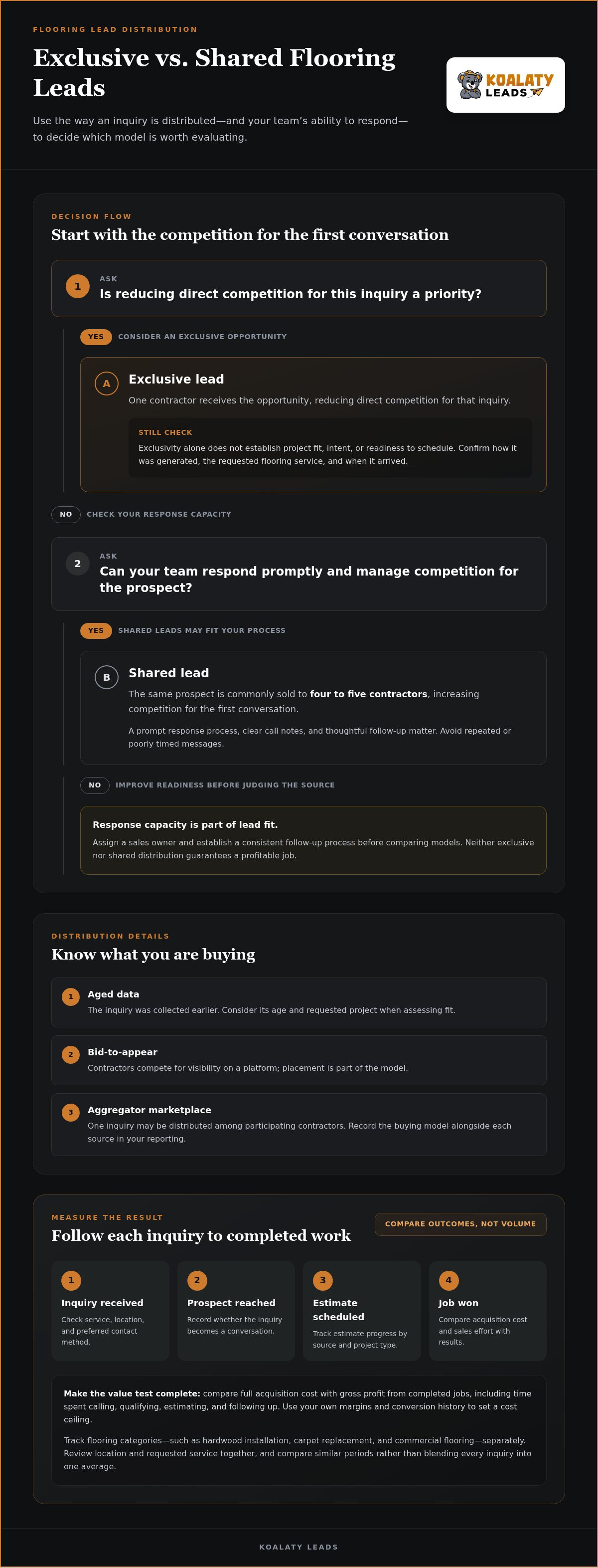
Lead distribution affects how quickly flooring contractors need to respond and how much competition they face. Compare exclusive and shared opportunities by buyer count, lead age, contact process, and the work required to turn an inquiry into a completed installation.
An exclusive lead is routed to one contractor for that opportunity. This can make the first sales conversation less crowded, but exclusivity alone doesn’t establish project fit, intent, or readiness to schedule. Check how the inquiry was generated, which service the prospect requested, and when it arrived.
Shared leads are commonly sold to four to five contractors. A homeowner searching for hardwood installation may hear from several businesses, so your team needs a prompt response process, clear call notes, and thoughtful follow-up. Stand out without sending repeated or poorly timed messages.
Neither model guarantees profitable jobs. Track each source through valid inquiry, successful contact, estimate, and closed project. Then compare acquisition spending and sales effort with the results. A lower inquiry cost can still mean a higher cost per acquired job if fewer prospects respond or schedule.
- Exclusive: One contractor receives the opportunity, reducing direct competition for that inquiry.
- Shared: Several contractors receive the same prospect, increasing competition for the first conversation.
- Aged data: The inquiry was collected earlier, so its age and requested project matter when assessing fit.
- Bid-to-appear: Contractors compete for visibility on a platform, so placement is part of the model.
These distinctions matter when reviewing advertising platforms. An aggregator marketplace may distribute one inquiry among participating contractors, while a bid-to-appear model sells visibility rather than an exclusive introduction. Record which buying model you use alongside each source in your reporting.
Intent varies by request. Someone searching for hardwood installation may have a defined project, while a broad home improvement inquiry may need more qualification. Before assigning an inquiry to a salesperson, check whether it identifies the flooring service, location, and preferred contact method.
If exclusive opportunities or direct call transfers fit your sales process, Koalaty Leads can discuss options for your flooring business and market.
Before testing a source, assign a sales owner and log every outcome in your customer relationship system. Compare similar periods and services, such as hardwood installation and carpet replacement, rather than blending all inquiries into one average. This gives you a practical basis for choosing a model that suits your team’s response capacity.
What rules apply to calling or texting flooring leads in the United States?
Use a documented contact process for every inquiry. Before calling or texting, review how the person submitted the request, which contact methods they selected, and any recorded preferences. A request for a flooring estimate doesn’t automatically warrant every type of follow-up campaign.
Requirements can depend on the contact method, technology, recipient, and applicable location. Have qualified counsel review campaigns involving automated dialing, prerecorded messages, or marketing texts. Focus the review on how your team and vendors collect permission and handle requests to stop contact.
Record consent and contact preferences
Keep the original inquiry record, including its source, submission time, requested service, and contact preferences. If someone requests hardwood installation through a form, preserve the form details with the lead. Don’t rely solely on a vendor’s summary when your team needs to know what the person requested.
Keep separate records for calls, texts, and later interactions. A phone inquiry and a text exchange are distinct events in your sales process. Before discussing an estimate, staff should confirm they have the right person and relevant request. If the record doesn’t support the planned outreach, pause and resolve the uncertainty first.
Honor stop requests and maintain suppression records
Make opt-out handling part of your standard workflow. If someone says “stop,” asks not to be contacted, or withdraws permission, record the request and halt the affected outreach. Ensure every employee and system handling the prospect can see the updated status.
Maintain a suppression list to prevent accidental follow-up. For example, a flooring estimator should see a stop request before sending an appointment reminder. Don’t remove an entry just because another record has matching details. Review duplicates carefully and document how your team resolved them.
Control scripts, timing, and vendors
Review scripts to ensure clear identification, an honest reason for calling, and a respectful way to end contact. Don’t imply someone booked an appointment when they only requested flooring information. Give staff a clear escalation path for consent disputes and complaints about unwanted outreach.
Before launching a campaign, map who collects consent, who calls or texts, and who processes opt-outs. Keep vendor terms, sample forms, and inquiry records together. For flooring leads gathered across multiple states, ask counsel to review the specific workflow and technologies involved.
Train sales staff to record every contact attempt and its outcome. A brief note can distinguish a requested callback from an unanswered call or a stop request. Review records regularly and ensure updates reach every tool your team uses. Consistent documentation helps managers see how flooring leads move from inquiry to estimate while keeping staff on the same process.
How can flooring businesses avoid fake leads and lead-generation scams?
Protect your lead budget with a repeatable review process. Before buying, identify how each inquiry is generated, what information comes with it, and how billing disputes are handled. Then test a small, trackable batch against your own contact and appointment records.
Start with the offer itself. Ask for a written description of the lead source, requested service, service-area targeting, delivery timing, and whether inquiries are exclusive or shared. A vague promise of “qualified flooring projects” is of little use unless it explains what qualification means.
Review purchase terms before committing. Look for the billing trigger, any minimum commitment, the cancellation process, and the policy for duplicate, invalid, or out-of-area inquiries. A duplicate inquiry, for example, should be identifiable through matching contact details and submission records, not just a salesperson’s judgment.
- Check the record: Confirm each lead includes a usable contact method, project type, and location.
- Check the timing: Compare the inquiry’s submission time with its delivery time.
- Check the territory: Match the address or ZIP code against the area your crews serve.
- Check the request: Separate flooring installation inquiries from unrelated home improvement requests.
Run a controlled test rather than placing a large order immediately. Route test inquiries to one sales owner, log every call attempt, and mark outcomes such as reached, wrong number, outside territory, or appointment booked. These labels help distinguish a weak source from a slow follow-up process.
Watch for records that don’t match the stated service. If your team receives a hardwood installation inquiry but the person denies submitting a request, preserve the call notes and lead record. Repeated mismatches warrant a documented review with the vendor before committing more budget.
Be cautious if a seller pressures you to decide before explaining delivery and billing terms. A sound evaluation should leave you able to describe what you’re buying, when charges apply, and how the provider handles a disputed record. Keep the offer, terms, and sample lead fields together for comparison.
Measure quality through business outcomes, not a vendor’s label. Track how many inquiries are reachable, how many become estimates, and which flooring projects close. If a source brings many contacts but few relevant appointments, adjust targeting or stop the test. Don’t judge performance by volume alone.
Finally, keep records in one place. A spreadsheet or customer relationship system can connect each inquiry to its source, contact attempts, dispute notes, and job outcome. Review these fields consistently before renewing or expanding a campaign.
How does flooring lead quality vary by location and project type
Location affects demand, competition, drive time, and the kinds of projects entering your pipeline. Project type affects likely job value and the sales work needed to qualify an inquiry. Review both dimensions together to see which flooring leads fit your operation.
Compare markets by operational fit
A dense market may offer more prospects, but it can also put more contractors in front of them. A less populated area may bring fewer inquiries and shorter drives between estimates. Neither setting guarantees stronger performance. Consider crew capacity, competition, travel time, and the services your business can complete.
Group results by service area instead of relying on one territory-wide total. Compare inquiry origins, estimates booked, and completed jobs across areas. If distant requests rarely become appointments, adjust routing or focus outreach closer to your crews. If a farther area produces suitable projects, keep it in the mix and schedule estimates efficiently.
Segment performance by flooring project
Project categories can carry different revenue potential. Hardwood projects are estimated at $3,000 to $18,000 per project; carpet projects are estimated at $500 to $5,000. Vinyl plank projects are estimated at $2,000 to $10,000, while epoxy jobs are estimated at $3,000 to $8,000.
Use those ranges as context, not as a profit prediction. Compare actual margins, estimating effort, crew availability, and close rates by project type. A smaller carpet replacement might fit an open installation slot, while a commercial request could require different estimating and scheduling resources.
Capture enough detail to route an inquiry correctly. Record whether the request concerns a single room or a larger project, the flooring service requested, and the prospect’s stated timeline. Keep residential and commercial inquiries separate in your reporting. This makes it easier to see which flooring leads fit your team’s capabilities and sales process.
Timing can affect follow-up priorities. Flooring customers may consider projects for 3 to 12 months before deciding. Record the prospect’s timing and agreed next step, then organize follow-up around that information. This helps your sales team distinguish an active estimate request from an early-stage inquiry without treating either as irrelevant.
Review the combined picture regularly. Compare hardwood inquiries from near and far service areas, then see which become estimates and jobs. Use the pattern to refine lead routing, campaign targeting, and estimator schedules. Your strongest segment is the one that suits both your target work and operational capacity.
Koalaty Leads: Roofing Leads
Koalaty Leads is a next step for contractors looking to add exclusive home improvement inquiries to their sales pipeline. Its offerings include roofing, window replacement, bathroom remodel, and kitchen remodeling leads. Choose the category that matches your crew’s work and sales process, then assess incoming opportunities using the lead-quality and follow-up criteria above.
For a flooring contractor, this section’s listed offerings may not match the trade’s needs. Koalaty Leads can still be relevant if your business also handles one of these remodeling categories and wants to explore exclusive leads for that work. Keep your evaluation grounded in service fit, territory, and the way your team follows up.
Visit Koalaty Leads to discuss whether its lead options fit your business.
Build a lead plan your team can execute
Make your next move operational. Choose the project types and service areas that fit your crew, then align lead handling with your estimating capacity. A focused plan helps your team respond consistently and judge whether new opportunities support the work you want to book.
Apply the same discipline to flooring leads: connect each opportunity to its source, sales follow-up, and eventual job outcome. If your company also works in other remodeling trades, Koalaty Leads offers Roofing Leads, Window Replacement Leads, and Bathroom Remodel Leads. Each can support a distinct service line without blurring your flooring pipeline.
Talk with Koalaty Leads about exclusive leads or live transfers for your trade and market, and find an option that fits your sales process.
Keep your next step clear, your tracking consistent, and your growth plan grounded in the work your team is ready to win.
Frequently Asked Questions
How can I grow my flooring business?
Grow by focusing on the services and customer segments your team can serve profitably. Review closed jobs to identify which project types bring repeatable work, then align sales capacity and marketing around those services. If commercial flooring fits your crew and schedule, for example, create a focused outreach plan for property managers. Track booked estimates and completed work so growth reflects revenue, not just more inquiries.
How do I get more flooring customers?
Build a steady flow through local visibility, customer referrals, and targeted lead acquisition. Keep your Google Business Profile current, publish photos of completed installations with project descriptions, and ask satisfied customers for honest reviews. Make it easy for prospects to request an estimate through your website. A page dedicated to hardwood installation, for example, can attract people searching for that service and give your team clearer inquiry details.
What are flooring leads and how do contractors use them?
A flooring lead is an inquiry from a prospective customer interested in flooring work. Contractors use the contact details and project information to assess fit, assign a salesperson, and schedule the next conversation. Route each inquiry to a named owner in your customer relationship system, then record the requested service and outcome. Koalaty Leads offers exclusive flooring opportunities, along with call transfers and inbound calls for contractors seeking direct conversations.
How much do flooring leads cost per lead or per month?
Lead spend depends on the billing model, requested service, targeting, and whether inquiries are exclusive or shared. A per-lead arrangement ties spend to accepted inquiries, while a monthly model sets a recurring budget. Compare offers by forecasting inquiry volume against your own contact, appointment, and close rates. Include follow-up capacity in the calculation, since inquiries your team can’t work promptly may not support the planned return.
What is the average cost to acquire a flooring customer?
Calculate customer acquisition cost by dividing a channel’s marketing and lead-generation spend by the customers who close from it. For a fuller picture, include the sales labor required to contact, estimate, and follow up with prospects. Track this separately for each source and project category. That shows whether a channel produces customers at a sustainable cost for your margins, rather than relying on a broad industry average.
Are exclusive or shared flooring leads more effective?
Effectiveness depends on your team’s capacity, response process, and the cost of turning inquiries into jobs. Compare each model using the same outcomes, such as reached prospects, booked estimates, and closed work. A contractor with a prepared sales team may be better equipped to work opportunities involving direct competition. A smaller team may prefer a workflow with clear lead ownership. Judge results by customer acquisition cost, not labels alone.
How can flooring contractors generate free flooring leads online?
Build organic visibility with a complete business profile, useful service pages, and consistent project updates. Share installation photos with clear descriptions, request reviews from satisfied customers, and answer common flooring project questions. A page about epoxy flooring, for example, can attract relevant searches when it explains your service and makes the next contact step clear. These tactics still require staff time and ongoing upkeep, even without paid lead charges.
How do Google Ads and local SEO compare for flooring lead generation?
Google Ads can target people searching for flooring solutions locally, and Google Local Services Ads charge for interested leads rather than clicks. Local SEO builds visibility through a refined Google Business Profile, local directories, and targeted local keywords; the article gives no direct performance comparison.
Need exclusive leads instead of shared ones? Koalaty Leads delivers qualified homeowners — web leads or live call transfers — to one contractor only.
Get Started