
Exclusive Roofing Leads: How Exclusivity Affects Roofing Sales ROI

A higher price per lead doesn’t automatically mean a higher cost to win a roofing job. Exclusive roofing leads give one contractor the opportunity to pursue a lead without competing contractors pursuing that same opportunity at the same time. But exclusivity alone doesn’t prove homeowner intent, lead quality, or likely ROI. Response speed and sales execution still matter.
If you’ve paid for a shared lead and found yourself racing other roofers to reach the same prospect, the appeal of exclusivity is clear. The real question is whether that difference leads to more productive conversations and profitable jobs. This article explains how exclusive leads compare with shared, aged, and live-transfer opportunities, and how to assess each against your sales process.
You’ll also see how to connect lead spend to contact rates, booked appointments, close rates, and cost per acquired job, rather than judging a source by its price per lead alone. Use those metrics to decide whether exclusive opportunities fit your team’s follow-up capacity and roofing sales goals.
Key Takeaways
- Exclusive roofing leads are routed to one contractor, while shared opportunities may be distributed among multiple contractors.
- Track each stage from lead delivery or call transfer through follow-up and job outcome to identify where sales opportunities are lost.
- Compare shared, exclusive, aged, and live-transfer leads by routing and timing, not just by their upfront cost.
- Check that your team has clear call coverage, qualification steps, estimating capacity, and follow-up ownership before adding a lead source.
- See how Koalaty Leads’ exclusive leads, inbound calls, and live transfers can align with different roofing sales processes.
What exclusive roofing leads mean for a contractor's sales pipeline
An exclusive roofing lead is an opportunity delivered to one contractor, not shared with rival contractors. The phrase exclusive roofing leads describes how an opportunity is distributed; it doesn’t establish whether the contact details are accurate, the project fits your business, or the prospect is ready to buy. For a closer look at the roofing opportunities Koalaty Leads supplies, visit our roofing leads page.
That distinction matters because exclusivity changes the competition for an opportunity, not the work required to sell it. A lead still has to move through your pipeline: make contact, qualify the project, book an appointment, prepare an estimate, and close the job. Each stage gives your team a chance to assess fit and decide what follow-up makes sense. The broader Lead Generation process starts with identifying potential customers, but a contractor’s sales process determines what happens next.
This video discusses advertising options. Use it as general context, not as a measure of roofing lead exclusivity or conversion.
What makes a roofing lead exclusive?
Exclusivity means the opportunity is routed to one contractor rather than distributed to competing contractors. That can reduce direct competition for the same prospect and give your sales team room to have a focused conversation instead of entering a race to make contact.
It doesn’t replace qualification. Confirm the contact’s needs, project scope, timing, service location, and fit with your company’s work. A lead can be exclusive and still prove inaccurate, unreachable, or mismatched once your team speaks with the prospect.
Exclusive does not mean guaranteed
Delivery status is separate from contactability, homeowner intent, appointment attendance, and close likelihood. Your team controls important parts of the outcome, including how quickly it responds, how consistently it follows up, and how effectively it qualifies the opportunity.
Exclusivity limits who receives the opportunity; it doesn’t guarantee a conversation, a signed job, or revenue. Treat each lead as a chance to sell, not as a completed sale. That discipline helps you evaluate the source by what progresses through your pipeline, rather than by its label alone.
How exclusive roofing leads move from first contact to a booked job
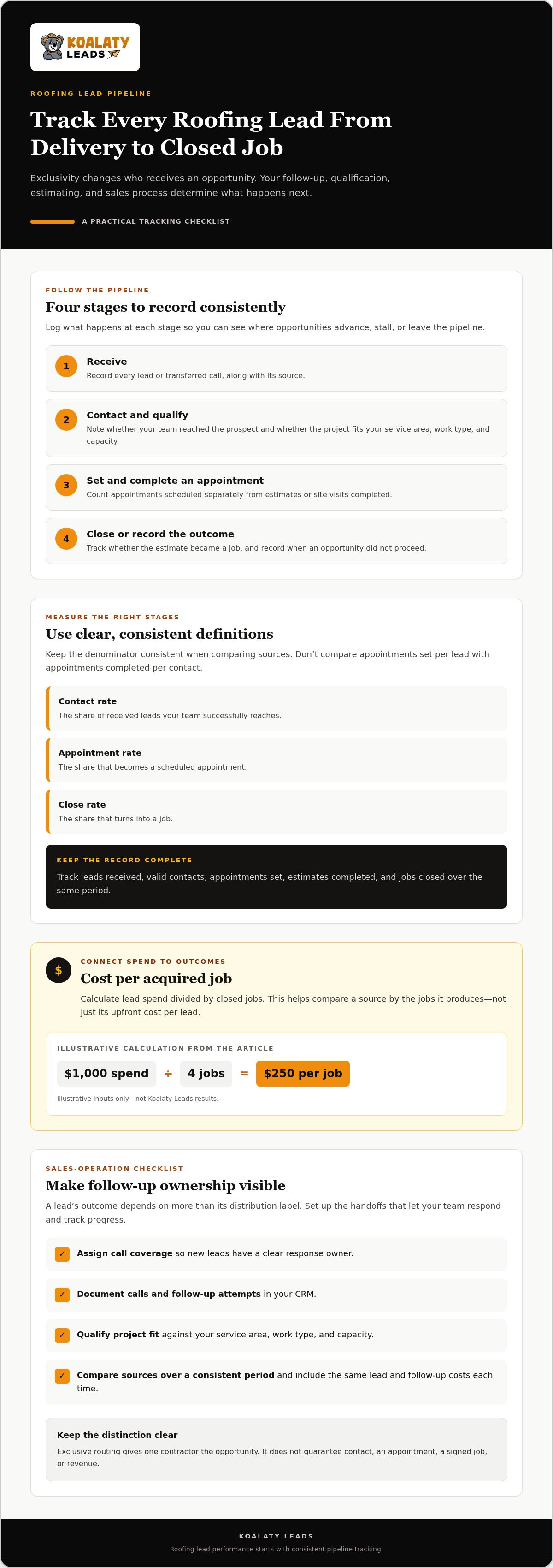
A lead’s value becomes clear as it moves through your sales process, from delivery or a call transfer to contact, qualification, an appointment, an estimate, and a final outcome. Track each stage consistently so you can see where opportunities advance, where they stall, and what your lead spend produces.
Use a simple pipeline:
- 1. Receive: Record each lead or transferred call and identify its source.
- 2. Contact and qualify: Log whether your team reached the prospect and whether the project fits your service area, work type, and capacity.
- 3. Set and complete an appointment: Count appointments scheduled separately from estimates or site visits completed.
- 4. Close or record the outcome: Track whether the estimate became a job, and note when an opportunity did not proceed.
Track the stages that reveal lead performance
Contact rate is the share of received leads your team successfully reaches. Appointment rate is the share that becomes a scheduled appointment, while close rate is the share that turns into a job. Define the denominator for each metric and keep it consistent. For example, don’t compare appointments set per lead in one source with appointments completed per contact in another.
Record leads received, valid contacts, appointments set, estimates completed, and jobs closed over the same period. That view helps separate lead-source results from follow-up, qualification, and estimating outcomes. The National Roofing Contractors Association is an industry reference; your own pipeline records are what show how your sales operation performs.
Why response speed and follow-up change the result
A delayed response can make it harder to start a useful conversation while the prospect is available. Assign call coverage, set clear ownership for each new lead, and document calls and follow-up attempts in your CRM. Otherwise, a missed connection can look like a source problem when the lead may simply have gone untouched.
Exclusivity gives one contractor the opportunity; it doesn’t give that contractor control over conversion. Your team still has to make contact, qualify the project, complete the estimate, and close the job.
To connect results to spend, calculate cost per acquired job as lead spend divided by closed jobs. If you spend $1,000 and close four jobs, the illustrative cost per acquired job is $250. Those inputs are hypothetical, not Koalaty Leads results. For a source-level comparison, include the same lead and follow-up costs each time, and compare channels over a consistent period.
If you’re assessing whether this approach fits your roofing pipeline, explore Koalaty Leads roofing opportunities.
Exclusive vs. shared roofing leads: compare the economics, not just the label
Lead models change how an opportunity reaches your team and what your sales process must do next. Compare routing, timing, and staffing needs alongside cost per lead. A lower upfront cost doesn’t prove better returns if fewer leads become appointments or closed jobs.
| Opportunity type | Routing | Timing | Operational trade-off |
|---|---|---|---|
| Shared | May be distributed to multiple contractors | Often delivered as a contact for follow-up | Can require quick outreach and clear differentiation when other contractors may also call. |
| Exclusive | Delivered to one contractor | Typically received for direct follow-up | Reduces direct competition for the same opportunity, but your team still needs to contact, qualify, and sell. |
| Aged | Previously collected lead information is made available later | There may be a gap between the original inquiry and delivery | Confirm current project interest and contact details before investing substantial follow-up time. |
| Live transfer | A call is connected to a contractor in real time | Immediate conversation opportunity | Requires call coverage and the ability to qualify the caller while connected. |
Shared and exclusive leads create different competitive conditions
A shared opportunity may put multiple contractors in contact with the same prospect. That can make response timing and sales execution especially important, while an exclusive lead gives one contractor the opportunity without that same direct competition. Neither routing model establishes project fit or purchase intent by itself.
Judge the economics by what happens after delivery. Track cost per lead alongside contact rate, appointment rate, close rate, and cost per acquired job. For example, a cheaper lead source may still cost more per closed job if fewer opportunities reach the finish line. Compare sources over the same period and use consistent counting rules, rather than relying on the lead label or purchase price alone.
Where live transfers fit
A live transfer connects a call to your team in real time, creating the chance to speak with the prospect immediately. That format can suit a sales operation prepared to answer, qualify, and route calls as they come in. If coverage is limited, a transferred call may be difficult to handle well.
Koalaty Leads offers exclusive roofing leads as a roofing lead option, while live transfers offer a direct-call format. Compare both against your team’s call coverage and recorded pipeline outcomes. No delivery model guarantees contact, appointments, closed jobs, or ROI.
How to assess whether exclusive roofing leads fit your sales operation
Exclusive roofing leads can suit a team that has the capacity to respond, qualify projects, prepare estimates, and follow up consistently. Before adding a source, establish how your current leads move through those stages. A clear baseline helps you judge whether a new channel is contributing opportunities your operation can handle and jobs that make financial sense. If you are looking to scale your pipeline through an integrated growth partner program, read more about comprehensive marketing engines designed for service businesses.
Use this readiness checklist before you commit budget:
- Call coverage: Assign someone to receive incoming calls and respond to delivered leads during your stated business hours.
- Qualification: Use consistent questions to assess project type, location, timing, and fit with your services.
- Estimating capacity: Make sure your team can handle the appointments and estimates generated by current demand plus any new opportunities.
- Follow-up ownership: Give each lead a clear owner and a documented next step, including when an estimate is still awaiting a decision.
Set measurement rules before buying
Define what your team counts as a valid lead, a successful contact, a scheduled appointment, and a closed job. Record the source, delivery type, first-response timing, sales stage, and final outcome the same way for every opportunity. A CRM report or simple tracking system can reveal patterns that memory misses.
Build a baseline from existing sources first. Then compare like-for-like roofing leads over comparable periods, using consistent definitions and enough time for the sales process to reach its normal outcomes. Review results on a regular cadence, and separate source performance from differences in follow-up, estimating, or job availability.
Match lead delivery to team capacity
Consider who answers incoming calls, how call coverage works during business hours, and whether estimators have room to take on additional appointments. For live transfers, immediate call handling is part of the operating requirement. For delivered leads, assign a clear response owner so new opportunities don’t sit unaddressed.
Finally, assess acquisition cost against job economics, not an arbitrary benchmark. Compare lead spend with the contribution margin your completed jobs generate after relevant job costs. Your tracked results can help determine what acquisition cost is sustainable for your business without assuming one threshold fits every contractor.
For a focused look at roofing opportunities and how they fit your process, explore Koalaty Leads’ roofing leads.
How Koalaty Leads approaches exclusive roofing leads and live transfers
Koalaty Leads delivers exclusive roofing opportunities to one contractor rather than sharing a lead with competing contractors. For teams comparing acquisition channels, that routing model is one part of the decision; call handling, qualification, estimating capacity, and tracked job outcomes matter too.
We offer three formats for roofing opportunities: exclusive leads, inbound calls, and live transfers. Each creates a different handoff to your sales team, so the right comparison is how well the format fits your workflow, not an assumption that one option works for every roofing company.
Choose the delivery format that matches your workflow
With a delivered exclusive lead, your team receives the opportunity and manages outreach and follow-up. Inbound calls give prospects a way to call your business, while a live transfer connects a caller to your team in real time. The call-based options make coverage especially important: someone needs to be available to answer, qualify the opportunity, and determine the next step.
Consider who handles new inquiries, how calls are routed, and whether your sales team and estimators can respond without interrupting existing appointments. If your team is stronger at organized follow-up than immediate call handling, that may affect which format fits best. Use your own contact, appointment, close, and acquisition-cost records to assess the results.
Roofing is one part of a contractor’s broader lead-buying decisions, but each trade has its own qualification and sales process. Keep roofing performance distinct in your reporting so results from other services don’t blur the picture.
Move from comparison to a practical conversation
Before discussing a new source, prepare a concise picture of your operation: the roofing work you pursue, who handles new leads and calls, how estimates are scheduled, and what you track from first contact through closed job. That context can make a conversation about lead delivery more useful and specific to your sales process.
Review how Koalaty Leads roofing leads fit your acquisition approach, then consider whether delivered opportunities, inbound calls, or live transfers best align with your team’s capacity. No format removes the need for prompt follow-up and consistent measurement.
Talk with Koalaty Leads about exclusive roofing leads or live transfers for your business.
Discuss roofing leads or live transfers with Koalaty Leads
Build a roofing pipeline you can measure
Exclusive roofing leads give one contractor the opportunity instead of sending it to competing contractors, but exclusivity alone doesn’t guarantee a qualified conversation or a closed job. The value depends on what your team does next: respond, qualify, schedule an estimate, and follow through. Judge performance by the full path, not just the lead label or upfront cost.
Compare sources using consistent contact, appointment, close, and cost-per-acquired-job measures. Then check whether your team has the call coverage, estimating capacity, and follow-up ownership to handle the opportunities. A channel is a better fit when its economics align with your job margins and your sales operation can act on the leads.
Roofing is Koalaty Leads’ top-priority offering, with exclusive leads, inbound calls, and live transfers available as different ways to connect opportunities with your team. Choose the format that fits your workflow, then use your own tracked results to guide your next growth decision.
Explore Koalaty Leads roofing leads
Build a process your team can measure and improve. With clear ownership and consistent follow-up, you’ll be better positioned to turn the right opportunities into sustainable growth.
Frequently Asked Questions
What are exclusive roofing leads?
Exclusive roofing leads are opportunities delivered to one roofing contractor rather than shared with competing contractors. Exclusivity describes distribution, not whether a prospect is reachable, has a project that fits your business, or is ready to move forward. Your team still needs to verify the details, qualify the opportunity, and manage follow-up. Track each lead through contact, appointment, estimate, and job outcome to understand its value in your pipeline.
Are exclusive roofing leads better than shared leads?
Exclusive leads reduce direct competition for the same opportunity, while shared leads may be distributed to multiple contractors. Neither format guarantees better profitability by itself. Compare cost per lead with contact, appointment, and close rates, then calculate cost per acquired job. A lower-priced shared lead may not be more economical if fewer opportunities become jobs; an exclusive lead still depends on fit, response, and sales execution.
How much do exclusive roofing leads cost?
There isn’t one standard price for exclusive roofing leads. Costs can vary with factors such as market, project type, and how the opportunity is delivered. Rather than judging a source on price per lead alone, compare its cost with your contact, appointment, and close rates, then calculate cost per acquired job. Use your own sales records to decide whether the economics fit your margins and capacity.
Do exclusive roofing leads guarantee roofing jobs?
No. Exclusivity means one contractor receives the opportunity instead of competing contractors receiving it; it doesn’t guarantee accurate details, successful contact, an attended appointment, or a signed job. Your response time, qualification, estimating process, and follow-up all affect the outcome. Set clear expectations with your team and record each stage in your CRM so you can distinguish lead delivery from sales execution.
What is the difference between an exclusive roofing lead and a live transfer?
An exclusive roofing lead is routed to one contractor, who then handles outreach and follow-up. A live transfer connects a caller with a contractor in real time, creating an immediate chance to speak. The formats differ in the handoff and timing, not in whether a job is guaranteed. Consider whether your team can answer and qualify calls promptly or has a stronger process for managing delivered leads.
How should roofing contractors measure lead ROI?
Measure performance across the funnel: leads received, valid contacts, appointments set, estimates completed, and jobs closed. Calculate cost per acquired job by dividing lead spend by the number of closed jobs, and compare results across sources over consistent periods. Use consistent definitions for each stage, and account for relevant job costs when judging profitability. This shows whether a source supports your business economics, not just whether it produces leads.
Need exclusive leads instead of shared ones? Koalaty Leads delivers qualified homeowners — web leads or live call transfers — to one contractor only.
Get Started