
Exclusive Leads: The Contractor's Guide to Higher ROI

A higher price per inquiry can still mean a lower cost to acquire a job. When an inquiry goes to one contractor, your team has less direct competition for that lead and a clearer opportunity to make contact. But exclusivity alone doesn’t make an inquiry qualified or profitable.
The real measure isn’t the lead price by itself. Results depend on whether your follow-up turns that spend into booked appointments and closed jobs at a cost your business can support. A poor fit, slow response, or unclear terms can erase the value.
This guide explains how targeting, qualification, and delivery shape lead performance, and how to assess pricing without mistaking a low cost per inquiry for strong ROI. You’ll also learn what to consider when evaluating appointment rates, minimum orders, guarantees, and contract terms. Use these criteria to decide whether a lead program fits your sales process and supports a workable cost per acquired job.
Key Takeaways
- Compare lead spend with appointment and close rates to understand what each acquired job really costs.
- Assess how exclusive selling and timely delivery affect competition for a prospect and your team’s follow-up process.
- Use targeting and qualification criteria that match your trade, service area, and sales capacity.
- Evaluate lead costs alongside minimum orders and the sales outcomes your team can track.
- Review guarantee language, credit policies, and contract terms so you understand how lead issues and commitments are handled.
How do exclusive leads reduce overall marketing costs?
Exclusive leads can reduce wasted sales effort because one contractor receives the prospect’s inquiry instead of competing with several businesses for it. The potential savings come from using follow-up time more effectively, not simply from the lead label. Compare campaign spend with appointments and completed jobs. A lower cost per inquiry means little if your team spends time pursuing prospects outside its services or territory.
Build a buyer-targeted strategy before purchasing. Define the service, job type, location, and details your team needs to assess fit. For example, a roofing contractor focused on replacements can distinguish those requests from inquiries for work it doesn’t perform. Clear targeting helps sales staff qualify consistently and directs campaign investment toward prospects who match the business.
For a service business, track every inquiry through the pipeline. Record its source, whether the prospect was reached, whether an appointment was booked, and whether the job closed. Review these stages by service and location. If calls are answered but appointments remain low, refine the qualification criteria or follow-up process before increasing campaign spend.
Location targeting can make that review more useful. Start with the cities and ZIP codes your crews can serve, then compare appointments and closed work across those areas. A contractor operating in several parts of a metro area might find that one zone produces more viable jobs. Use those results to adjust campaign boundaries and sales coverage.
Attorney lead examples show why acquisition cost must be considered alongside case value. One example assigns a $45,000 fee value to a case and $1,425 in acquisition cost. Those figures describe a legal-services example, not a contractor benchmark. Apply the calculation to your own business using actual lead spend, job revenue, and direct costs.
In the United States, assess how consent was obtained, which contact method the prospect agreed to, and whether opt-outs are recorded. Keep consent and outreach records with the lead, and use them to guide calls or texts. These steps help your team manage contact responsibly without treating an inquiry as permission to send unrelated messages.
The main advantage of exclusive leads is reduced competition for the same inquiry. The trade-off may be a higher price per lead than shared distribution. Exclusivity doesn’t establish project fit or ensure a sale. Judge the model by cost per appointment and acquired job, then compare those results with your current channels. That gives you a practical basis for deciding whether the added control supports your margins.
Exclusive lead selling and real-time delivery
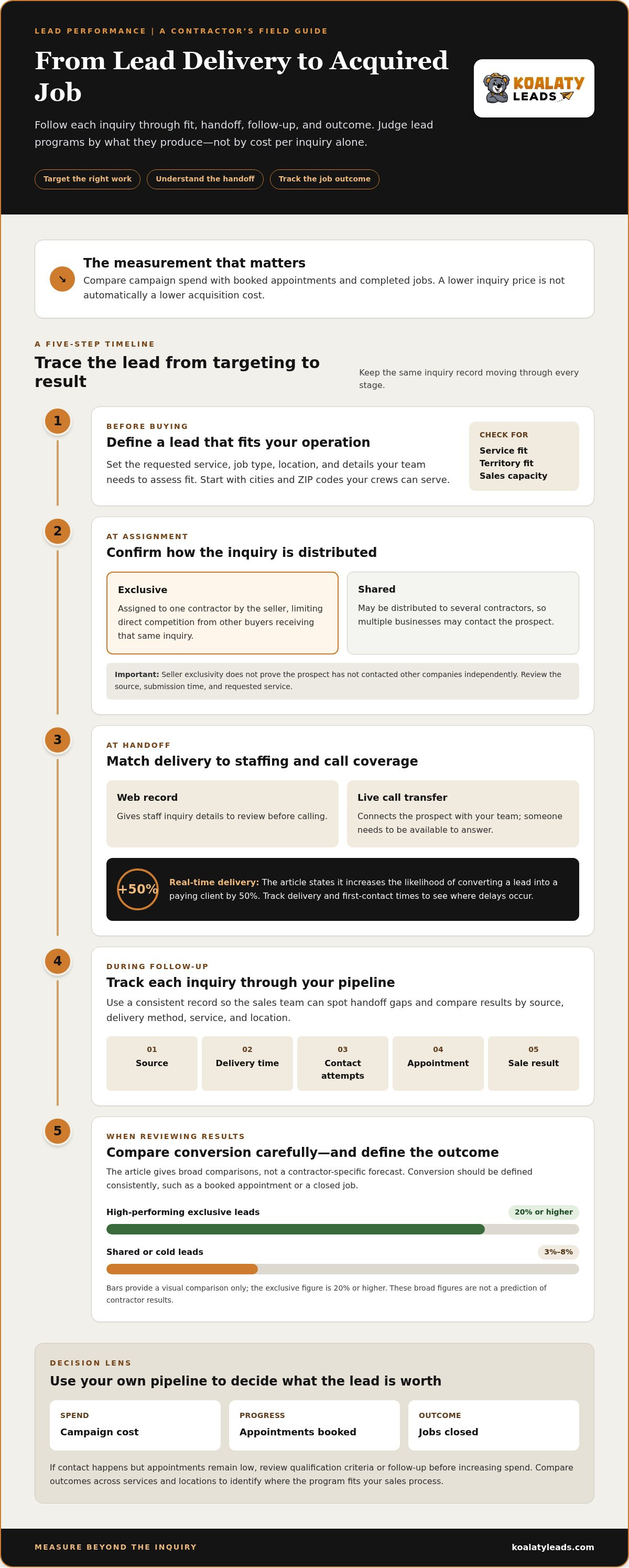
Exclusive leads are assigned to one contractor, while shared leads may be distributed to several businesses. Delivery method and response timing shape how your team handles each inquiry.
Exclusive and Shared Lead Differences
A single-sale lead limits direct competition from other buyers receiving that same inquiry through the seller. Shared distribution can send one prospect’s details to multiple contractors, so several businesses may contact them. Ask how the provider defines exclusivity and whether records are routed to other buyers or services.
That distinction doesn’t prove a prospect hasn’t contacted other companies independently. Review the lead record for its source, submission time, and requested service. For example, a prospect may have filled out another company’s form before your team receives a separately generated inquiry.
Delivery Methods and Timelines
Common handoffs include a web record delivered to your sales system and a live call transfer connecting a prospect with your team. Web delivery gives staff details to review before calling; a transfer requires someone to be available to answer. Match the method to your staffing, call routing, and approach to new opportunities.
Real-time delivery increases the likelihood of converting a lead into a paying client by 50%. Put an owner on incoming records, route calls to available staff, and capture the delivery and first-contact times. Those timestamps help identify whether a delay occurred during routing or after the lead reached your team.
Lead Qualification and Competition
Legal practices may qualify inquiries by case type, relevant location, and facts needed for an initial review. Contractors can use comparable screening: requested service, project location, and whether the inquiry fits the work they perform. Qualification provides context for follow-up; it doesn’t mean the prospect is ready to sign or schedule.
Competition can still influence results, so track outcomes by source and delivery method. High-performing exclusive leads often convert at 20% or higher, while shared or cold leads often convert at 3% to 8%. These figures are broad comparisons, not a contractor-specific forecast. Define conversion consistently, such as a booked appointment or a closed job.
Use a tracking system to follow each inquiry from receipt to outcome. Record source, delivery time, contact attempts, appointment status, and sale result. Review those fields together to find handoff gaps. For instance, if calls transfer successfully but appointments don’t follow, examine qualification and call handling rather than changing delivery alone.
Keep campaign reports focused on decisions your sales manager can act on. Compare delivery channels, lead fit, and follow-up outcomes, then adjust the workflow where records reveal friction. This makes the value of exclusive leads easier to assess through your own pipeline, rather than relying only on lead counts or broad performance claims.
How the agency targets, qualifies, and delivers leads
Strong targeting connects a prospect’s location and requested work with your business’s actual capacity. Before buying, define your service territory, job types, and required lead details. Then clarify how those filters are applied and delivery is recorded.
To assess exclusivity, ask whether each inquiry is sold or routed to another contractor, and how distribution is documented. Ask what targeting criteria, qualification fields, delivery method, and lead-issue process apply before you commit.
Geographic Targeting and Territory Protection
Territory targeting should reflect where your crews can take work, not just a broad metro boundary. Map the cities and ZIP codes you can serve, then identify overlaps with existing branches or sales teams. For example, a contractor with crews serving neighboring communities can define who handles leads near the boundary.
Clarify how territory boundaries are applied and how inquiries near an edge are handled. Review the written territory definition alongside your dispatch map, so each lead’s assigned location fits the area your team actually covers.
City and ZIP Code Targeting
City names alone can hide meaningful differences in travel time and crew availability. Build a target list by ZIP code, then label each area as open, limited, or unavailable based on current capacity. A contractor serving several communities can prioritize nearby ZIP codes before adding farther locations.
Keep the list specific to the service being promoted. A window replacement campaign and a kitchen remodeling campaign may have different staffing and project-fit requirements, even within the same city. Compare lead records against the target list to identify out-of-area submissions and adjust boundaries.
Verifying Exclusivity and Assessing Providers
Ask for the provider’s exact definition of “exclusive”: does it mean one contractor receives the lead, or only that the same record isn’t resold? Request delivery timestamps and distribution records showing where an inquiry went. Compare those details with your CRM records, including source, contact time, and duplicate status.
Also clarify how leads are generated, which details qualify them, and how duplicate or out-of-area records are handled. Get clear terms for delivery channels, reporting fields, and the process for raising a lead-quality concern. These details turn broad claims into terms your sales manager can evaluate.
Targeting should match the trade, not just the map. A siding contractor can distinguish installation inquiries from unrelated exterior work, while an HVAC company can define which service requests fit its team. Use those distinctions in campaign criteria and lead reviews, then flag mismatches with a specific reason.
Finally, align qualification with what sales can act on. Decide which details matter, such as requested service, project location, and contact preference. Review those fields with the provider and sales staff before launch. This gives your team a consistent way to assess incoming records and spot gaps in targeting or delivery.
Lead costs, appointment rates, and minimum orders
A low lead price doesn’t guarantee a low customer acquisition cost. Track each stage: inquiries received, appointments booked, jobs sold, and contribution profit. Then compare total lead spend with completed work. This shows whether a campaign supports your sales operation, rather than merely producing a high inquiry count.
Calculate cost per appointment by dividing lead spend by booked appointments. Calculate cost per acquired job by dividing that spend by closed jobs. One insurance agent reported about 15 leads in a week, seven appointments, and five sales. That example illustrates funnel tracking, not a contractor benchmark. Your own appointment and close rates depend on lead fit, follow-up, and sales execution.
Set a minimum-order decision around your team’s capacity and test budget. Clarify whether the minimum applies to lead count, spend, or campaign duration. Then estimate how many inquiries your team can promptly work and how many appointments it can schedule. A minimum that exceeds sales capacity can create a backlog; one below useful test volume may not reveal consistent results.
A towing campaign example reports a 30% average closing rate and 92 jobs, with estimated extra revenue of $13,800. It uses a $150 average towing job value. These figures describe towing, not home improvement. The useful lesson is to connect calls with booked jobs and job value. For a contractor, use the same steps with actual project revenue and fulfillment costs.
Lead cost should be judged against acquired-job economics, not another industry’s price. A mortgage lead has been reported at around $20-30 each, but that is not a contractor lead price. Instead, compare each provider’s quoted cost with your own lead-to-appointment and appointment-to-sale results. Include the sales time needed to work inquiries, since follow-up also consumes operating capacity.
For ROI, use contribution profit from completed jobs, not gross revenue alone. Subtract direct job costs from revenue, then compare the remaining contribution with campaign spend. Divide net campaign return by campaign spend to calculate ROI. Keep the calculation consistent across sources and periods. This makes it easier to judge whether higher-cost, lower-volume leads outperform a larger batch that produces fewer appointments.
Before accepting a minimum order, model a conservative scenario using your recorded close rate and average contribution per job. Don’t treat an appointment as a sale or a projected job as collected revenue. Review lead charges, appointments, sold work, and cancellations together. This gives your sales manager a practical basis for setting a test budget and deciding whether to continue, adjust, or stop a campaign.
Money-back guarantee and contract terms
A guarantee matters only when its conditions are clear and usable. Before signing, identify what qualifies for a refund or account credit, what records you must provide, and how to submit a claim. A broad promise may not cover the lead issues that matter to your sales team, so read the exclusions as carefully as the headline terms.
Start with the agreement’s definition of an invalid lead. Does it include a duplicate, incorrect contact details, an inquiry outside your service area, or a request for a different type of work? For example, if your campaign is for replacement projects, clarify how an inquiry about unrelated repairs is handled. Specific definitions make decisions more consistent.
Next, understand the claim process before the campaign begins. Note where to report a concern, which records support a review, and how the provider communicates its decision. Keep the original lead record, contact notes, and campaign criteria together. If a credit is used instead of a refund, understand how it applies to future charges.
Review the contract’s billing model and commitment at the same time. Identify whether charges apply per lead or per call, and read any minimum-order, campaign-period, renewal, payment, and cancellation terms. Your staffing or capacity can change, so understand what the agreement requires if the campaign no longer fits your operation.
Check that the written lead criteria match the campaign you intend to run. Confirm the requested service, territory, and qualification details that determine whether an inquiry is billable. If the campaign setup and agreement describe different targeting, resolve the mismatch before launch. Clear alignment gives your team a consistent basis for reviewing incoming records.
Reporting terms matter too. Identify which delivery details and lead outcomes you can access, and how to document a disputed record. For instance, a timestamp and a CRM note identifying a duplicate provide more useful context than a general comment that an inquiry was unsuitable. Consistent records help your team apply the agreement’s process accurately.
Before approval, write down the key terms you need to understand: guarantee conditions, excluded cases, claim steps, credit or refund treatment, billing, renewal, cancellation, and lead criteria. Compare your notes with the final agreement and resolve unclear language before committing. That gives you a practical view of the obligation, not just the sales promise.
Koalaty Leads: Roofing Leads
Koalaty Leads provides contractors with roofing leads for businesses seeking opportunities in their trade and market. If your sales team can respond promptly and track inquiries through appointments and closed jobs, this can be a practical next step after defining your targeting and lead-quality criteria.
Koalaty Leads also offers Window Replacement Leads, Bathroom Remodel Leads, and Kitchen Remodeling Leads. Choose the service that matches the work your business sells, then use your appointment and close data to assess how the leads contribute to customer acquisition.
Contact Koalaty Leads to discuss leads for your trade and market, or visit koalatyleads.com.
Make Your Next Lead Decision With a Clear Standard
Turn your next campaign into a controlled business decision. Set the maximum acquisition cost your margins can support, define the sales capacity available to work inquiries, and choose the outcomes that will determine whether you continue. That standard keeps a burst of activity from being mistaken for sustainable growth.
Use those criteria to decide whether exclusive leads fit your operation and whether your team can act on them consistently. When you speak with Koalaty Leads, bring your trade, target market, and sales goals into the conversation. A focused discussion can help you understand the lead approach and assess its fit with your business.
Growth becomes more manageable when every marketing decision has a purpose and a measurable next step. Build your process, put it to work, and keep moving toward stronger results.
Frequently Asked Questions
What is the typical conversion rate for exclusive leads?
A useful benchmark depends on whether you mean appointments or closed sales. Koalaty Leads reports a 15-25% appointment-set rate for standard leads and 30-40% for organic and paid-search leads; 40-50% of appointments convert to sales. These figures describe separate funnel stages. Track your own lead-to-appointment and appointment-to-sale rates separately to identify whether qualification, contact handling, or sales follow-through needs attention.
What are exclusive leads in sales and marketing?
An exclusive lead is a prospect inquiry assigned to one contractor rather than distributed to multiple competing buyers. The term describes how the inquiry is sold, not whether the prospect will purchase. For example, a roofing company can receive a request for its service and market without another contractor receiving that same purchased lead. Measure results by qualified appointments and jobs, not exclusivity alone.
How much do exclusive leads cost by industry?
There’s no single price across industries; trade, targeting, demand, and campaign setup affect lead cost. Koalaty Leads lists exclusive leads at $45-175 per lead. Organic and paid-search leads start at $150/CPL and may increase based on demand. These are provider prices, not universal market rates. To compare campaigns, calculate cost per acquired job using your own lead spend and closed-sale records.
Where can businesses buy exclusive leads?
Businesses can purchase exclusive leads from a provider that specializes in contractor inquiries. Koalaty Leads provides exclusive web leads and live inbound call transfers on a pay-per-lead basis. Roofing, window replacement, and bathroom remodeling are among its offerings. Match the campaign to your trade and service area, then assess appointments and sales against your team’s capacity and acquisition targets.
What factors affect the quality of exclusive leads?
Quality depends on whether an inquiry matches your service, location, and qualification criteria. Useful project details and accurate contact information help your sales team follow up effectively. Koalaty Leads states that it qualifies leads through a 13-point stack. Review delivery records alongside campaign outcomes: if inquiries fit your targeting but don’t become appointments, examine your follow-up and sales process.
How can businesses generate exclusive leads themselves?
Build campaigns around a defined trade, service area, and requested job, then direct submissions to your sales team. Channels include Google, Yahoo, Bing, Facebook, Instagram, TikTok, YouTube, email, SMS, organic search, and paid search. Capture the details your team needs and route each response into one system. Review appointment and sale outcomes by channel to refine targeting and improve campaign performance.
What laws and consent rules apply to buying and contacting leads in the United States?
Check how consent was obtained, which contact method the prospect agreed to, and whether opt-outs are recorded. Keep consent and outreach records with the lead; law firms should also ensure their provider follows Telephone Consumer Protection Act guidelines and state bar ethics rules.
Need exclusive leads instead of shared ones? Koalaty Leads delivers qualified homeowners — web leads or live call transfers — to one contractor only.
Get Started