
Dominating the Solar Market: Why Exclusive Live Transfers Beat Quinstreet Every Time

The real test in quinstreet vs exclusive solar live transfers isn’t the provider name. It’s what your sales team receives: contact details to follow up on or a live conversation to handle, and whether another contractor is pursuing the same prospect. Those differences affect call coverage, sales workload, and how you measure the cost of acquiring a job.
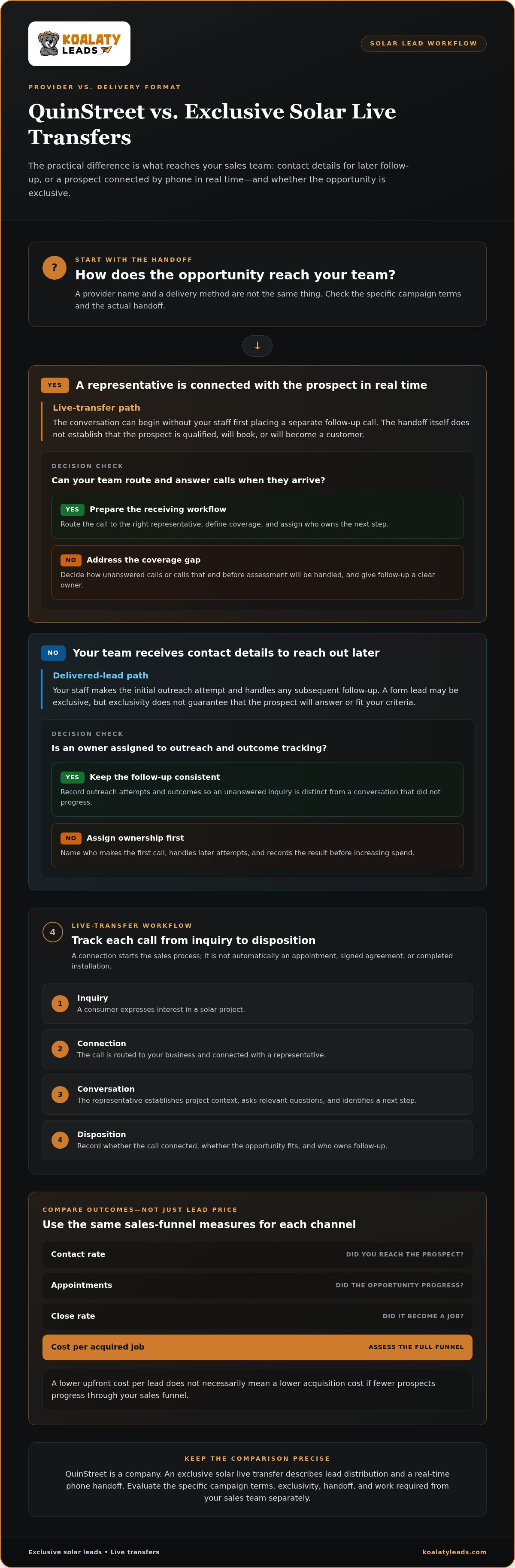
Compare the options using the same outcomes: contact rate, appointments, close rate, and cost per acquired job. A lower upfront cost per lead does not necessarily mean a lower acquisition cost if fewer prospects progress through your sales funnel.
This comparison explains how lead delivery and exclusivity shape your workflow, what to track for ROI, and how to assess whether each option fits your sales capacity. It gives you a practical way to weigh a QuinStreet campaign against exclusive solar leads and live transfers without assuming one format will work for every contractor.
Key Takeaways
- Compare a specific QuinStreet campaign with the live-transfer format, since a provider and a handoff method are not the same thing.
- Assess lead distribution, sales workload, and fit with your team’s follow-up process.
- For quinstreet vs exclusive solar live transfers, measure the full sales funnel rather than relying on cost per lead alone.
- Track contact, appointment, and close rates consistently to calculate cost per acquired job for each channel.
- Match the workflow to your team’s call-answering capacity and assign clear ownership of follow-up before increasing spend.
QuinStreet vs Exclusive Solar Live Transfers: What Is Being Compared?
In quinstreet vs exclusive solar live transfers, a named provider is being compared with a lead-delivery format. To make the comparison useful, separate the provider’s campaign terms from the mechanics of exclusive distribution and a real-time phone handoff.
QuinStreet is a company. An exclusive solar live transfer describes how a prospect is distributed and connected to a contractor. For your sales operation, the practical questions are whether you receive contact details or a live call, whether the opportunity is exclusive, and what follow-up your team must handle.
This video offers a related look at exclusive solar lead generation and sales workflow:
What does exclusive mean in solar lead generation?
An exclusive solar lead is delivered to one contractor rather than distributed to multiple contractors. Exclusivity describes how the opportunity is allocated. It does not mean the prospect is ready to buy, meets your qualification criteria, or will become a customer.
With a shared lead, multiple contractors may receive the same prospect’s information and compete to make contact. Exclusive delivery removes that direct lead-level competition, but your team still needs to reach the prospect, assess fit, and manage the sale. Koalaty Leads delivers each lead to one contractor. When evaluating exclusive solar leads, keep the distinction clear: exclusive delivery is not a conversion guarantee.
How is a live transfer different from a delivered lead?
A delivered form lead gives your team contact details for a later outreach attempt. A live transfer connects a prospect with your representative in a real-time phone handoff, so the conversation can begin without your staff first placing a separate follow-up call.
Definition: A live transfer is a prospect connected to a contractor by phone in real time. Standard lead delivery sends the prospect’s information for the contractor to contact later.
Call format, exclusivity, qualification, and sales outcome are separate factors. A live handoff does not establish that a prospect meets your criteria or will book an appointment. A form lead can be exclusive and still require prompt outreach. Compare these variables separately when assessing a QuinStreet campaign against exclusive solar live transfers.
How Solar Live Transfers Move from Inquiry to Contractor Conversation
A live transfer moves a solar inquiry into a phone conversation, but your team needs a receiving process ready before the call arrives. The workflow depends on call routing, staffed coverage, and clear ownership of the next step after the conversation.
The U.S. Energy Information Administration reported that solar supplied a record 17% of U.S. electricity. For contractors working in the solar market, lead handling still needs to be managed at the opportunity level: give each inquiry a clear path from initial contact to a recorded outcome.
What happens during a live solar call transfer?
A typical transfer workflow moves through four stages:
- 1. Inquiry: A consumer expresses interest in a solar project.
- 2. Connection: The call is routed to your business and connected with a sales representative.
- 3. Conversation: Your representative establishes the project context, asks relevant questions, and identifies an appropriate next step.
- 4. Disposition: Your team records whether the call connected, whether the opportunity fits, and who owns any follow-up.
A connection is the start of the sales process, not automatically an appointment, signed agreement, or completed installation. Your representative still needs to assess fit and handle the conversation. Record what happens next so the call can be evaluated along with the rest of your pipeline.
Prepare for incoming calls by routing transfers to the right representative and assigning coverage responsibilities. Decide how your team will handle a call that goes unanswered or ends before the opportunity is fully assessed. Without a clear owner, follow-up can fall through the cracks even when the lead reaches your business.
What does a form-based lead workflow require?
A form-based inquiry generally gives your team contact details and leaves the first outreach attempt to your staff. Assign someone to make that initial call, handle subsequent attempts, and record each outcome. A defined process supports consistent follow-up, but it cannot guarantee that the prospect will answer or book.
Use the same dispositions across lead sources, such as attempted, contacted, appointment set, not a fit, and closed. Recording attempts and outcomes in your sales system helps distinguish an unanswered inquiry from a conversation that did not progress. That distinction makes a channel review more useful because it shows where opportunities are stalling.
Koalaty Leads offers solar leads, including live call transfers. Before adding real-time handoffs to your workflow, decide who receives each call and who takes responsibility if it does not result in a next step. That basic ownership makes it easier to compare transfers with leads that your team contacts later.
Compare QuinStreet and Exclusive Solar Live Transfers Side by Side
Compare the documented QuinStreet campaign with the live-transfer format your team is considering. QuinStreet is a provider; an exclusive solar live transfer describes how an opportunity is distributed and connected to a contractor. The specific campaign terms determine what your sales team receives.
Focus on the handoff, prospect information, lead ownership, and work required from your staff. These details show whether a campaign fits your call coverage and sales process. Avoid assuming that a provider name alone tells you how a particular lead will be delivered.
| Comparison point | QuinStreet campaign | Exclusive solar live transfer |
|---|---|---|
| Lead format | Use the campaign terms to identify the format delivered. | A prospect is connected to a contractor by phone in real time. |
| Delivery or handoff | The delivery method and timing are set out in the campaign terms. | The contractor needs call routing and a representative ready to receive the connection. |
| Exclusivity | Assess the campaign’s distribution terms rather than assuming leads are shared or exclusive. | Exclusive means the opportunity is delivered to one contractor, not that a sale is assured. |
| Contractor workload | Work depends on the format. A delivered inquiry may require your team to initiate outreach. | Requires call coverage and a process for recording the conversation and next steps. |
| Tracking needs | Record the source, contact attempts, appointments, and outcomes consistently. | Track the call connection separately from appointments and closed jobs. |
Keep provider-specific facts separate from general format characteristics. A live transfer is not automatically a qualified appointment or a closed sale, and exclusivity does not establish a prospect’s readiness to buy. Compare campaign terms, then measure each source using the same definitions and measurement window.
Operational fit matters as much as the handoff. Consider when calls arrive, whether your team can answer, and who owns follow-up if a conversation does not progress. Koalaty Leads offers exclusive solar leads and live-transfer services for contractors evaluating these workflows. If you are weighing those formats, talk with Koalaty Leads about exclusive leads or live transfers for your solar operation.
For additional context on responsible solar-industry practices, SEIA provides an industry best practices resource. Use it as a reference for your own sales approach, not as evidence of a specific campaign’s lead quality or results.
Measure Solar Lead Economics Beyond Cost per Lead
A low cost per lead does not automatically mean a lower cost per acquired solar job. Compare each channel across the same funnel, using consistent definitions and verified spend to see where opportunities advance or stall.
Set a measurement window and define each stage before reviewing results. Count eligible leads, reached prospects, booked appointments, and closed jobs separately. This prevents different counting rules from making one source appear stronger simply because it is measured differently.
How do you calculate cost per acquired solar job?
Cost per acquired job = total channel spend ÷ jobs attributed to that channel. Apply the same attribution rules to every source, and be consistent about which expenses you include. If you track sales labor, include it consistently alongside lead spend rather than counting it for only one channel.
Use clear definitions for each metric:
- Cost per lead: Channel spend divided by eligible leads received.
- Contact rate: Unique prospects reached divided by eligible leads.
- Appointment rate: Appointments booked divided by reached prospects. Track held appointments separately if useful.
- Close rate: Closed jobs divided by a clearly defined group, such as appointments held.
- Cost per acquired job: Channel spend divided by closed jobs attributed to the source.
State the denominator when reporting a rate. A close rate based on appointments held cannot be compared fairly with one based on all leads received. Make the same distinction for appointments booked and appointments held, since a booked meeting does not necessarily progress to a completed sale.
Does a live transfer justify a different cost calculation?
Use the same core calculation for live transfers and delivered inquiries: compare attributable channel spend with closed jobs. Then review contact, appointment, and close rates to understand how each source performs through the funnel. A higher initial cost may still be efficient if it produces an acceptable acquisition cost for your business, but your own data must establish that.
Include operational factors in your review. Call coverage, missed transfers, and representative time can affect how well your team handles a channel. For delivered inquiries, account for the outreach your staff needs to make. Do not assume that a live handoff automatically reduces labor or guarantees a sale.
Assess payback using verified channel costs and the job value and margin figures your business records. Keep attribution rules consistent so you can see which leads produced closed work and whether the resulting economics fit your business. This makes the comparison between QuinStreet campaigns and exclusive solar live transfers more useful without relying on assumed benchmarks or unsupported return claims.
Choose a Solar Lead Workflow That Fits Your Sales Team
The right choice in quinstreet vs exclusive solar live transfers depends on how your team handles calls, follow-up, and sales attribution. Compare the workflow you can reliably support with measured cost per acquired job, not just the lead format or upfront price.
Koalaty Leads provides solar lead options, including exclusive leads and live transfers. Each lead is delivered to one contractor, reducing direct competition from other contractors for that same lead. Exclusivity does not guarantee a response, appointment, or sale. Your team still owns the sales conversation and outcome.
When might exclusive solar live transfers fit?
A live transfer may fit a team with a clear call-routing process and representatives ready to receive incoming conversations during expected delivery periods. The format puts the opportunity into a direct conversation rather than leaving the first contact attempt entirely to later outreach. It can suit teams whose sales process starts with a phone discussion and whose staffing can support the handoff.
Capacity matters. If calls may go unanswered or no one owns the next step, a live connection cannot compensate for gaps in coverage. A delivered exclusive lead may be a better operational match for a team built around scheduled follow-up. Neither format guarantees volume, conversion, or return, so evaluate performance against your own results.
What should the contractor do before comparing results?
Set the measurement rules before a campaign starts. Define what counts as a valid lead, a reached contact, an appointment, and an acquired job, then apply those definitions consistently across sources. Assign responsibility for answering calls or following up, and record the lead source and disposition in your sales system.
Review outcomes across the same measurement window. Separate missed calls and unreachable contacts from prospects who were reached but did not book. Also distinguish booked appointments from completed sales. This view can help you identify whether the constraint is call coverage, follow-up ownership, qualification, or sales execution.
Use the workflow your team can execute consistently, then compare cost per acquired job using verified spend and closed-job data. Koalaty Leads offers exclusive solar leads and live call transfers for contractors evaluating direct-conversation approaches. Talk with Koalaty Leads about exclusive solar leads or live transfers for your operation.
Build a Solar Lead System Your Team Can Measure
The useful takeaway from quinstreet vs exclusive solar live transfers is to compare the actual campaign terms and sales handoff, rather than assume a provider name tells you everything. A live transfer puts a prospect into a real-time phone conversation, while a delivered lead may require your team to initiate contact. Neither format guarantees an appointment or a closed job.
Measure each channel with the same definitions for contact, appointment, and acquired job. Compare the full funnel and cost per acquired job, while accounting for your team’s call coverage and follow-up process. A workflow only performs as well as your operation can support it.
Koalaty Leads provides exclusive solar leads and live call transfers. Each lead is delivered to one contractor. If direct conversations and exclusive delivery fit your sales process, talk with our team about the options for your operation.
Talk with Koalaty Leads about exclusive solar leads and live transfers
Set clear ownership, track outcomes consistently, and base your next growth decision on what your own sales data shows and what your team is ready to execute.
Frequently Asked Questions
What is the difference between QuinStreet leads and exclusive solar live transfers?
The quinstreet vs exclusive solar live transfers comparison puts a provider beside a lead-delivery format, so they are not identical categories. An exclusive lead is distributed to one contractor; a live transfer connects a prospect with a contractor by phone in real time. A delivered form inquiry instead requires follow-up from your team. Compare the campaign’s documented format and distribution terms with the live-transfer workflow you are considering, then measure both using the same sales outcomes.
Are exclusive solar leads better than shared leads?
Exclusive solar leads can fit a contractor looking to limit direct competition for an opportunity, but exclusivity alone does not guarantee contact or a sale. Shared leads may be sent to multiple contractors, creating competition to reach the prospect. Compare how each source fits your contact process, then use consistent contact, appointment, close, and cost-per-acquired-job data to decide which model works better for your operation.
How do solar live transfers work?
A solar live transfer starts with a consumer inquiry, followed by a real-time phone connection to a contractor’s representative. The representative discusses the project and records the next step, such as follow-up or an appointment. Track whether the call connected and how the opportunity progressed. A transfer is not automatically a qualified appointment, signed agreement, or completed job; outcomes still depend on fit and sales execution.
Does QuinStreet offer exclusive solar live transfers?
Exclusivity and transfer format are separate attributes: exclusivity describes how an opportunity is distributed, while a transfer describes how a prospect is connected with a contractor. Compare the documented distribution and delivery terms of the specific QuinStreet campaign with the live-transfer option you are evaluating. Do not assume that every campaign from a provider uses the same setup.
Are solar live transfers worth the cost?
Solar live transfers are worth the cost only if your tracked results support the investment. Calculate cost per acquired job by dividing attributable channel spend by closed jobs, and review contact, appointment, and close rates to see where opportunities advance or stall. Include operating costs consistently, such as sales time and missed-call handling, and assess payback using your own job value and margin. No lead format guarantees a return.
How should a solar contractor compare lead providers?
Compare lead ownership, delivery method, contact timing, information supplied, and the follow-up your team must handle. Review the specific campaign terms instead of assuming a provider uses one fixed setup. Then standardize definitions for valid leads, reached prospects, appointments, and closed jobs. Finally, assess whether your team can answer calls or promptly own follow-up, using your verified results rather than unsupported price or lead-quality rankings.
What should a contractor track when buying solar leads?
Track channel spend alongside valid leads, prospects reached, appointments booked and held, and jobs closed. Record each lead’s source and use consistent attribution rules and a shared measurement window so channels are evaluated on the same basis. Calculate cost per acquired job by dividing attributable spend by closed jobs. Rely on your own verified figures; assumed benchmarks can obscure workflow or follow-up problems.
Need exclusive leads instead of shared ones? Koalaty Leads delivers qualified homeowners — web leads or live call transfers — to one contractor only.
Get Started