
CraftJack vs Live Transfer Contractor Leads: Which Model Fits Your Business?

A lower-priced lead can become the more expensive job to acquire if you’re competing for the same prospect and can’t reach them quickly. That’s the key to comparing craftjack vs live transfer contractor leads: one model typically delivers a prospect’s details for your team to follow up on, while the other connects you with a caller in real time.
Lead cost matters, but it doesn’t tell you what you’ll spend to book a job. Compare who else receives each opportunity, how quickly your team can respond, and how many contacts become appointments and sold work.
There’s also a current wrinkle: platform shifts and corporate realignments frequently change where contractor sign-ups land and how accounts are managed. If you’re considering CraftJack today, confirm which platform, terms, and lead delivery model you’d actually be signing up for.
This comparison looks at marketplace-style delivery and live transfers by contact speed, team capacity, follow-up workload, and cost per acquired job. Use it to judge which model fits your sales process, without assuming the lowest lead cost or fastest connection automatically wins.
Key Takeaways
- Compare lead ownership, delivery speed, and follow-up workload separately.
- Use the craftjack vs live transfer contractor leads comparison to understand what your team receives and what it needs to do next.
- Before signing up through a CraftJack-related page, confirm the provider, current lead delivery model, and applicable terms.
- Track contact, appointment, and close rates alongside cost per acquired job to evaluate performance consistently.
- Choose a lead source that matches your team’s capacity to answer calls and follow up promptly.
CraftJack vs live transfer contractor leads: what are you actually comparing?
Compare the lead source, delivery method, and business economics separately. A marketplace-style lead may give you an inquiry to follow up on, while a live transfer connects a caller to your team in real time. Neither label tells you whether another contractor receives the same opportunity.
In contractor terms, a marketplace collects project inquiries and distributes them to participating businesses. An overview of lead generation provides the broader definition. For your decision, focus on what information or conversation reaches your sales team and what work it takes to pursue the opportunity. An inbound call is a prospect calling your business directly, while an exclusive lead is delivered to one contractor according to the provider’s terms.
For additional context on contractor lead platforms and sales channels, watch this overview:
What does a live transfer deliver to a contractor?
A live transfer connects a prospect’s call to your business in real time after the call has been qualified. Rather than starting with a contact record and making the first outbound attempt, your team joins a live conversation. This can shorten the gap between inquiry and response, but it doesn’t guarantee the caller will become a customer.
The format requires call coverage. Someone needs to be available, ready to answer, and prepared to handle the conversation. Qualification criteria and transfer rules vary by provider, so ask what is checked before connection. Don’t assume every caller will be reachable later or ready to buy.
Is an exclusive lead the same as a live transfer?
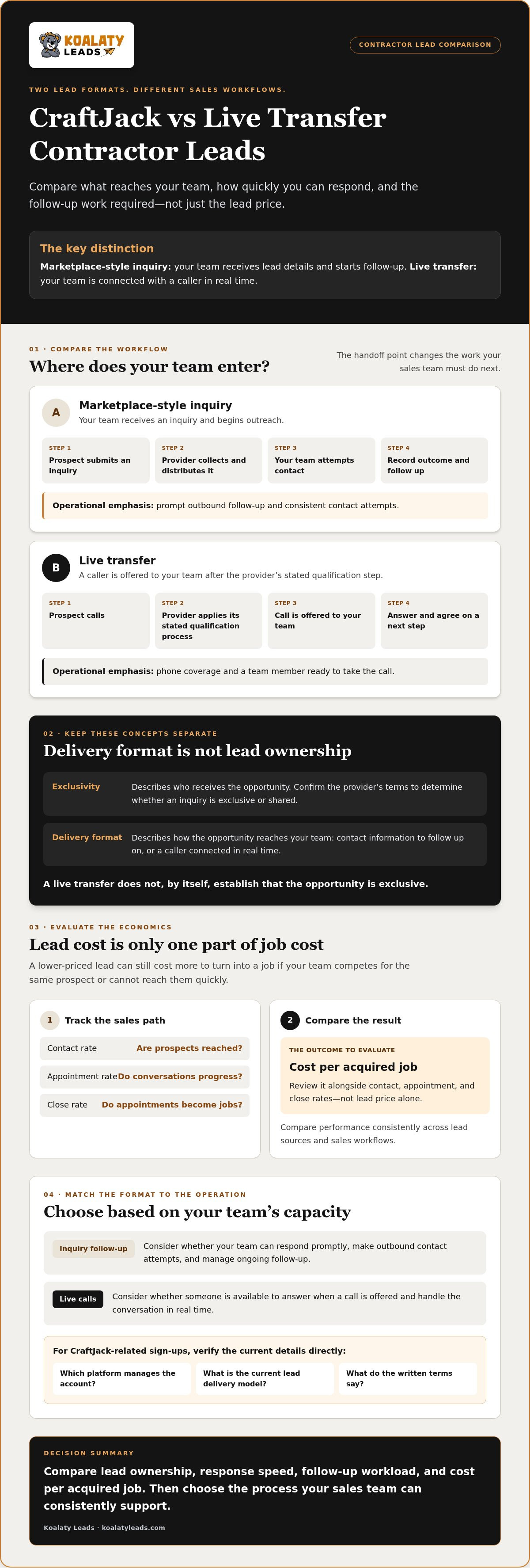
No. Exclusivity concerns who receives the opportunity; a live transfer concerns how the prospect is connected. An exclusive inquiry can arrive as contact information for your team to follow up on, without a live conversation. The transfer format alone doesn’t establish whether an opportunity is exclusive, so confirm that in the provider’s terms.
Exclusivity describes who gets the lead; delivery format describes how it reaches your team. That distinction is central to craftjack vs live transfer contractor leads. Verify CraftJack’s current sharing and delivery terms directly before drawing conclusions or comparing it with another source. Contractors comparing lead formats across trades can review Koalaty Leads’ contractor lead services.
How CraftJack-style leads and live transfers reach your sales team
The main operational difference is where your team enters the process. With a marketplace-style inquiry, your team receives lead information and starts follow-up. With a live transfer, a call is routed to your team after the provider’s qualification step. Confirm CraftJack’s current workflow and terms directly rather than assuming how the process works.
- Marketplace-style journey: Prospect submits an inquiry → provider collects and distributes it → contractor receives the inquiry and available details → team attempts contact → sales team records the outcome and follows up.
- Live-transfer journey: Prospect calls → provider applies its stated qualification process → call is offered to the contractor → team member answers and speaks with the caller → sales team records the outcome and agrees on a next step.
The first path puts more emphasis on prompt outbound follow-up. The second depends on phone coverage when the call is offered. Either way, a slow response or unavailable sales team can leave an opportunity unworked. The NAHB’s guidance on digital marketing strategy offers broader context for connecting marketing activity with business results.
What should contractors verify about CraftJack?
Before relying on a CraftJack-style process, check the current written terms. Confirm whether inquiries are shared, what contact details are provided, when leads are delivered, and how service areas are selected. Ask how inquiries are generated and what information you can review before purchase. Check billing, dispute, and cancellation terms in current documentation rather than relying on historical descriptions.
What operational setup does a live transfer need?
Map the hours when calls may arrive against actual staff coverage. Assign someone prepared to answer, use a short intake script, ask consistent qualification questions, and define the next step, such as scheduling a follow-up. Don’t build the process on the assumption that every caller will be qualified or ready to book.
Track unanswered, connected, qualified, and booked calls as separate outcomes. These measures help identify whether a gap comes from missed coverage, call fit, or the sales conversation. In craftjack vs live transfer contractor leads, use those outcomes to evaluate how each delivery model fits your team’s workflow.
Compare CraftJack and live transfer contractor leads in one decision table
For craftjack vs live transfer contractor leads, compare what reaches your team, who else may receive the opportunity, and what your staff must do next. The table describes general workflows and flags CraftJack details that require current confirmation.
| Factor | CraftJack-style marketplace lead | Live transfer |
|---|---|---|
| Delivery | Typically, an inquiry and available contact details are delivered for contractor follow-up. Confirm CraftJack’s current process directly. | A prospect’s call is connected to your team in real time after the provider’s qualification step. |
| Exclusivity | Verify in current written terms whether other contractors receive the inquiry. | A live connection doesn’t establish whether the opportunity is exclusive. Check the provider’s terms. |
| Response demands | Your team must attempt contact and manage follow-up. Response speed can affect whether you reach the prospect. | A team member must be available to answer when the call is offered. |
| Qualification visibility | Ask what details are supplied and how the inquiry is generated. | Ask what the provider screens for before transfer and what qualification information is shared. |
| Follow-up workload | Usually includes outbound attempts, tracking, and later follow-up. | Starts with a live conversation, but your team still needs to record the outcome and handle agreed next steps. |
| Billing and terms | Confirm the billing basis, dispute process, cancellation terms, targeting, and sharing rules in current documentation. | Confirm what triggers a billable call, qualification criteria, targeting, and what happens if a call is unanswered or disconnected. |
As of September 2026, CraftJack’s site redirects contractors to Angi’s professional sign-up page. This confirms where sign-up is directed, not the current sharing, billing, or delivery terms. Verify those details before deciding.
Which model fits your team's capacity?
A marketplace-style process can suit a team that reliably responds to new inquiries, manages a follow-up queue, and tracks contact attempts. Live transfers require dependable phone coverage and trained call handlers. Neither format makes up for missed calls or inconsistent follow-up, so match the lead flow to actual staffing, not an ideal schedule.
Which terms can change the comparison?
Compare the total billing basis and lead-sharing terms using current provider documents. Review targeting, qualification criteria, and what happens when a prospect can’t be reached. Clear processes and professional customer interactions matter across lead sources; NARI is a resource for the professional remodeling industry.
If you’re weighing the formats for your operation, discuss exclusive leads or live transfers for your trade.
Measure live transfer leads ROI against shared lead economics
Judge craftjack vs live transfer contractor leads by the cost to acquire a job, not the price label attached to an inquiry or call. Apply the same attribution rules and measurement window to both sources. Before classifying CraftJack-style leads as shared, confirm their current terms.
How do you calculate cost per acquired job?
Track the funnel from source-level spend to completed work. Keep each measure separate so you can see where opportunities drop off:
- 1. Record attributable spend: Include lead charges and, if you can measure them consistently, staff time spent on follow-up or call handling.
- 2. Count delivered opportunities: Log each inquiry or transferred call, using a consistent rule for duplicates and invalid records.
- 3. Track contact and appointments: Calculate the share of opportunities that result in a two-way conversation, then the share of conversations that book an appointment.
- 4. Record sales and cancellations: Track appointments that become sold jobs, then note cancellations separately. Don’t count a canceled sale as completed work when assessing final payback.
- 5. Calculate acquired-job cost: Divide attributable spend by jobs won. For a completed-job view, divide by completed jobs instead.
Hypothetical illustration, not a lead-price benchmark: If a channel uses 100 accounting units of spend and produces two won jobs, its cost per won job is 50 units. If another channel uses the same 100 units and also produces two wins, the result is equal at that stage, even if contact and appointment rates differ. Continue tracking through completion to account for cancellations.
How should contractors assess payback without misleading themselves?
Compare acquired-job cost with your own gross profit per completed job, not just the contract’s total value. Use reliable figures from your books for average job value and gross margin. If those figures vary by trade or job type, calculate them separately instead of relying on a blended estimate.
For a fuller comparison, include measurable follow-up labor and sales capacity in the source cost. Apply the same attribution window to both channels, define how long you’ll wait for a lead to become a sale, and use consistent rules for assigning credit when more than one source touched the customer. A higher cost per lead or call doesn’t prove better or worse return on its own. Conversion through completion is what settles the comparison.
Choose a contractor lead model that matches your sales operation
The right choice in craftjack vs live transfer contractor leads depends on how your sales team works. A team that can respond quickly and manage follow-up may suit inquiry-based leads. A team with reliable phone coverage and trained call handlers may be better equipped for live transfers. Either way, missed calls and inconsistent follow-up can weaken the return.
Before increasing spend, run a limited evaluation with a defined budget and tracking rules. Record the source, delivery format, sharing status, response time, contact outcome, appointments, sales, cancellations, and completed jobs. Use the same attribution window for each option, then compare cost per acquired job and payback using your own gross-profit figures.
What should you ask any lead provider before committing?
Get the operating terms in writing. Ask whether opportunities are shared or exclusive and how the provider defines exclusivity. Request details on how leads are qualified and delivered, what information your team receives, how billing works, and how to dispute a lead or call.
Confirm current targeting, any minimums, and cancellation conditions directly with the provider. For CraftJack, don’t rely on historical descriptions. Verify which platform and terms apply now, and whether the current offer matches the delivery model you’re evaluating.
When is it worth discussing Koalaty Leads?
If you’re comparing exclusive lead opportunities with live transfers, Koalaty Leads offers both formats across supported home improvement trades. Review the contractor lead services and use a home improvement leads buying guide as a checklist for questions about delivery, targeting, and billing. Then assess the options against your team’s coverage and the job-level economics you track.
Choose a format your team can handle, verify the written terms, and measure results before scaling. A disciplined test gives you a stronger basis for deciding than assumptions about lead price or delivery alone.
Choose your lead model with clear numbers
The craftjack vs live transfer contractor leads decision depends on more than the advertised cost of an inquiry or call. Compare sharing and delivery terms separately, then track contact, appointments, sales, cancellations, and cost per acquired job using the same rules.
Fit matters as much as the math. Marketplace-style inquiries call for disciplined outbound follow-up, while live transfers require someone ready to answer when a call comes through. Verify CraftJack’s current written terms before drawing conclusions, and test any lead source on a defined scale before committing more budget.
Koalaty Leads offers exclusive contractor leads and live transfers for trades including roofing, HVAC, solar, and remodeling. Choose the format your team can handle, then judge it by the jobs it helps you acquire.
A clear process and honest job-level tracking put your next growth decision on stronger ground.
Frequently Asked Questions
Is CraftJack a shared lead service for contractors?
CraftJack has historically been described as a marketplace-style lead source, but contractors should verify current sharing and delivery terms directly. As of September 2026, CraftJack’s website redirects to Angi’s professional sign-up page, so historical descriptions may not reflect the current platform or terms. Before signing up, get written confirmation of whether each inquiry is shared, how sharing is defined, and which provider’s terms apply.
What is the difference between CraftJack leads and live transfer leads?
A marketplace-style lead typically gives your team an inquiry and available contact information to follow up on. A live transfer connects a prospect’s call to your team in real time after the provider’s qualification process. That changes the first step in your sales workflow: outbound contact versus answering a call. In the craftjack vs live transfer contractor leads comparison, verify CraftJack’s current delivery model rather than relying on historical descriptions.
Are live transfer contractor leads exclusive?
Not automatically. “Live transfer” describes how a call reaches your team; “exclusive” describes whether the provider sends that opportunity to other contractors. Ask the provider to confirm exclusivity in writing and explain exactly what it covers. Also clarify what qualification happens before a transfer and what information your team receives. A real-time connection can speed up the first conversation, but it doesn’t establish lead ownership or guarantee a sale.
How much do CraftJack contractor leads cost?
Don’t rely on a CraftJack price without checking the applicable offer and terms directly. Historical pricing descriptions may not apply now, especially since CraftJack’s website redirects to Angi’s professional sign-up page as of September 2026. Confirm the current billing basis, any minimums, and what triggers a charge in writing. To compare fairly, measure total source spend against jobs won, not just the cost of each lead.
Can live transfer leads improve a contractor’s close rate?
They may help your team begin a sales conversation sooner because the call is connected in real time, but that alone doesn’t prove a higher close rate. Results depend on factors such as call fit, qualification criteria, staff availability, sales handling, and follow-up. Track transferred calls through connection, qualification, appointment, sale, and completion. Compare those results with another source over the same measurement period before deciding whether the format performs better for your business.
How do I calculate ROI on live transfer leads?
Record the spend attributable to transferred calls, then track calls answered, qualified conversations, appointments, sales, cancellations, and completed jobs. Divide attributable spend by jobs won for cost per acquired job; for completed-job cost, divide by completed jobs instead. Compare that cost with your own gross profit per completed job, using reliable figures from your books. Apply consistent attribution rules and include measurable follow-up labor where possible.
What should contractors ask before buying leads from CraftJack?
Ask which platform and terms apply, whether inquiries are shared, how leads are generated, what contact and project details are provided, and when opportunities are delivered. Confirm targeting, billing, dispute procedures, minimums, and cancellation conditions in current written documentation. If considering a live transfer, ask what qualification means, what happens if your team can’t answer, and which call events are billable. Don’t assume historical CraftJack terms describe today’s offer.
Need exclusive leads instead of shared ones? Koalaty Leads delivers qualified homeowners — web leads or live call transfers — to one contractor only.
Get Started