
Contractor Lead Generation: Strategies to Scale Your Business

Contractor lead generation works when you can trace inquiries through follow-up, appointments, estimates, and booked jobs, then compare the cost of each source with the work it produces. More leads alone won’t scale your business if your team can’t respond consistently or determine which opportunities are profitable.
Referrals, shared inquiries, exclusive leads, and live transfers arrive through different processes. Compare them by delivery, competition, response requirements, and acquired-job results, not by lead count alone. Exclusivity can reduce competition for an inquiry, but it doesn’t guarantee a sale.
Use clear pipeline stages and consistent tracking to see where opportunities stall and what each acquired job costs. That gives you a practical basis for deciding which sources fit your trade, sales capacity, and job economics.
Key Takeaways
- Track the path from inquiry to booked job so you can see where opportunities stall and follow-up needs attention.
- Compare referrals, owned marketing, marketplaces, exclusive leads, and live transfers by delivery model and the work each requires from your team.
- Connect lead spending with acquired jobs, job value, and payback using consistent pipeline measures.
- Build a repeatable workflow for capturing lead sources, assigning ownership, responding, qualifying, and recording outcomes.
- Contractor lead generation can include exclusive leads, inbound calls, and live transfers as part of a broader plan.
What contractor lead generation includes, from inquiry to job opportunity
Contractor lead generation is the process of attracting, capturing, and managing potential customer inquiries so your business can pursue suitable work. The important distinction is between an inquiry entering your pipeline and a customer agreeing to a job. Track what happens after each inquiry instead of treating every name or call as a sales opportunity.
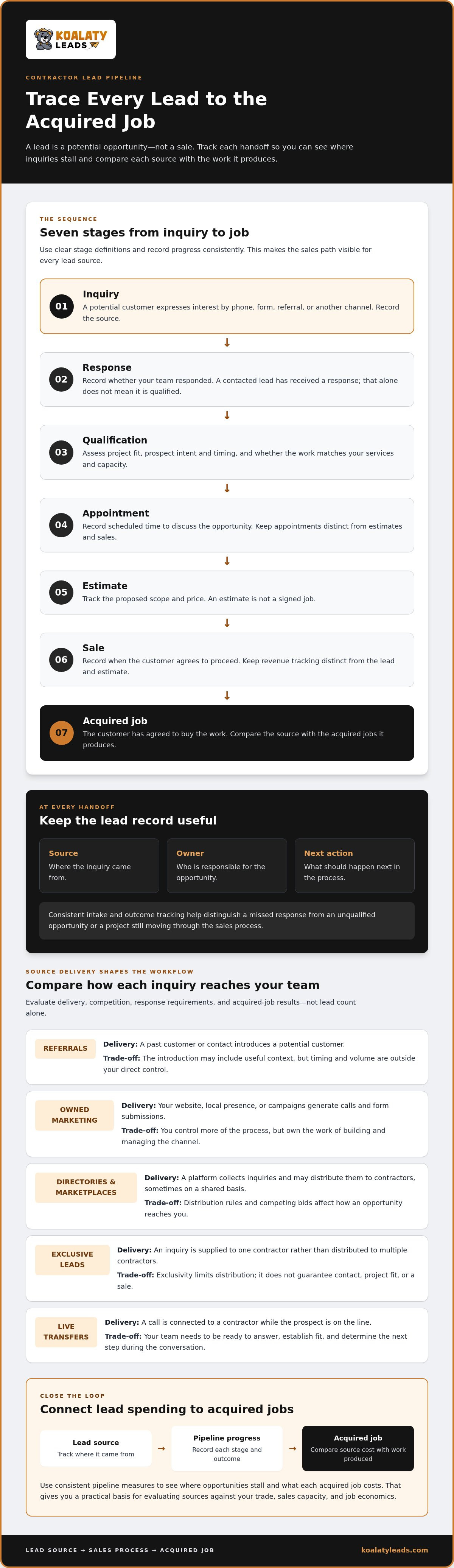
A useful pipeline makes each handoff visible: inquiry, response, qualification, appointment, estimate, sale, and acquired job. Define these stages clearly so your team records progress consistently and you can compare sales activity with marketing investment.
What counts as a contractor lead?
An inquiry is a potential customer’s expression of interest in a service your business provides. A lead is the record of that opportunity, with the information your team needs to respond and assess whether it fits. It may arrive by phone, form, referral, or another channel.
A lead isn’t automatically qualified, reachable, scheduled, or won. Its value to your sales process depends on the trade and project type, the prospect’s intent and timing, and whether the work fits your services and capacity. Record those details early so your team can prioritize suitable opportunities.
How lead generation fits the contractor sales pipeline
Lead sources create inquiries; your intake and follow-up process turns them into opportunities the sales team can work. Record the source, assign an owner, and capture the next action. This helps distinguish a missed response from an unqualified opportunity or a project that is still moving through the sales process.
Lead management is the work of organizing and moving opportunities through that process. Lead Management: Methodologies and Practices offers a broader overview. For contractors, the practical takeaway is to use consistent intake and outcome tracking to see which inquiries advance and where follow-up breaks down.
Keep the stages distinct. A contacted lead has received a response; an appointment is scheduled time to discuss the opportunity; and an estimate is a proposed scope and price. A sale means the customer has agreed to proceed, while revenue is the money the business earns under its payment and accounting practices. Don’t count an estimate as a signed job or a lead as revenue.
A lead is a potential opportunity to pursue; an acquired job is work the customer has agreed to buy. Track each opportunity from its first inquiry through its final outcome, whether it came from a referral, a paid source, or broader home improvement leads. That gives you a sounder basis for evaluating business growth.
How contractor lead generation sources differ in intent and delivery
Lead sources differ in how an inquiry is created, delivered, and assigned. Compare the workflow and trade-offs, not just the source name. A referral, a marketplace form submission, and a connected call can each place different demands on your intake team.
| Source | Delivery model | Typical contractor responsibility | Key trade-off |
|---|---|---|---|
| Referrals | A past customer or contact introduces a potential customer. | Respond, confirm project fit, and manage the sales process. | The introduction may include useful context, but timing and volume are outside your direct control. |
| Owned marketing | Your website, local presence, or campaigns generate calls and form submissions. | Maintain the channel, capture inquiries, and handle intake and follow-up. | You control more of the process, but also own the work of building and managing it. |
| Directories or marketplaces | A platform collects inquiries and may distribute them to contractors, sometimes on a shared basis. | Respond through the platform’s process and compete for the opportunity when it is shared. | These platforms provide access to inquiries, while distribution rules and competing bids affect how an opportunity reaches you. |
| Exclusive leads | An inquiry is supplied to one contractor rather than distributed to multiple contractors. | Contact the prospect, qualify the project, and manage each sales stage. | Exclusivity limits distribution; it does not guarantee contact, fit, or a sale. |
| Live transfers | A call is connected to a contractor while the prospect is on the line. | Be ready to answer, establish fit, and determine the next step during the conversation. | The call connects in real time, but it still needs effective qualification and follow-through. |
Contractors comparing lead options can review Koalaty Leads’ contractor lead services, including exclusive leads and live transfers. Choose a delivery model your team can support with clear ownership, timely responses, and follow-up.
Shared, exclusive, and aged leads: what the labels mean
Shared leads are inquiries distributed to multiple contractors. They may have a lower quoted cost per inquiry, but you can be competing with other businesses contacting the same prospect. Exclusive leads are supplied to one contractor, reducing that direct competition without promising contact, qualification, or conversion.
Aged leads are inquiries with time elapsed since their original submission. The label alone doesn’t establish a universal age cutoff or tell you whether the prospect is still active. Track lead age and response outcomes so you can compare these opportunities fairly with newly received leads.
Inbound calls and live transfers compared with form leads
An inbound call starts when a prospect calls your business or a designated number. A form lead starts with submitted information that your team uses to follow up. A live transfer connects a call to your team while the prospect is on the line. Each format has a different handoff, but response readiness, trade fit, and qualification still determine whether it becomes a sales opportunity.
Use the same pipeline stages for every source, then record delivery type and lead age where relevant. This makes comparisons more useful than treating all inquiries as interchangeable. For additional context on construction opportunities and lead services, see Construction Project Opportunities and Lead Services.
How to measure contractor lead generation by acquired-job economics
Lead price is only the starting cost. To assess whether a source supports profitable growth, connect its spend to the jobs you acquire, the value and margin of that work, and the time your team spends moving inquiries through the pipeline. Use your own records rather than assumed conversion benchmarks.
A simple contractor lead-generation measurement framework
Record the source, trade, date received, and lead type for every inquiry. Then track contact attempts, successful contacts, qualified opportunities, appointments, estimates, and wins. Use the same stage definitions across channels so referrals and purchased leads are measured consistently.
Calculate each stage rate from your records and state the denominator. For example, contact rate is leads reached divided by total leads; appointment rate could be appointments divided by contacted leads or qualified leads. Choose a definition and apply it consistently. Close rate is acquired jobs divided by estimates presented, or by another clearly defined sales stage.
- Cost per lead: lead-source spend divided by leads received.
- Contact rate: leads reached divided by leads received.
- Appointment rate: appointments set divided by the stage count you use as the denominator.
- Close rate: acquired jobs divided by estimates presented, or another consistently tracked sales stage.
- Cost per acquired job: lead spend divided by acquired jobs.
- Payback: whether gross profit from acquired work covers the cost of generating and handling those opportunities, and how long that takes.
If S is lead spend and J is acquired jobs, cost per acquired job = S ÷ J. If a source hasn’t produced an acquired job during the period, don’t record its cost per job as zero. Mark it as not yet calculable and continue tracking opportunities that are still in progress.
When a low cost per lead can mislead
A low cost per lead can still mean a high cost per acquired job if few inquiries become work. Compare sources at the job stage, and include the labor involved in calling, qualifying, scheduling, estimating, and following up. Those hours use sales capacity even when they aren’t part of the lead invoice.
Job value alone doesn’t tell the whole story. Average job value indicates revenue potential, while gross margin helps show what remains to cover acquisition and operating costs. A larger sale may require more follow-up or involve different costs, so evaluate payback using your company’s actual job economics.
Cost per acquired job tells you what it took to win work; lead count only tells you how many opportunities entered the pipeline. Review results by source and trade over a period that gives opportunities time to progress. Note open estimates and long sales cycles, which can change the picture. This turns contractor lead generation into a decision process based on jobs won, not just activity.
A practical workflow for responding to and improving contractor leads
A repeatable intake process helps your team handle opportunities consistently and shows where follow-up is breaking down. Set a response standard your team can meet with its staffing and operating capacity. Track each lead through an outcome instead of relying on memory.
Build a repeatable lead intake and follow-up process
Use the same basic sequence for calls, forms, referrals, and purchased opportunities. Assign an owner as soon as a lead arrives and capture its source before it moves between team members. This creates a useful record even when several people contribute to the sale.
- Capture the source. Record the date, trade, lead type, and source when the inquiry enters your system. Keep the original source attached if the opportunity is reassigned.
- Assign ownership. Name the person responsible for the next action. If ownership changes, update the record so the inquiry doesn’t sit between roles.
- Respond. Set an internal standard for when and how your team responds, based on coverage, workload, and how the inquiry arrives. A standard your team can meet consistently is more useful than a target your staffing cannot support.
- Qualify. Use consistent notes for service fit, project interest, timing, and the next action. Keep the criteria practical for your trade and sales process.
- Record the outcome. Log contact attempts and results, including whether the prospect was reached, qualified, scheduled, estimated, won, or closed out. An unanswered inquiry is not a sale.
- Review. Look for missing records, stalled follow-up, and opportunities without a clear next step. Use what you find to refine routing, staffing, or the response process.
With this process in place, you can assess whether exclusive leads or live transfers fit your trade, intake capacity, and sales workflow. Koalaty Leads offers both, so your team can discuss how these lead formats fit the way you handle new opportunities.
Review performance and adjust the mix
Compare sources using your own records and consistent definitions for contact, appointment, close, and acquired-job measures. Group leads by source and arrival period, then give each group enough time to progress before comparing results. If sales cycles vary by trade or project, account for that in your review window.
Keep context alongside the numbers. Note changes in staffing, response coverage, qualification practices, or available job capacity. Otherwise, you may attribute a change in results to the lead source when your team’s ability to respond or take on work has also changed.
Use recorded business economics to decide whether to keep, adjust, or pause a source. Review patterns across a group of leads, including unresolved opportunities, rather than reacting to one unusually strong or weak inquiry. A useful improvement loop is straightforward: capture, act, measure, and refine.
How Koalaty Leads fits into a contractor lead-generation plan
Koalaty Leads provides exclusive leads, inbound calls, and live transfers for home improvement and home service contractors. These options can add another source alongside referrals or owned marketing. The right approach depends on your trade, the work you want, and how your team handles incoming opportunities.
Where exclusive leads and live transfers may fit
Koalaty Leads delivers exclusive leads to one contractor and connects live-transfer calls while the prospect is speaking with your team. Each format calls for a different intake process. A lead that needs follow-up should have an assigned owner and next action; a transferred call requires someone ready to speak with the prospect and capture relevant details.
Consider how either option would work alongside your current channels. For example, a roofing contractor can compare exclusive roofing leads with referrals and website inquiries, then assess whether the team has capacity to follow up and manage the resulting opportunities. Koalaty Leads serves contractors across multiple home improvement and home service trades, so the discussion can focus on the work your business wants to pursue.
Choose the next step around your actual pipeline
Before discussing a new source, identify your trade, the projects you want, your current lead mix, and who handles incoming inquiries. Consider your team’s capacity to respond, qualify opportunities, and follow through. These details help you assess a delivery format against the way your business operates.
Bring the measures you already track, such as lead source, appointments, and acquired jobs. If you don’t yet record some of them, note the gap and decide how to establish a baseline. A focused conversation about your trade and market can help you assess exclusive leads or live transfers for your plan.
Talk with Koalaty Leads about exclusive leads or live transfers for your trade and market.
Make your next growth decision with confidence
Choose one practical priority for your next review: improve a handoff, clarify source attribution, or assess whether your lead mix matches your team’s capacity. Give that change enough time to produce useful evidence before making another adjustment. A steady decision process turns contractor lead generation into a capability your business can improve, rather than a scramble to fill the calendar.
Keep your focus on the opportunities your team can pursue well, and use recorded outcomes to guide your next move. When you’re ready to discuss exclusive leads or live transfers, bring your trade and market into the conversation.
Frequently Asked Questions
What is contractor lead generation?
Contractor lead generation is the work of creating opportunities for a contracting business to pursue. It can include referrals, marketing that brings in calls or forms, and purchased lead opportunities. A roofing company, for example, can track a referral call separately from a form inquiry, then compare each by service fit, sales progress, and acquired jobs.
How much does contractor lead generation cost?
There isn’t one fixed cost for contractor lead generation. Spend depends on the source, trade, delivery model, and terms of a particular program. Track both the amount paid to generate or receive inquiries and the resulting cost per acquired job. Include your team’s sales effort too, so a low invoice cost doesn’t hide a high operational burden.
Are exclusive contractor leads better than shared leads?
Exclusive leads are distributed to one contractor, which reduces competition for the same inquiry. Shared leads may have a lower cost per inquiry, but multiple contractors may contact the prospect. Neither model proves that an inquiry is qualified or will convert. Compare contact, appointment, and acquired-job results, along with the time your team spends pursuing each opportunity.
What is the difference between a live transfer and a contractor lead?
A contractor lead is a potential sales opportunity that may arrive through a form, call, or another channel. A live transfer is a delivery format that connects a call to your team while the prospect is on the line. The person taking the call should be ready to identify the requested service, capture useful details, and agree on a next step.
How do contractors measure lead-generation ROI?
Compare the value created by acquired jobs with the costs required to generate and pursue those opportunities. Use completed sales records, attribute each job to a source where possible, and account for gross margin rather than relying on revenue alone. Also consider the time between inquiry and sale. Open estimates may need a longer evaluation window before a source’s return is clear.
How quickly should contractors follow up with a new lead?
Set a response standard your team can meet based on staffing, call coverage, and workload; there isn’t one universal timing rule for every contractor. Decide who handles calls and forms, what happens when that person is unavailable, and how attempts are logged. Review missed or delayed responses alongside lead outcomes to see whether coverage or ownership needs to change.
Need exclusive leads instead of shared ones? Koalaty Leads delivers qualified homeowners — web leads or live call transfers — to one contractor only.
Get Started