
Commercial Solar Leads: The ROI Guide for Installers

Commercial solar growth starts with reaching the people who can approve a project, then qualifying the property, energy needs, decision-making authority, and buying timeline. Commercial solar leads are most valuable when they connect your sales team with a real decision-maker and a credible opportunity, rather than simply adding another name to follow up with.
That distinction matters. Commercial projects can involve multiple stakeholders and longer buying cycles, so lead volume alone won’t show whether your marketing is working. You need a clear view of which opportunities progress, how consistently your team follows up, and what it costs to acquire a job.
This guide explains how to target commercial property decision-makers, distinguish qualified prospects from poor-fit inquiries, and build a follow-up process that keeps opportunities moving. You’ll also learn how to compare paid and organic sources, generate leads online, and assess results by tracking cost per qualified opportunity, appointments and closes, cost per acquired job, and job value. The goal is a more disciplined pipeline, with fewer wasted sales conversations and a clearer picture of what’s driving growth.
Key Takeaways
- Identify who can approve a commercial project and qualify opportunities by fit, decision-making authority, and timing.
- Compare lead sources by how they charge and how well they support your cost-per-job goals, not by lead price alone.
- Build a prompt, persistent follow-up process to improve your chances of reaching prospects and moving conversations forward.
- Balance paid lead channels with organic efforts that can create a longer-term pipeline of commercial inquiries.
- Match lead strategy to your sales capacity, then explore exclusive leads or live transfers that fit your solar business.
Commercial Solar Leads: Qualifying Decision-Maker Opportunities
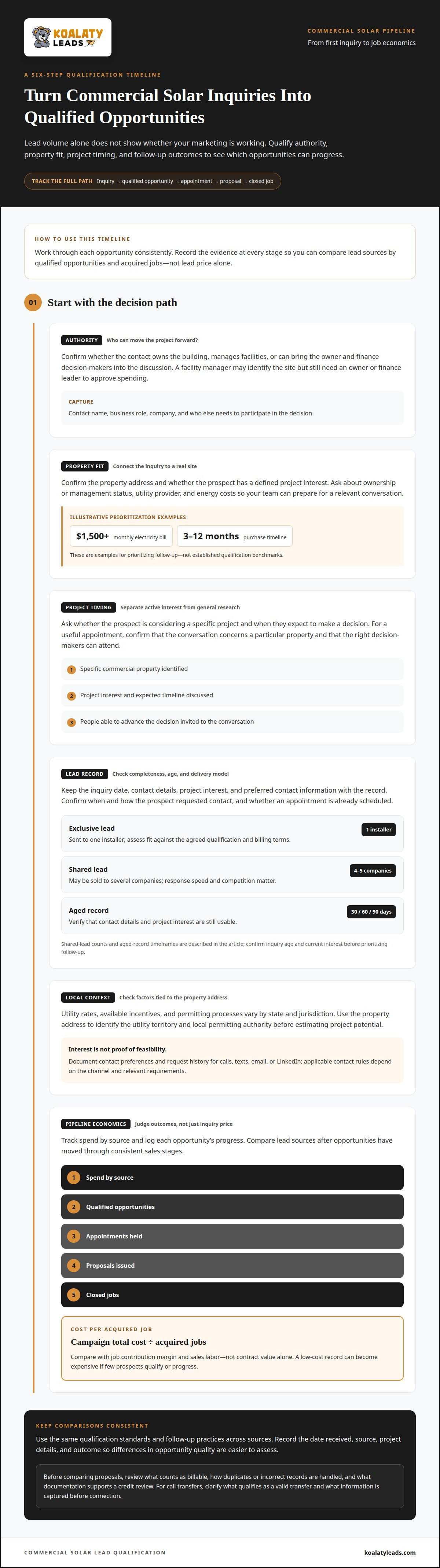
Qualification starts with authority, property fit, energy costs, and timing. A useful solar lead opportunity connects your team with someone who can advance a commercial project, not merely a calendar booking.
Lead Qualification and Solar Appointments
A qualified prospect represents a commercial property and can influence its energy decisions. Confirm whether the contact owns the building, manages facilities, or can bring the owner and finance decision-makers into the discussion. A monthly electricity bill of at least $1,500 and a purchase timeline within 3 to 12 months are illustrative examples for prioritizing follow-up, not established qualification benchmarks.
A meeting is more useful when the prospect has a defined project interest and the right people can attend. Ask who approves the project and whether the appointment concerns a specific property, rather than general information gathering.
Exclusive, Shared, and Aged Leads
An exclusive lead goes to one installer; shared leads may be sold to four or five companies. Aged records can be 30, 60, or 90 days old, so confirm the inquiry date and whether the prospect remains interested. Each model has trade-offs in competition, timeliness, and outreach effort.
There is no single “best rated” lead company across every rating source or sales process. Compare documented appointment accuracy, access to decision-makers, lead age, and fit with your commercial pipeline.
Lead Quality and Required Information
A useful record includes the contact’s name, business role, company, property address, and preferred contact details. Ownership or management status, utility provider, electricity bill, project interest, and expected timeline help a sales representative prepare. For example, a facility manager may identify the site but need an owner or finance leader to approve spending.
Also record when and how the prospect requested contact and whether an appointment is scheduled. Define billable lead criteria, duplicate handling, and dispute procedures in the agreement. Clear terms make records easier to assess consistently.
State Factors Affecting Lead Quality
Utility rates, available incentives, and permitting processes vary by state and jurisdiction, affecting project economics and timelines. Use the property address to identify the utility territory and local permitting authority before estimating a project’s potential. A prospect’s interest alone does not establish eligibility or feasibility.
Contact rules depend on the channel and applicable federal and state requirements. Document the prospect’s contact preferences and request history, especially when a campaign uses calls, texts, email, or LinkedIn. This supports careful, consistent outreach without assuming one rule applies to every channel.
Commercial Solar Lead Costs and Buying Models
Commercial lead costs depend on sourcing, screening, location, timing, and what the seller counts as billable. The quoted lead price alone is not a useful comparison. Measure how each model contributes to qualified opportunities and acquired jobs, then compare performance with your sales costs and job margins.
| Buying model | What drives the cost | What to assess |
|---|---|---|
| Exclusive pay-per-lead | Target criteria, market demand, and screening requirements. | Whether delivered records match the agreed qualification and billing terms. |
| Shared marketplace | Competition for inquiries and the marketplace’s delivery structure. | How quickly your team can engage and how many other installers may receive the inquiry. |
| Aged-data list | Record age, completeness, and the method used to collect data. | Whether the contact details and project interest remain usable. |
| Bid-to-appear model | Competition for placement and visibility. | How spend relates to qualified inquiries, not just exposure. |
| Live call transfer | Call qualification and transfer criteria. | Whether the connected conversation fits your commercial sales process. |
Read the billing definition closely before comparing proposals. It should explain what qualifies as a lead, how duplicates or incorrect records are handled, and what documentation supports a credit review. For calls, clarify what counts as a valid transfer and what details are captured before connection. These terms determine what you pay for and how you evaluate delivery.
Use your CRM to track the full acquisition path. Record spend by source, then log qualified opportunities, appointments held, proposals issued, and closed jobs. Divide the campaign’s total cost by acquired jobs to estimate cost per job. Compare that figure with job contribution margin and sales labor, rather than judging return by contract value alone.
Lead price and job economics are linked through conversion. A low-cost record can become expensive if few prospects qualify or progress. A higher-cost source may perform better when its inquiries match your target projects and sales team capacity. Review results by source and project type, because a blended conversion figure can hide important differences.
For a fair test, keep qualification standards and follow-up practices consistent across sources. Record the date received, source, project details, and outcome for every inquiry. Review results after enough opportunities have moved through your sales stages to support a useful comparison. This makes buying decisions an operating measure: spend against qualified pipeline and closed work, not lead count alone.
There is no single fixed cost per lead. Pricing depends on the sourcing model, screening, location, timing, and billing terms.
Following Up on Purchased Commercial Solar Leads
Respond while the inquiry is active, then keep follow-up organized around the prospect’s preferred channel. SolarReviews reports an 80% contact rate when a lead receives an immediate call and repeated attempts during the first few hours. That makes speed and persistence practical priorities, not substitutes for relevant questions or respectful outreach.
Start with a clear assignment process. Route each new lead to one representative, record the delivery time, and make the first call promptly. Introduce your company, refer to the solar inquiry, and confirm whether the contact has authority over the property or can connect you with the decision-maker. Understand the project before launching into an installation pitch.
If the first attempt doesn’t connect, use a measured sequence rather than repeating identical calls in a burst. Leave a concise voicemail, follow up with a short email, and log each attempt in your CRM. Let the contact’s stated preferences and the campaign’s consent details guide your choice of channel. Stop when the prospect declines, asks you to pause, or the information indicates a poor fit.
Make each follow-up useful. An email can summarize the prospect’s stated goal, identify the next information needed, and explain the purpose of a meeting. For example, ask whether they want to discuss the facility’s energy use, project timing, or approval process. This can help a property manager bring the right owner, finance contact, or facilities stakeholder into the conversation.
Adapt follow-up to the lead’s response. If a prospect says a regional owner has authority, ask for an introduction or the right contact path. If the timing is later, record the preferred follow-up point and the reason. If the prospect is actively evaluating proposals, arrange a focused meeting and confirm who will attend. An appointment without the decision-making group may not move the opportunity forward.
Track each stage separately: delivered, contacted, qualified, appointment set, meeting held, proposal requested, and closed or lost. Compare outcomes by source, lead age, project type, and representative. A high contact rate but few qualified meetings points to a targeting problem; missed connections may indicate slow routing or inconsistent attempts. These distinctions help improve the process without blaming the entire campaign.
For commercial solar leads, exclusivity can reduce direct competition for the same prospect, but prompt outreach still matters. A live conversation can establish context faster than an unanswered form, while a written record supports consistent follow-through. Review call notes and email activity in regular pipeline meetings, then adjust lead ownership or messaging where prospects stall. Focus on useful engagement, verified authority, and a clear next step.
Organic and Paid Sources for Commercial Solar Leads
Paid channels can bring inquiries into your pipeline, while organic marketing builds visibility over time. Compare each source by prospect intent, qualification, conversion, and the work required to attract commercial buyers. A channel may generate traffic without producing many sales-ready opportunities.
Commercial solar lead costs depend on the source, market, screening, and whether an inquiry is exclusive or shared. Conversion rates and customer acquisition costs also vary by channel. Track spend, qualified prospects, appointments, proposals, and closed jobs, then compare acquisition cost with job contribution margin.
| Source | How it generates inquiries | What to assess |
|---|---|---|
| Paid lead provider | Delivers inquiries through forms or calls. | Billing criteria, screening, lead age, and exclusivity. |
| Paid search | Shows ads to people searching for commercial solar. | Search intent, campaign spend, and qualified inquiry volume. |
| Organic search content | Attracts traffic through pages addressing commercial solar questions. | Relevance of visitors and progress from inquiry to sales conversation. |
| Direct outreach | Targets property owners and facility managers. | Contact relevance, staff time, and decision-maker access. |
| Email marketing | Follows up with relevant business contacts. | Audience fit, engagement, and resulting qualified opportunities. |
Businesses can buy inquiries from lead-generation companies or marketplaces, and use paid search to reach active prospects. Before choosing a source, understand how it defines a billable inquiry and what information accompanies delivery. Compare those terms with your target customer profile and sales capacity, not just the channel’s promised reach.
Solar companies can build an in-house pipeline by focusing on a defined property type. For example, create useful content for warehouse owners and use professional outreach to engage facility managers or business decision-makers. Explain the commercial evaluation process and give prospects a clear way to request a discussion. Track these inquiries separately from paid campaigns.
For a fair channel comparison, keep lead handling consistent. Record each source, project type, sales stage, and outcome in your CRM. If paid search generates inquiries but few reach a qualified conversation, review search intent and landing-page messaging. If organic traffic engages but does not convert, strengthen the next step and clarify the project inquiry process.
Use the results to decide where to focus your next marketing effort. Paid activity can support immediate campaign demand; organic content and outreach can build a longer-term pipeline. The strongest mix is one your team can serve effectively and assess against qualified opportunities and acquired work.
Koalaty Leads for Solar Contractors
Koalaty Leads offers exclusive solar leads for contractors seeking another source of opportunities alongside their own marketing. If your team has a defined commercial sales process and wants to explore how exclusive web leads or live inbound call transfers could fit, start by discussing your target projects and follow-up workflow.
The right lead approach depends on how your business handles new inquiries. Consider who responds, what information the team needs before booking a meeting, and how sales staff track progress from first contact to proposal. A source that fits your process is easier to assess by appointments, qualified opportunities, and acquired jobs.
Before discussing a lead program, outline the projects your team wants to pursue and how it defines a sales-ready prospect. For example, note whether your sales team prioritizes access to the property owner, an identified decision-maker, clear project interest, or a defined purchasing timeline. These criteria make a conversation about lead fit more specific.
Also consider how your team prefers to receive new opportunities. Koalaty Leads uses a pay-per-lead model, with exclusive web leads and live inbound call transfers supporting different workflows. A web lead gives your staff a record to work through its follow-up process, while a transferred call connects the prospect with your team for a conversation. Staffing, response processes, and qualification steps should shape which format you explore.
- Describe the commercial projects your team is equipped to sell.
- Identify the decision-maker details your sales staff need to qualify an inquiry.
- Explain how your team handles new leads and tracks appointments.
- Set out the metrics you use to assess cost per acquired job and campaign performance.
These details help distinguish lead delivery from closed-job outcomes. A lead source can create a sales opportunity; your team still qualifies the project, prepares the proposal, and manages the buying process. Keep each stage visible in your reporting so you can assess how a source fits the broader pipeline.
Koalaty Leads also offers roofing, window replacement, and remodeling leads, but solar should remain the focus when evaluating a commercial solar pipeline. Bring your target customer profile and sales workflow into the conversation, then discuss whether exclusive solar leads or live inbound call transfers align with your approach. The goal is a clear fit between the inquiries you pursue and the team ready to follow through.
Contact Koalaty Leads to discuss solar leads for your business.
Put Your Next Solar Lead Strategy to Work
Turn your lead process into a deliberate growth system. Define the project profile your team wants, decide how each inquiry will be handled, and measure progress through qualified conversations and acquired jobs. This gives your sales team a clear standard for assessing whether commercial solar leads support the pipeline you want to build.
Koalaty Leads also offers roofing, window replacement, and bathroom remodeling leads for contractors working across those trades. For solar, start with a focused conversation about whether exclusive leads or live inbound call transfers fit your sales process and market.
Bring a clear picture of your target projects and sales workflow. With the right criteria in place, you can make your next lead decision purposefully and keep building toward stronger results.
Frequently Asked Questions
How To Generate Solar Leads?
Combine targeted online campaigns with useful content for commercial buyers. Build a page for a defined property type, such as distribution facilities, and explain the commercial solar evaluation process. Use paid search or social advertising to attract relevant traffic, then capture project details with a short form. Email can support follow-up with interested business contacts. Track inquiries through appointments and sales to see which activity contributes to your pipeline.
How do you determine if a Solar lead is billable?
Use the billing criteria in the lead agreement, not whether the prospect eventually buys. Before a campaign starts, define how the agreement treats records outside your target project type or containing conflicting details. If you dispute an invoice, compare the delivery record with the agreed criteria and your CRM notes. Base the decision on documented terms, rather than a salesperson’s judgment after an opportunity stalls.
What is the conversion rate from leads to set appointments?
Appointment rates depend on lead source and handling, so compare like with like. Koalaty Leads states a 15-25% appointment-set rate for standard leads and 30-40% for organic and paid-search leads. It also states that 40-50% of appointments convert to sales. Track appointments set and sales separately in your CRM; the first rate measures booking, while the second measures outcomes after an appointment.
What are commercial solar leads, and what types of businesses qualify?
Commercial solar leads are inquiries from businesses considering solar for a commercial property, rather than a homeowner’s residence. A warehouse operator, retail-property owner, office manager, or industrial facility representative may be a potential prospect. The business should have a real site under its ownership or management and a clear path to project approval. A lead identifies a sales opportunity; it does not establish that the property is technically suitable.
How can businesses verify and qualify commercial solar leads?
Start by matching the inquiry to the business and specific property, then confirm that the contact recognizes the request. For example, a corporate sustainability contact may express interest but lack authority over a leased facility. Record who controls the site, who approves capital projects, and which contact should join the next discussion. Compare these details with the inquiry history to distinguish genuine project interest from a broad information request.
Which commercial solar lead generation companies are best rated?
There is no single best-rated company across every rating source or sales process. Compare documented appointment accuracy, access to decision-makers, lead age, and fit with your commercial pipeline.
Need exclusive leads instead of shared ones? Koalaty Leads delivers qualified homeowners — web leads or live call transfers — to one contractor only.
Get Started