
Best Leads for Contractors: A Guide to High-Quality Growth

The best leads for contractors aren’t necessarily the cheapest or delivered in the largest batch. They’re opportunities that match your trade and service area, give your team a fair chance to connect with the prospect, and make sense for the value of the jobs you win. Referrals, local reputation, paid channels, and lead platforms can all contribute, but each source has different costs, competition, and follow-up demands.
Shared leads may be sold to several contractors, often four to five, while an exclusive lead is sent to one contractor. Home improvement leads can also come through live transfers, where a prospect’s call is connected directly to your business. Each approach has trade-offs in speed, competition, and how you manage follow-up. This guide explains where to find construction leads, how shared, exclusive, and home improvement leads differ, and how to judge lead quality by the work it can realistically bring in. You’ll have a clearer basis for choosing a lead source that fits your sales process, capacity, and growth goals.
Key Takeaways
- Match lead sources to the project type, location, and sales capacity your team can serve.
- Understand how shared distribution increases competition, while exclusive leads give one contractor the opportunity to respond.
- Compare sources by contact, appointment, and close rates, not lead volume alone.
- Measure lead spending against the jobs you actually win to see whether a channel supports profitable growth.
- Assess exclusive remodeling leads and live transfers by how well they fit your trade and market.
Best Leads for Contractors: Compare Lead Sources
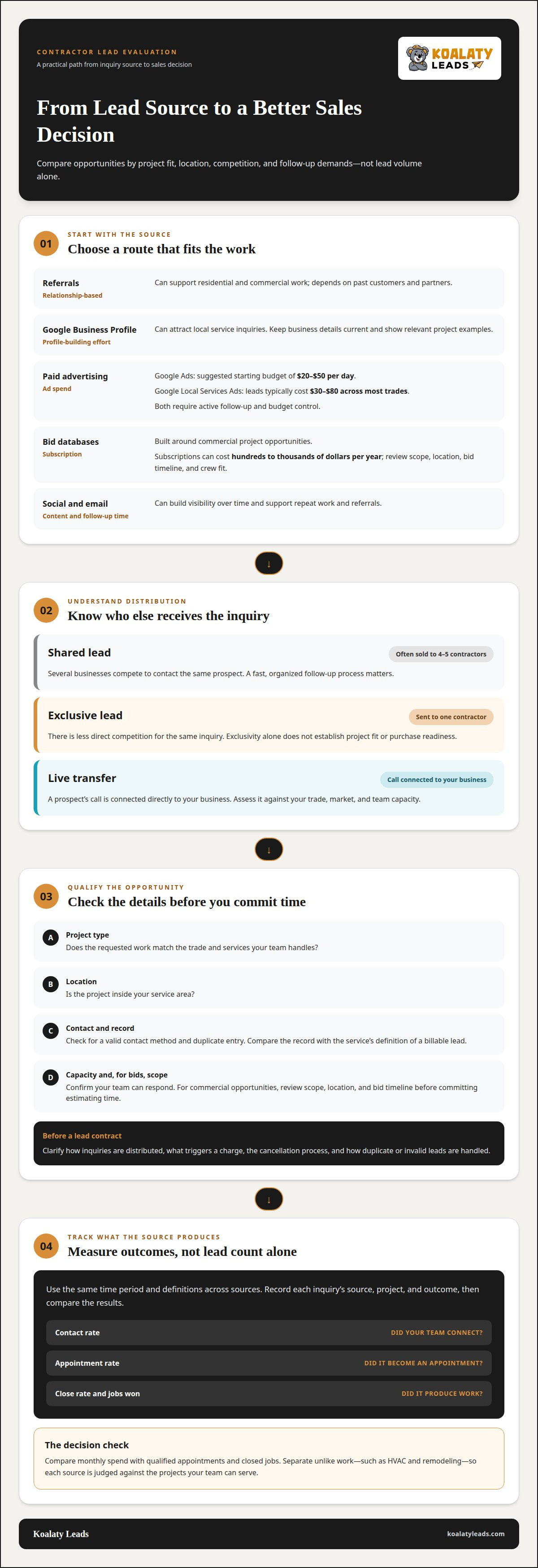
For roofing, HVAC, plumbing, and remodeling, the strongest lead source depends on project fit, service area, and your team’s capacity to respond. Referrals and Google profiles can generate free inquiries; paid advertising and bid databases offer other routes to residential and commercial work.
Compare sources by project relevance, location, competition, and cost per lead, not volume alone. A homeowner seeking a kitchen remodel needs a different response from a general contractor reviewing commercial bids.
Homeowner Lead Matching
A well-matched homeowner lead connects a specific project and location with a contractor’s services. For example, a roofing inquiry within your service area is more relevant than a general construction inquiry for work you don’t handle. Unlike a referral, matching organizes inquiries by project type and geography so your team can assess fit before following up.
Trade-Specific and Low-Cost Lead Sources
Trade-specific sources help focus outreach: roofing teams can promote completed projects, HVAC contractors can build local profiles, plumbers can request referrals, and remodelers can share case studies. Google Business Profiles, customer referrals, and social posts can keep acquisition costs low, but they require consistent follow-up. Google Ads can provide a paid option, with a suggested starting budget of $20-$50 per day.
Commercial construction lead sources work differently. Project and bid databases list opportunities for general contractors and specialty trades, while residential profiles typically attract homeowners seeking a defined service. Subscription-based project databases can cost hundreds to thousands of dollars per year. Check whether each listing matches your trade, geography, and capacity before treating it as a sales opportunity.
Bid invitations and project databases can support commercial sales, but each opportunity still needs qualification. Review the scope, location, bid timeline, and fit with your crew before committing estimating time. Email updates can keep past customers and referral partners informed about completed work. A useful case study describes the job type, challenge, and result, while project photos can show the kind of work your team handles.
| Lead source | Best fit | Cost model | Key trade-off |
|---|---|---|---|
| Referrals | Residential and commercial | Relationship-based | Depends on past customers and partners |
| Google profile | Local service inquiries | Profile-building effort | Requires current details and project examples |
| Paid advertising | Targeted project inquiries | Ad spend | Needs active follow-up and budget control |
| Bid databases | Commercial projects | Subscription | Requires scope and bid-fit review |
| Social and email | Repeat work and referrals | Content and follow-up time | Builds visibility over time |
Choose a source whose project type, service area, and follow-up demands fit your sales process.
For email and phone outreach, record opt-outs and act promptly: after receiving an opt-out, businesses have no more than 10 business days to stop calling and texting the consumer, according to the Federal Communications Commission.
Shared Versus Exclusive Contractor Leads
Shared leads go to multiple contractors; exclusive leads go to one. Distribution affects competition, follow-up, and how you assess an opportunity’s value.
Shared Contractor Leads
A shared contractor lead is distributed to multiple businesses for the same residential project. Each contractor competes to contact the prospect, so a fast, organized follow-up process matters. When comparing lead services, review the project details and distribution model, then assess whether the inquiry fits your work and service area.
Exclusive Contractor Leads
An exclusive lead goes to one contractor, rather than being circulated to several businesses. That means less direct competition for the same inquiry, but exclusivity alone doesn’t establish project fit or purchase readiness. Check whether the lead matches your trade, service area, and capacity. For example, roofing leads should align with the work your roofing team takes on.
Platform Quality and Conversion Rates
Google Local Services Ads can generate contractor inquiries, with leads typically costing $30 to $80 across most trades. Their value depends on whether the inquiries become appointments and closed jobs. Track outcomes by source and trade; for example, compare HVAC leads separately from remodeling inquiries rather than combining unlike projects.
To check lead quality, review each record for a valid contact method, correct project type, location, and duplicate entry. Compare those details with the platform’s definition of a billable lead. Ask how the service handles duplicates and invalid contacts, and how it processes credit requests. Keep the answers with your campaign records.
Lead Costs
Before signing a lead-generation contract, ask how inquiries are distributed, whether the model charges per lead or by subscription, and what triggers a charge. Clarify the terms, cancellation process, and policy for duplicate or invalid leads. A contractor lead service should make its model clear enough for you to compare against your sales process.
Measure monthly spend against qualified appointments and closed jobs, not lead count alone. For a consistent comparison, use the same time period and definitions across sources. Record each lead’s source, project, and outcome, then review which combinations produce work your team can serve. If you’re weighing exclusive leads or live transfers for your trade and market, discuss the options with Koalaty Leads.
How Contractor Lead Platforms Compare on Quality and Conversion
Lead quality comes down to fit, contactability, and progress toward paid work. Compare sources using the same stages, definitions, and review period.
Record each inquiry’s source, trade, project type, and location. Then track whether your team reached the prospect, booked an appointment, prepared an estimate, and won the work. A roofing inquiry and a commercial bid should not share one conversion category: their qualification steps and sales timelines differ.
Separate lead validity from sales performance. A duplicate record or unusable contact detail is a data issue; an unanswered call may point to a follow-up gap. An inquiry outside your service area signals a targeting mismatch. Tracking these outcomes separately helps distinguish lead issues from missed opportunities.
Use a consistent review window. Tracking sources for 90 days gives you a practical period for comparing patterns, rather than reacting to a brief spike or slow week. Keep trade and geography visible in the report. If one source sends inquiries across several project types, segment results before deciding where to allocate attention.
| Measure | What to record | What it helps diagnose |
|---|---|---|
| Valid inquiry rate | Correct contact and project details | Lead screening and data quality |
| Contact rate | Prospects reached by your team | Follow-up process and reachability |
| Appointment rate | Reached prospects who schedule | Project fit and sales conversation |
| Close rate | Appointments or estimates that become jobs | Sales execution and opportunity quality |
| Acquisition cost | Source spending divided by jobs won | Financial return by channel |
Review the measures together. A high contact rate but few appointments may indicate weak project alignment or an ineffective qualification conversation. Strong appointment numbers but few wins may call for a closer look at estimates, follow-up, or job fit. Each stage helps narrow down where the process needs attention.
For a fair comparison, apply the same lead definitions to every source. Count scheduled estimates consistently and record cancellations separately from completed appointments. Include staff time when comparing channels that require substantial qualification. This reveals the workload behind each reported conversion.
Use your review to make one change at a time. For example, adjust project filters for one campaign while leaving another unchanged. Compare the next reporting period using the same measures. This makes it easier to connect changes in targeting or follow-up with progress through your pipeline.
Choose lead sources based on qualified opportunities and closed work your business can serve. A large inquiry count alone doesn’t show whether a source supports profitable growth; consistent records help you assess the difference.
What Contractor Leads Cost Per Lead and Per Month
Lead costs depend on the source, trade, market, project scope, and billing model. Compare total spending with the work won, not just the advertised cost per lead. A low unit price can still strain cash flow if inquiries need extensive qualification or rarely match your services.
For pay-per-lead campaigns, monthly spend changes with the number of billable inquiries received. Estimate it by multiplying the agreed lead charge by the expected quantity, then account for any separate advertising or platform costs. Before setting a budget, define which inquiries count as billable and how duplicates or invalid contact details are handled.
Pricing models determine when and how costs accrue. Pay-per-lead charges are tied to delivered leads, while project databases may charge for access over a billing period. Paid advertising adds campaign spend, and inquiry costs depend on how many relevant prospects respond. Compare the terms and results, not headline prices alone.
| Cost measure | How to calculate it | Why it matters |
|---|---|---|
| Cost per lead | Lead-related spend divided by billable inquiries | Shows the acquisition cost of each inquiry |
| Monthly lead spend | All campaign charges during the billing period | Shows the cash commitment for that period |
| Cost per acquired job | Lead-related spend divided by jobs won | Connects marketing cost with actual sales |
| Return by project type | Job revenue and margin compared with acquisition cost | Shows which work supports profitable growth |
Set a budget that reflects both your sales capacity and available cash. If estimators can price only a limited number of projects, buying more inquiries may create delays rather than more revenue. If your team has room to respond, start at a manageable level and review whether the resulting projects justify the spend.
Track spending by trade and campaign rather than combining everything into one monthly total. Roofing, window replacement, and remodeling inquiries can involve different sales processes and job economics. Label charges and outcomes separately, then compare like with like. This helps show whether campaign costs reflect volume, weak project fit, or limited returns after the sale.
Build a break-even threshold from your own margins: determine how much acquisition spending a won job can support after labor, materials, and other operating costs. Use that threshold to assess proposed lead volume and spending. Review billing terms, rejected-lead criteria, and any recurring charges before committing, so the monthly calculation reflects the actual agreement rather than an assumed rate.
Koalaty Leads
Koalaty Leads gives contractors a way to pursue exclusive opportunities through exclusive web leads and live inbound call transfers. Its offerings include Roofing Leads, Window Replacement Leads, Bathroom Remodel Leads, and Kitchen Remodeling Leads. Each serves a distinct project type, so choose a starting point based on the work your team wants and has capacity to handle.
Use practical filters to assess fit: trade, service area, project type, sales capacity, and the follow-up your team can provide. A roofing contractor focused on replacement projects has different needs from a remodeling company pursuing kitchen or bathroom work. Define those priorities first.
Exclusive distribution means an inquiry is not shared among several contractors. That reduces direct competition for the same prospect, but exclusivity alone doesn’t determine whether an inquiry becomes a job. Results still depend on project details, prospect fit, your team’s follow-up, and alignment with your services.
Choose an offering that matches your sales focus. Roofing Leads suit roofing contractors, while Window Replacement Leads are for businesses pursuing window projects. Bathroom Remodel Leads and Kitchen Remodeling Leads are for contractors focused on those respective projects. Aligning the trade and project type makes it easier to assess inquiries and track results.
- Roofing leads: for contractors pursuing roofing opportunities.
- Window replacement leads: for businesses selling window replacement projects.
- Bathroom remodel leads: for contractors focused on bathroom remodeling.
- Kitchen remodeling leads: for businesses seeking kitchen renovation inquiries.
Before changing your lead mix, identify where your current process needs support. If your team has room for more inquiries in one of these trades, compare them with your existing sources using the same measures: valid contacts, appointments, closed jobs, and acquisition cost. This keeps the decision grounded in sales results rather than lead volume alone.
Be clear about the work you want to pursue and the locations your team serves. For example, identify whether you’re prioritizing roofing or remodeling and which projects you can handle. Those details give the conversation a useful starting point and connect your lead strategy to your actual capacity.
Koalaty Leads provides exclusive leads for these home improvement project categories. Contact Koalaty Leads to discuss exclusive leads for your trade and service area.
Build Your Next Lead Strategy With Purpose
Choose a lead mix that fits your trade, service area, and sales capacity. The best leads for contractors are opportunities your team can follow up on, qualify, and turn into work. Make that the standard for your decisions, rather than relying on a high lead count alone.
Koalaty Leads offers Roofing Leads, Window Replacement Leads, and Bathroom Remodel Leads. These options connect contractors with project-specific opportunities through an exclusive lead model. Consider which trade you want to grow and how new inquiries would fit your current sales process.
A focused conversation can help you assess whether exclusive leads or live inbound call transfers align with your market and business goals. Bring your trade and growth priorities to Koalaty Leads, then discuss a practical next step for your lead strategy.
Keep your growth plan grounded in the work you want to win. With a clear target and a consistent process, you can move forward with confidence.
Frequently Asked Questions
Quick answer: What are the best lead generation websites for contractors?
The right fit depends on your trade, market, and sales process, not a universal website ranking. Separate services that provide leads from tools that help contractors manage inquiries. Then assess how each source identifies the project, handles exclusivity, and charges. Koalaty Leads provides exclusive home improvement leads, pay-per-lead delivery, and live inbound call transfers for contractors.
What Is a Construction Lead?
A construction lead is an inquiry or project opportunity that may become paid work. A call about a roofing project is a residential lead, while an invitation to price a commercial project is a bid opportunity. Keep these records distinct in your sales system: they involve different next steps, from contacting a homeowner to reviewing bid requirements.
What are the best lead generation services for contractors in 2026?
The right service in 2026 is one whose delivery model fits your sales capacity and target work. Koalaty Leads provides exclusive web leads and live inbound call transfers on a pay-per-lead basis. Its lead qualification uses a 13-point stack. Contractors comparing services can start by matching the service’s project category and inquiry format to the team responsible for handling new opportunities.
Which contractor lead services offer exclusive versus shared leads?
Lead services differ in whether an inquiry goes to one contractor or multiple businesses. Koalaty Leads provides exclusive leads and does not sell shared leads. Its exclusive web leads and live inbound call transfers are delivered to one contractor. When evaluating a lead service, distinguish its distribution model from the channel: a web form or phone call alone doesn’t tell you how many contractors receive the inquiry.
Need exclusive leads instead of shared ones? Koalaty Leads delivers qualified homeowners — web leads or live call transfers — to one contractor only.
Get Started