
Angi Leads Price Increases vs. Pay Per Call ROI: A Contractor’s Comparison Guide

A lower-priced lead can still produce a more expensive job. To assess angi leads price increases vs pay per call roi, compare what you spend to acquire a booked job, not just the charge for each opportunity.
It makes sense to question Angi when lead charges feel less predictable and a shared opportunity can put several contractors in a race to respond. But a higher upfront cost for an exclusive call doesn’t automatically mean a better return, either. Your close rate, sales follow-up, and the profit margin on completed jobs all affect the result.
This guide gives you a practical way to compare the two models using your own numbers. You’ll calculate cost per acquired job, work out the close rate each source needs to break even, and consider whether your team can respond quickly enough to make live transfers count. The goal isn’t to crown one source for every contractor. It’s to identify which one fits your job economics and sales capacity, then make a decision based on return rather than headline lead price.
Key Takeaways
- Compare the full cost of each lead source with the gross profit it helps generate, not the lead charge alone.
- Track every stage from contact through completed job so you can see where leads convert or fall out.
- Use the same qualification rules and attribution process when evaluating Angi leads price increases vs pay per call roi.
- Run a controlled test that fits your team’s capacity, with consistent response expectations and a budget you can manage.
- Consider whether exclusive opportunities, inbound calls, or live transfers fit your trade, market, and call-handling process.
Angi Leads Price Increases vs Pay Per Call ROI: What Contractors Should Compare
Rising lead charges matter only when you weigh them against conversion and job economics. The angi leads price increases vs pay per call roi comparison should show what each source costs to turn into profitable work, not just what you pay for one lead or call.
For lead buying, ROI compares the gross profit attributable to a source with the costs required to generate and handle its opportunities. Track source charges and sales-handling expenses separately from job-delivery costs, such as labor and materials, so you can see whether acquired work is profitable after fulfillment.
This video discusses evaluating Angi by cost per booked job:
Why a higher lead charge does not settle the ROI question
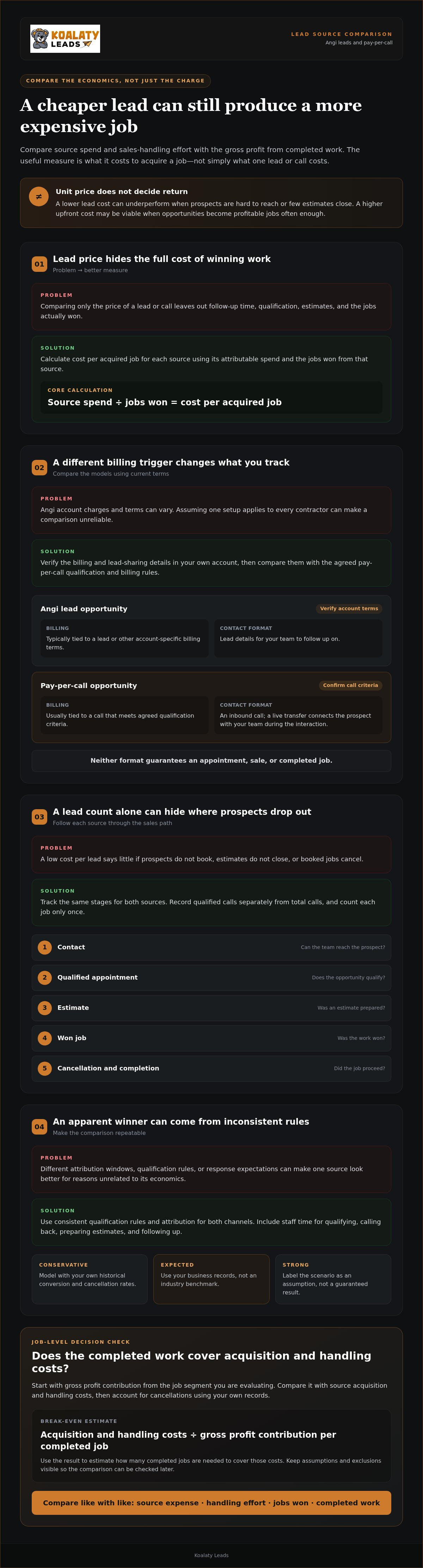
A higher unit cost can still make sense if qualified opportunities turn into profitable jobs often enough. A lower cost per lead can underperform when prospects are hard to reach, few appointments qualify, or estimates rarely close. The relevant measures are cost per lead or call, cost per qualified appointment, and cost per acquired job, each calculated from the same source spend.
Cost per acquired job is source spend divided by the jobs won from that source. If you compare channels, count outcomes over a consistent period and include the staff time spent contacting, qualifying, estimating, and following up. For roofing businesses, reviewing roofing lead opportunities alongside those internal costs can help keep the analysis grounded in the trade’s sales process.
What pay-per-call means in this comparison
Pay-per-call (PPCall) generally means paying for qualifying inbound calls under agreed criteria, not paying only when a job is won. A live transfer connects a prospect with your team during the interaction; a standard lead may instead require your staff to make the first call and continue outbound follow-up. Neither format guarantees an appointment, sale, or completed job.
Before comparing sources, understand what counts as a billable call or lead, how qualification is defined, and how costs are recorded. Angi account charges and terms can vary, so use your current account details rather than assuming a general price or plan applies. Then compare like with like: source expense, handling effort, qualified opportunities, and jobs actually won.
How Angi Lead Costs and Pay-Per-Call Conversion Affect Job-Level ROI
To compare angi leads price increases vs pay per call roi, follow each source from first contact through completed, retained work. A low cost per lead means little if few prospects book or jobs cancel; a higher source cost may be viable if the resulting jobs contribute enough gross profit.
Use the same attribution window and job qualification rules for both channels. Count a job only once, assign it to a source consistently, and track the stages that show where prospects drop out: contact, qualified appointment, estimate, close, and cancellation.
Build a source-level calculation from your own records
For each reporting period, record Angi spend and resulting leads separately from pay-per-call spend and calls. For calls, distinguish qualified calls from total calls, then record booked appointments, estimates, won jobs, and cancellations. Include attributable sales-handling costs, such as staff time spent qualifying leads, calling back, and preparing estimates.
Calculate cost per acquired job by dividing each source’s attributable spend by its won jobs. Then compare gross profit from completed jobs with both acquisition and handling costs. Revenue alone can mislead: a large contract may still contribute little after direct job costs. Keep the assumptions and exclusions visible so the comparison can be checked later.
Find the break-even point before switching
Start with the gross profit contribution from a typical completed job in the segment you’re evaluating. Divide a source’s acquisition and handling costs by that contribution to estimate how many jobs it needs to cover those costs. Adjust for cancellations using your own records, since a booked job that doesn’t proceed won’t produce the same contribution as completed work.
Model conservative, expected, and strong conversion scenarios using your business’s historical contact, appointment, close, and cancellation rates. Label each scenario as an assumption, not an industry benchmark. Apply the same rules to both channels; otherwise, the apparent winner may reflect inconsistent attribution rather than stronger economics.
Keep the comparison evidence-based. The FTC’s truth-in-advertising standards are a useful reference when assessing marketing claims, but your own source-level records should drive the ROI calculation. To explore exclusive lead and call options for your trade, review Koalaty Leads contractor lead services.
Angi Leads vs Pay Per Call: Compare the Models Without Guessing
The main difference is how the opportunity reaches your team and what triggers a charge. Angi account setups and terms can vary, so confirm your current billing and lead-sharing details before comparing; don’t treat one contractor’s setup as universal. Pay-per-call also depends on defined qualification and billing rules.
| Factor | Angi lead opportunity | Pay-per-call opportunity |
|---|---|---|
| Billing trigger | Typically tied to a lead or other account-specific billing terms; verify your agreement. | Usually tied to a call that meets agreed qualification criteria; confirm what counts as billable. |
| Contact format | Lead details for your team to follow up on. | An inbound call, which may be connected through a live transfer. |
| Sharing model | Marketplace opportunities may be shared; verify the sharing setup for your account. | May be exclusive to one contractor when offered that way; exclusivity doesn’t guarantee a sale. |
| Primary performance metric | Cost per acquired job, including follow-up effort. | Cost per acquired job, including call handling and qualification. |
Where marketplace leads and pay-per-call differ operationally
A lead usually asks your team to initiate contact, qualify the prospect, and set an appointment. A live transfer connects the caller and contractor by voice, which can reduce the delay before a conversation but still requires effective qualification and sales follow-through. In either model, a call or lead is an opportunity, not proof of homeowner fit, booked work, or profit.
If an opportunity is shared with multiple contractors, response speed and a clear sales workflow can matter because other businesses may also be following up. Exclusive delivery means the opportunity is sent to one contractor, but it doesn’t ensure contact, an appointment, or a won job. Measure results rather than assuming the delivery format determines performance.
Match the model to your team’s sales capacity
Consider whether your staff can answer calls during the hours they arrive. If not, assess who handles missed calls, callbacks, qualification, and appointment setting. A team with reliable call coverage may make better use of live transfers; a team with a disciplined outbound process may be equipped to work leads that need follow-up.
For broader context on evaluating sources and trade-offs, see the home improvement leads buying guide. Apply the same comparison to both models: track billable opportunities, qualified appointments, estimates, won jobs, cancellations, and handling effort. That’s how you make the angi leads price increases vs pay per call roi decision using your operation’s actual capacity, not assumptions about which format should win.
A Practical Test for Angi Price Increases vs Pay Per Call ROI
A fair comparison of angi leads price increases vs pay per call roi needs a defined test period, a budget your business can support, and consistent tracking from first contact to final outcome. Set the test around your available sales and job capacity, not an assumed minimum spend, and allow enough time for opportunities to move through your normal sales cycle.
Keep service area, project type, qualification rules, and response expectations as consistent as possible across sources. If one channel gets faster follow-up or is evaluated against a different definition of a qualified opportunity, the results won’t tell you which source performs better under comparable conditions.
Set up a fair comparison with your CRM
Tag every lead and call by source when it enters your CRM. Keep that source attached through contact attempts, qualification, appointment, estimate, won or lost status, and any cancellation. Use the same outcome labels for both channels, including invalid, duplicate, unqualified, unreachable, and out-of-scope opportunities.
Then compare cost per qualified opportunity, booked appointment, and acquired job, alongside gross profit contribution after acquisition and handling costs. Note missed calls and callback delays too. A pay-per-call source can appear weaker if your team misses incoming calls, while a lead source requiring outbound follow-up can be disadvantaged if callbacks are delayed or inconsistently recorded.
Separate channel performance from other factors. Record who handled each opportunity, relevant staffing changes, seasonality, and service mix. If one source generated a different type of project or was worked by a different sales team, flag that context rather than treating the raw conversion rates as a clean comparison.
Use the results to make a measured decision
Use your acquired-job economics and operational fit to decide whether to keep, reduce, or expand a source. A channel that produces profitable jobs but strains call coverage may need a workflow adjustment; one with low cost per opportunity but weak conversion may not justify more spend. Treat early results as directional if too few opportunities have reached a final outcome.
Repeat the comparison when pricing, qualification criteria, or sales coverage materially changes. For broader context, review Koalaty Leads’ contractor lead services and consider how different delivery options fit your team’s process.
Explore contractor lead services from Koalaty Leads
Explore Exclusive Pay-Per-Call Leads With Koalaty Leads
Exclusive opportunities and live transfers give contractors another model to evaluate alongside marketplace leads. Koalaty Leads provides exclusive home improvement opportunities, inbound calls, and live transfers, so your team can compare those formats against its own source-level results, not assume any lead type will produce a particular return.
The right fit depends on the work you sell and how your team handles new opportunities. Discuss your trade, market, call-handling coverage, and evaluation goals so you can assess whether direct conversations or leads that need follow-up fit your sales process.
What to evaluate in an exclusive call program
Start with the operating details that affect your calculation: what makes a call qualified, how an opportunity is delivered, and what information your team needs to record for attribution. Align those criteria with your CRM stages so you can track calls from initial contact through appointment, estimate, won or lost outcome, and any cancellation.
Capacity matters. Consider who can answer incoming calls, how missed calls are handled, and who owns qualification and appointment setting. A live transfer creates a direct conversation, but your sales team still needs to assess fit and guide the opportunity through its process. If calls arrive when staff can’t respond, that handling gap can affect results regardless of the source.
Then compare the program’s economics with your recorded acquisition costs. Use your own qualified-opportunity, close-rate, and job contribution data to estimate what the source would need to deliver to make sense for your business. Keep assumptions visible, and don’t treat exclusivity as a promise of conversion or profit.
Take the next step with your own ROI baseline
Bring a practical baseline to the discussion: current source spend, qualified opportunity counts, close rates, and average job economics. Those records help you evaluate exclusive opportunities or live transfers against your actual acquisition costs and sales capacity, rather than relying on headline lead prices.
Use that comparison to decide what you want to test, how your team will handle calls, and which outcomes will determine whether the source fits. The aim is a clear evaluation plan for your operation, not an assumed price, volume, or return.
Talk with Koalaty Leads about exclusive leads or live transfers
Make Your Next Lead Decision With Confidence
The angi leads price increases vs pay per call roi decision comes down to what each source contributes after lead costs, sales handling, and job expenses. Compare cost per acquired job and gross profit, not just the upfront charge. Track each opportunity consistently from first contact through appointment, close, and cancellation.
A measured test can show whether the model fits your sales capacity as well as your job economics. Koalaty Leads offers exclusive opportunities delivered to one contractor rather than shared, along with inbound calls and live transfers. Bring your trade, market, current source spend, qualified opportunity counts, close rates, and job economics to the discussion. There’s no assumed price, volume, or guaranteed return.
Talk with Koalaty Leads about exclusive leads or live transfers
Use your own numbers to set the standard. With clear tracking and a lead source that fits how your team sells, you can make the next decision with greater confidence.
Frequently Asked Questions
Why can Angi lead costs increase?
Angi lead charges may vary with account terms, service category, market conditions, or account configuration, so one contractor’s experience may not apply to yours. Review your invoices and current account terms, then track total source spend against qualified opportunities and jobs won. The key measure is cost per acquired job compared with those jobs’ gross profit contribution. A rising charge matters when acquisition costs outpace what your job economics can support.
Is pay-per-call more profitable than Angi leads?
Not automatically. Pay-per-call can connect your team directly with a caller, while other lead formats may require outbound follow-up, but neither format guarantees a booked job. For the angi leads price increases vs pay per call roi comparison, use actual spend, qualified opportunities, appointments, won jobs, and job contribution over the same period. The better fit is the source with acceptable acquired-job economics that your team can handle consistently.
How do contractors calculate ROI on Angi leads?
Start with Angi spend over a defined period and track how many leads become qualified opportunities, appointments, and acquired jobs. Divide attributable source spend by jobs won to find cost per acquired job. Then compare that acquisition cost with the gross profit contribution from those jobs, accounting separately for sales labor and other direct expenses. Use your own records and consistent attribution rules, not an unverified industry benchmark.
What should I compare when evaluating pay-per-call leads?
Track total call spend, qualified calls, booked appointments, jobs won, and the contribution those jobs generate. Record missed calls, response coverage, and follow-up work too, since call handling can affect results. Before comparing sources, understand how the program defines a qualified, billable call. Use the same reporting period and attribution rules as your existing lead source so the comparison reflects channel performance, not different measurement methods.
Can exclusive pay-per-call leads improve close rates?
They can change the sales interaction, but exclusivity alone doesn’t guarantee a qualified caller, a purchase, or a higher close rate. An exclusive opportunity is delivered to one contractor rather than shared among multiple buyers. A direct conversation may let your team assess fit sooner, while results still depend on service match, availability, sales execution, and follow-up. Track close rates by source to see how the format performs in your business.
What if my Angi leads cost more but still bring in jobs?
Judge the source by job contribution, not the price change alone. Compare total spend with the number and value of jobs acquired, then account for the sales effort needed to win them and the direct costs of delivering the work. If acquired jobs remain profitable and the source fits your team’s capacity, higher charges may still be workable. If costs erode contribution, test alternatives before making a broad change.
Need exclusive leads instead of shared ones? Koalaty Leads delivers qualified homeowners — web leads or live call transfers — to one contractor only.
Get Started