
Angi Lead Disputes and Refund Policies: A Contractor's Guide

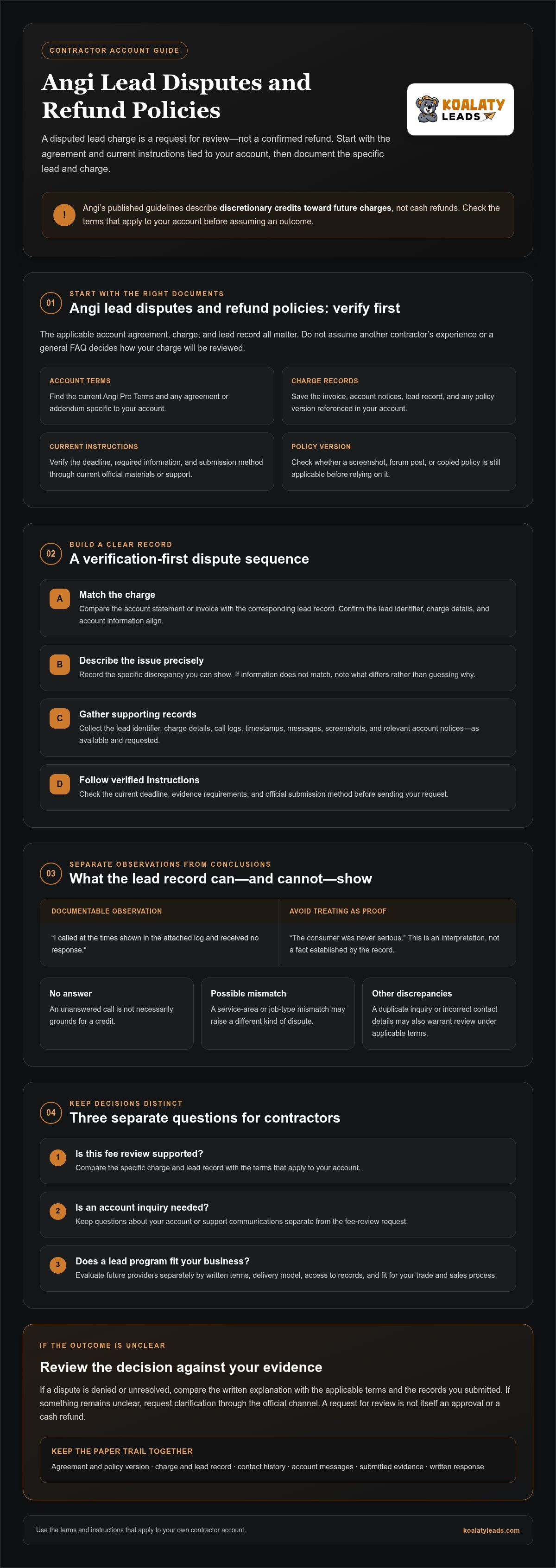
A disputed Angi lead charge isn’t automatically a cash refund. Understanding angi lead disputes and refund policies starts with identifying which Angi Leads agreement and current credit guidelines apply to your account. Angi’s published guidelines describe discretionary credits toward future charges, not cash refunds, so the terms and the evidence you provide matter.
It’s frustrating when a lead doesn’t turn into a conversation or a job, but an unanswered call isn’t necessarily grounds for a credit. A duplicate inquiry, a mismatch in service area or job type, or incorrect contact details may raise a different kind of dispute. The practical first step is to document what happened and compare it with the policy that applies to your account.
This guide explains how to find the terms that govern your charge, assemble a clear dispute record, and assess the decision you receive without relying on assumptions. It also covers how to evaluate lead programs by their written policies and the business metrics that matter, including contact rates, close rates, and cost per acquired job.
Key Takeaways
- Start angi lead disputes and refund policies research by checking the agreement and current support instructions tied to your account.
- Build a clear dispute record with the lead identifier, charge details, contact history, and relevant account messages.
- Keep a fee review separate from an account inquiry or a decision about future lead providers.
- If a dispute is denied or unresolved, compare the written explanation with the terms and evidence you submitted, then request clarification through the official channel if needed.
- Before choosing a lead partner, compare written terms, delivery model, access to records, and fit for your trade and sales process.
Angi lead disputes and refund policies: What contractors should verify first
A lead-fee dispute is a request for Angi to review a charge under the agreement that applies to your contractor account. Making that request doesn’t establish that the charge qualifies for a refund or that an adjustment has been approved. The applicable terms, account details, charge, and lead record all matter.
Start with the documents tied to your account, not assumptions based on another contractor’s experience or a general description of Angi's business model. A company’s broad service information may provide context, but it can’t determine which agreement governs a specific lead charge.
For a general look at a contractor discussing lead credits, this video may provide additional perspective. Treat it as an anecdotal resource, not a substitute for the current terms tied to your account.
Which Angi terms and account records should you check?
Find the current Angi Pro Terms and any agreement or addendum specific to your account. Match those documents to the charge and lead you’re questioning. Save the invoice, account notices, lead record, and any policy version referenced in your account. These records help you confirm what was charged and identify which terms may apply.
Before submitting a request, verify the current deadline, required information, and submission instructions in Angi’s official materials or through its official support channel. Don’t rely on an old screenshot, forum post, or copied policy without checking whether it still applies.
Why can’t one refund rule be assumed for every lead?
Contractor account agreements are not the same as consumer-facing terms or broad website FAQs. Those pages may describe Angi’s services generally without explaining how a particular contractor charge is reviewed. Similarly, a search result that mentions a dispute process doesn’t establish eligibility criteria unless the applicable policy text confirms them.
That’s why the phrase angi lead disputes and refund policies calls for a document check, not an assumed outcome. First identify the account and terms, then connect the specific charge to its lead record and follow the verified instructions.
A dispute request asks for review; it is not a confirmed refund decision. Keep that distinction clear in your records and expectations while you assess the charge.
How to review an Angi lead charge and build a clear dispute record
Use a verification-first sequence: identify the charge, find the terms that apply to your account, gather records tied to that lead, then follow Angi’s current official support instructions. This creates a clear paper trail and helps separate what you can document from what you suspect happened.
Start by matching the charge on your account statement or invoice to the corresponding lead record. Check that the lead identifier, charge details, and account information align before describing the issue. If something doesn’t match, note the specific discrepancy rather than guessing at the reason.
What evidence can help explain a disputed fee?
Gather records that show what happened and when. Depending on what’s available, useful items may include the lead identifier, charge details, call logs, timestamps, messages, screenshots, and relevant account notices. Before sending anything, confirm the evidence Angi requests, any applicable deadline, and the submission method in current official instructions.
- Lead and charge: Record the lead identifier, charge date and amount as shown in your account, and the invoice or statement reference.
- Contact history: Keep call attempts, timestamps, and messages related to your follow-up.
- Account communications: Save notices or support messages that refer to the lead, charge, or applicable terms.
Keep factual observations separate from conclusions about a consumer’s intent or the lead’s value. For example, “I called at the times shown in the attached log and received no response” reports what your records show. “The consumer was never serious” is an interpretation and may not establish how the charge should be reviewed.
How should a contractor write the dispute request?
Keep the request focused. Identify the charge and lead, describe the specific issue in a few sentences, and attach relevant records. Avoid claiming a policy violation unless you’ve matched the facts to a provision in the agreement that applies to your account.
You can ask support to clarify which agreement provision governs the review and whether additional records are needed. Keep the question specific to the charge and lead. A general account explanation should not be treated as confirmation that an adjustment will be made.
Before submitting, recheck the current official instructions for required evidence, deadlines, and submission method. Keep a copy of your request and any response so you can reconcile the account later. A clear paper trail also makes it easier to compare other lead options. If you’re assessing exclusive leads and live transfers for your trade, review the available information and terms before deciding what fits your business.
Compare lead dispute options without assuming Angi’s refund outcomes
Keep a fee review separate from an account question and from the decision to evaluate another provider. The right next step depends on what you need to resolve, what your records show, and what the applicable terms say. The phrase angi lead disputes and refund policies shouldn’t be treated as a prediction of how a specific request will be decided.
| Option | Purpose | Records to check | Questions to ask | Outcome uncertainty |
|---|---|---|---|---|
| Fee-review request | Ask for a specific lead charge to be reviewed under the applicable agreement. | Lead record, invoice or account statement, contact history, and relevant terms. | Which provision applies? Is more documentation needed? | Review does not guarantee a credit, refund, or other adjustment. |
| Account inquiry | Clarify a charge, account notice, billing entry, or term before deciding what to do next. | Account messages, invoice details, agreement, and related lead records. | What does this charge relate to? Which agreement version governs? | The explanation may clarify the account without changing a charge. |
| Future provider evaluation | Decide whether another lead arrangement better fits your trade and sales process. | Current terms, delivery model, lead and call records, and conversion results. | How are leads delivered and billed? What documentation and dispute criteria are stated? | New terms and delivery models still require review; performance isn’t assured. |
Compare terms and delivery models
Look for written dispute criteria, required documentation, and an easy way to locate the current policy. Confirm whether billing is per lead, per call, or based on another stated model. Check how the agreement describes delivery: a shared lead may be sent to multiple contractors, while an exclusive lead is directed to one contractor. A live transfer connects a call rather than simply delivering contact information. Compare what each model includes, not just its label.
For a practical comparison, contractors considering exclusive leads and live transfers can review the written terms and delivery details alongside their existing options.
Connect disputes to cost per acquired job
Cost per lead is only one input. Track lead spend alongside valid contacts, appointments, and closed jobs, using the same definitions and reporting period across providers. Then calculate cost per acquired job by dividing total lead spend by the jobs closed from those leads. Use your own records rather than an unsupported benchmark.
A dispute can affect how you interpret a charge, but it can’t replace conversion analysis. Review the terms and records, then judge the channel by its documented costs and the jobs it helps your business acquire.
When an Angi lead dispute is denied or unresolved
A denial or unclear response isn’t the end of your recordkeeping. Check the written decision against the agreement that applies to your account and the evidence you submitted. If the reason isn’t clear, ask for clarification through Angi’s current official support channel rather than assuming what the decision means.
How can you review a dispute decision?
First, confirm the response identifies the right account, lead, and charge. Then compare the stated reason with the applicable written terms and the records you kept, such as lead details, contact history, and account messages. If the decision appears to refer to different facts, point out the specific mismatch and ask for clarification.
Keep follow-up professional and focused. Ask which agreement provision informed the decision, whether additional documentation could be considered, or whether another review route is available. Verify next steps through official materials, and save dated copies of your request, attachments, responses, and follow-up so you can track the issue and reconcile your account.
If the disagreement raises contract-specific legal concerns, consult a qualified professional. A general guide can help you organize records, but it can’t interpret your agreement or provide legal conclusions about your particular situation.
When should you reassess a lead source?
Review overall performance, not only disputed charges. Track dispute frequency alongside contact, appointment, and close rates. Then calculate cost per acquired job from your actual lead spend and closed-job records, and compare that result with job value and your business’s margin requirements.
A dispute pattern may be worth investigating, but it doesn’t tell the whole performance story. A source with few disputes may still produce limited contact or few booked jobs; a disputed charge alone doesn’t establish whether the channel is profitable. Use consistent definitions and time periods when comparing sources.
For a broader evaluation, review home improvement lead options alongside your current provider’s written terms. Compare billing model, delivery type, documentation access, and fit for your trade and sales process. Treat dispute outcomes as one input, then make your decision using the full picture of conversions and acquired-job cost.
Choose a lead partner with clear terms and a fit for your trade
Use the questions raised by angi lead disputes and refund policies as a buying checklist before committing to any lead program. Clear written terms, a defined delivery model, access to useful account records, and fit with your trade and sales process give you a stronger basis for comparing options than promises or assumptions.
Which questions should you ask before committing?
Ask the provider to explain in writing how leads are delivered and billed, what happens when you question a charge, and which dispute criteria apply. Confirm what records you can access to reconcile leads, calls, charges, and account communications. Then compare the program with your team’s capacity to respond promptly and follow up consistently.
Delivery matters. Shared marketplace leads may be distributed to multiple contractors, which can mean competing for the same prospect. Exclusive opportunities are directed to one contractor, while live transfers connect a prospect’s call to a business. These models involve different workflows, so assess them against your staffing, response process, and sales capacity rather than assuming one is right for every contractor.
How can Koalaty Leads fit into a provider review?
Koalaty Leads provides exclusive leads and live transfers for home improvement and home service contractors. These are options to consider as part of a broader review, not a promise of specific results or terms. Ask for the details relevant to your trade, then compare them with the written terms and delivery model of any other provider you’re evaluating.
Keep the comparison practical: Can your team work the lead type effectively? Can you track the path from inquiry or call to appointment and closed job? Do the available records give you a way to assess spend and outcomes over time? Judge fit against your actual sales process, not a generic claim about lead quality.
Review the contractor lead services available, then discuss whether exclusive leads or live transfers may fit your trade.
Make your next lead decision with clear terms
Strong angi lead disputes and refund policies decisions start with the agreement, the charge, and records tied to the specific lead. A review request is not a confirmed refund, so verify the current instructions, document what happened, and assess any decision against the applicable terms.
Use the same discipline when evaluating your next lead source. Compare written billing and dispute terms, delivery model, access to account records, and fit with your trade. Then measure contact, appointments, closed jobs, and acquired-job cost using your own business data.
Koalaty Leads offers exclusive leads delivered to one contractor, along with pay-per-call and live-transfer options. Discuss whether these models may fit your team and sales process.
Clear terms and consistent tracking put you in a stronger position to make informed decisions and build a lead program around the way your business sells.
Frequently Asked Questions
How do I dispute an Angi lead fee?
Match the charge to its lead record, locate the agreement and current official dispute instructions for your account, then submit a concise request through the specified channel. Include the lead identifier, charge details, contact history, and relevant account messages. The angi lead disputes and refund policies that apply depend on the current terms for your account. A request for review does not confirm eligibility or mean a refund has been approved.
Does Angi refund fees for bad leads?
Don’t assume a lead you consider bad automatically qualifies for a refund or credit. Check the current agreement and official policy for the criteria that apply to your account, then compare them with the lead record and evidence. Ask Angi to clarify the decision if the policy basis isn’t clear. The outcome may depend on the applicable terms and facts, so verify rather than relying on another contractor’s experience.
How long does Angi take to resolve a lead dispute?
There isn’t a resolution timeframe established here that applies to every contractor or dispute. Check the current official support instructions for any stated response expectations, and ask the support channel handling your request if the expected timing isn’t clear. Keep a dated copy of your submission and each response. If you follow up, refer to the specific lead and charge so the inquiry stays easy to track.
What information should I include in an Angi fee dispute?
Identify the lead and charge clearly, then summarize the issue using verifiable details. Include the lead identifier, charge date and amount as shown in your account, invoice or statement reference, contact attempts and timestamps, and relevant account messages. Attach available records that support your description. Before sending, check Angi’s current official instructions for required evidence, deadlines, and submission method, since those details shouldn’t be assumed.
Can I dispute an Angi charge if I did not reach the homeowner?
You can ask Angi to review a charge, but not reaching the homeowner alone doesn’t establish that the charge qualifies for an adjustment. Check the agreement and current policy that apply to your account, then document contact attempts with dates, times, and available call or message records. Describe what happened without assuming the consumer’s intent or expecting a particular decision.
Where can I find Angi’s current terms for contractors?
Start with Angi’s official legal materials for the current Angi Pro Terms, then check your account for any agreement or notice specific to your service. Save the version that appears to govern the charge, along with relevant invoices and lead records. Use official Angi support instructions to confirm which terms apply if the documents are unclear. Consumer-facing terms or general FAQs may not address contractor lead billing.
What should contractors compare when choosing a lead provider?
Compare written billing terms, dispute criteria, documentation requirements, and access to account records. Confirm whether delivery is shared, exclusive, or through live transfers, and assess how each model fits your team’s response and follow-up capacity. Track contact, appointment, and close rates, then calculate acquired-job cost using your own records. Koalaty Leads offers exclusive leads and live transfers for contractors to consider as part of that evaluation.
Need exclusive leads instead of shared ones? Koalaty Leads delivers qualified homeowners — web leads or live call transfers — to one contractor only.
Get Started